


Enhancing Oil and Gas Security Systems: Advanced Security for Critical Infrastructure
Enhancing oil and gas security with advanced surveillance systems is crucial for protecting critical infrastructure from threats like terrorism,...
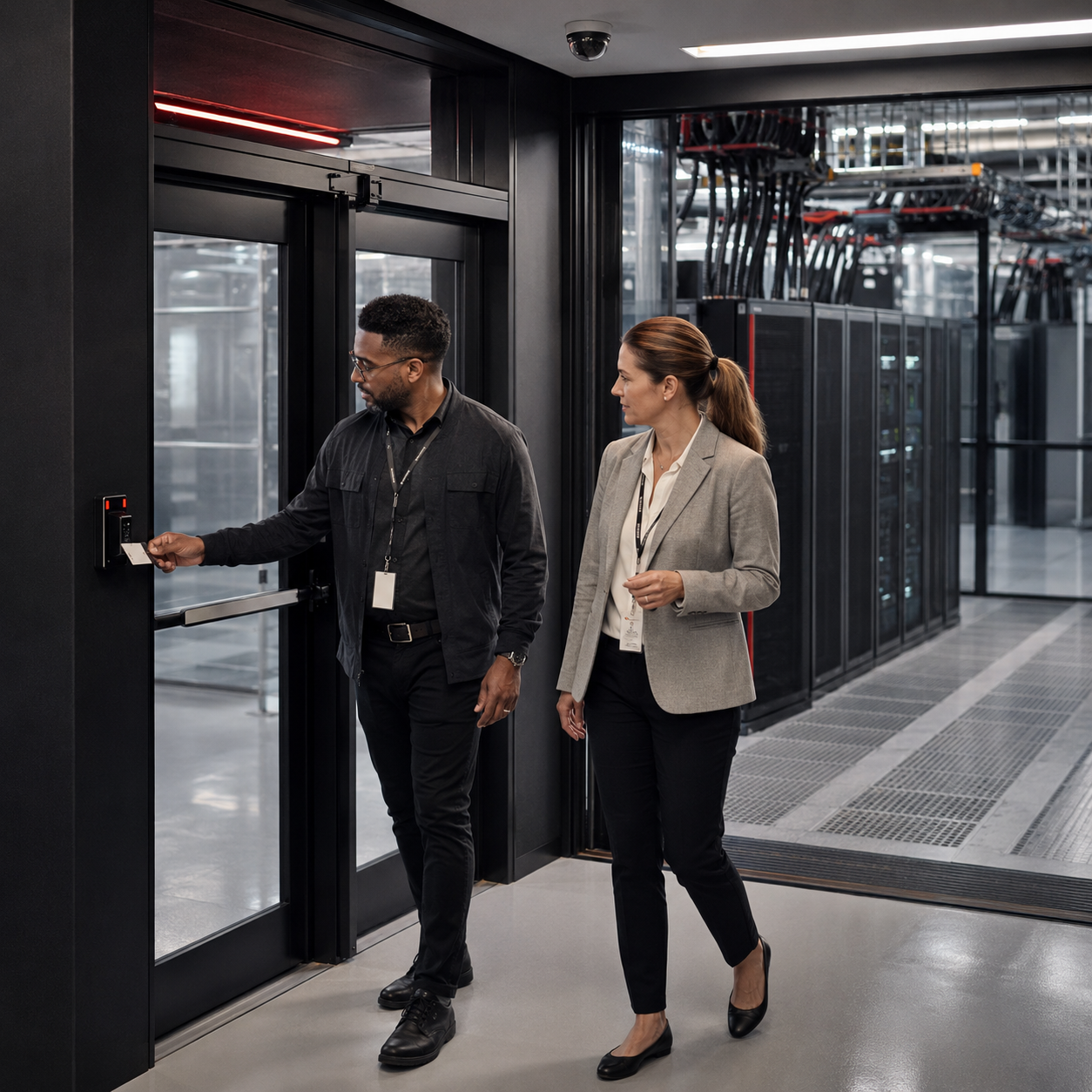
Data center physical security relies on multiple layers of protection around the facility, critical equipment, and restricted areas. A strong strategy combines perimeter security, controlled physical access, video surveillance, intrusion detection, environmental monitoring, and clear security policies so unauthorized activity can be prevented, detected, and investigated.
That approach aligns with CISA’s 2025 Security Assessment at First Entry (SAFE) guidance, which evaluates facilities across areas including security management, entry control, perimeter security, and other physical security measures. CISA also recommends selecting improvements based on the facility’s existing security posture, operational changes, and available resources.
For a data center, that means applying stronger controls as access moves from the site perimeter to entrances, data halls, network rooms, and other critical spaces. Coordinating these controls gives security teams a clearer view of who entered, what happened, and how to respond.
Data center physical security is the set of controls, policies, and procedures used to prevent unauthorized physical access to critical infrastructure, equipment, and restricted areas. It covers the full facility, from the site perimeter and building entrances to data halls, server rooms, network spaces, power systems, and other sensitive areas.
A comprehensive physical security program may include perimeter controls, access control, video surveillance, visitor management, intrusion detection, environmental monitoring, security personnel, and documented access policies. The specific security measures should reflect the sensitivity of each area and the operational impact if that area is compromised.
Physical security extends well beyond servers and storage. A data center facility depends on several interconnected systems that need different levels of protection.
A weakness in any of these areas can create operational or security risk, even when the main data hall itself is well protected.
Once the facility is divided into security zones, each zone needs controls that match its risk. A layered data center physical security program combines deterrence, access control, detection, monitoring, and response so that no single security measure carries the entire burden. A useful way to plan those controls is to work from the outside of the facility inward.
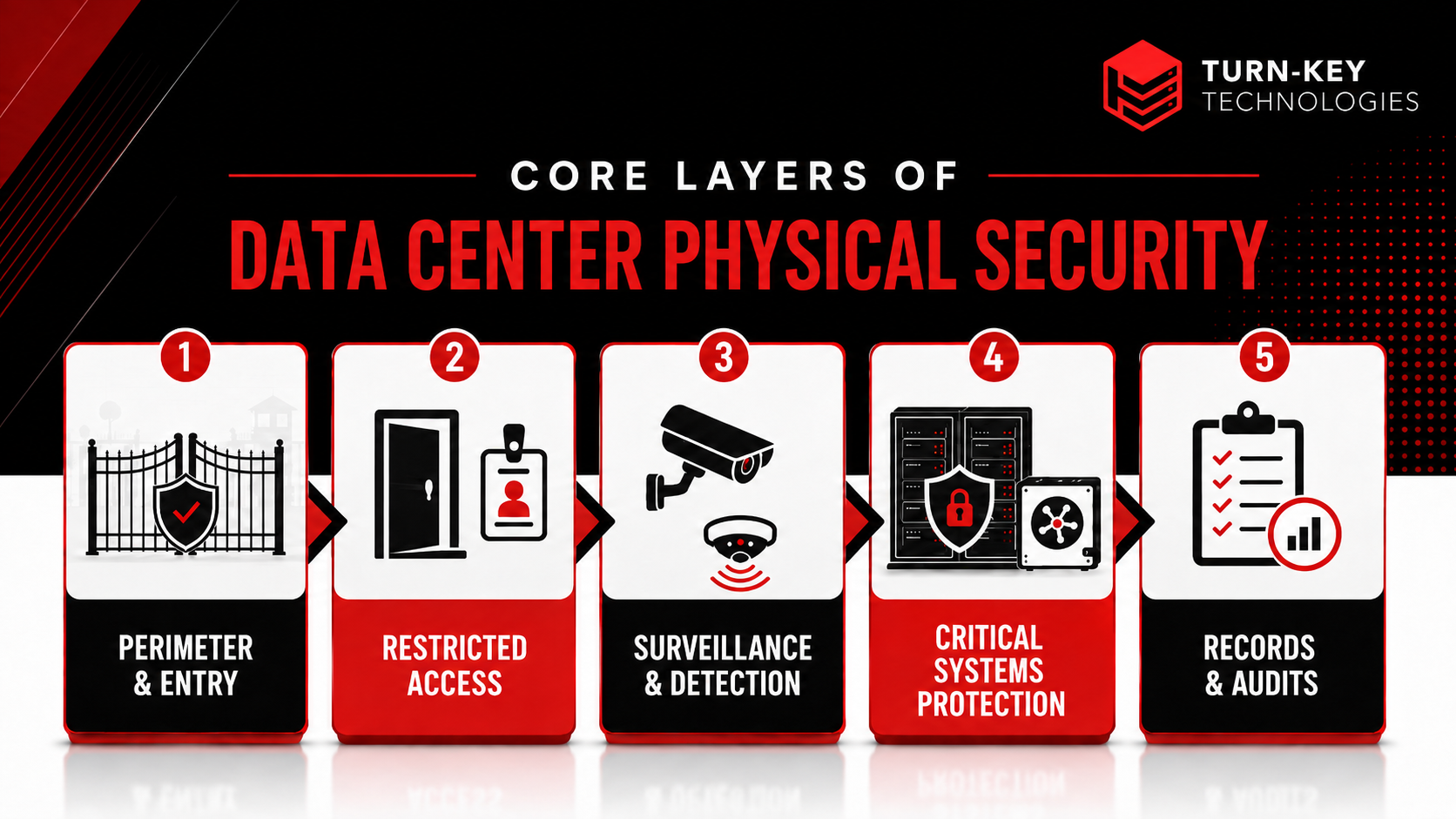
The first layer should help security teams detect and control activity before someone reaches restricted areas. Depending on the site, this may include controlled gates, fencing, exterior lighting, surveillance coverage, vehicle restrictions, and monitored pedestrian entrances.
The goal is to reduce uncontrolled approaches to the building and establish clear entry points. Large campuses and standalone data center facilities may require more perimeter controls than facilities located within shared buildings, but the same planning principle applies: people and vehicles should not be able to move directly from public space into sensitive operational areas without passing through a defined security checkpoint.
Once someone enters the facility, access should be based on their role and operational need. A valid building credential should not automatically provide access to every server room, network closet, power area, or data hall.
Access control systems can enforce these boundaries by assigning permissions to specific doors, areas, schedules, or groups of authorized personnel. Higher-risk areas may also justify stronger authentication or additional approval requirements.
Access levels should be reviewed whenever responsibilities change. Credentials for former employees, expired contractors, transferred staff, and temporary vendors should not remain active beyond their approved need.
Video surveillance provides visibility across entrances, corridors, data halls, loading areas, equipment spaces, and other locations where activity may need to be verified. Camera placement should be based on what the security team needs to see during an incident, rather than simply maximizing the number of cameras installed.
Intrusion detection adds another layer by identifying activity such as forced doors, unexpected entry, or movement in protected areas. When surveillance and detection systems cover the same critical spaces, security personnel have better context when an alarm occurs.
Coverage also needs periodic review. Equipment layouts change, racks are added, walls or partitions move, and new infrastructure can create blind spots that were not present when the original system was designed.
Read More: Video Surveillance for Data Centers: Building Secure Facilities
Some risks begin after a person has legitimately entered the building. Data halls, network rooms, power equipment, cooling infrastructure, and secured racks may therefore require additional controls beyond the main facility access system.
Environmental monitoring is particularly important because physical threats are not limited to human intrusion. Temperature changes, water leaks, humidity problems, or other abnormal conditions can threaten data center equipment without anyone entering a restricted room.
Controls should reflect the impact of the equipment being protected. A space containing core network infrastructure or power systems may justify a different access level and monitoring approach than a general storage or administrative area.
Physical security also depends on maintaining accurate records. Access logs, visitor records, alarms, surveillance footage, credential assignments, and security policies should support both routine oversight and incident investigation. Retention periods should be established before an incident occurs. Organizations also need a process for reviewing access rights, testing security controls, documenting exceptions, and correcting issues identified during security audits.
These management practices close the loop between installed security systems and day-to-day security operations. Without them, organizations can accumulate outdated permissions, inconsistent procedures, and gaps that remain unnoticed until an incident or audit exposes them.
Read More: Data Retention Policies: Best Practices for Enterprise Video
Data center security systems depend on network connectivity, power, and cabling. Cameras, access controllers, environmental sensors, recording platforms, and monitoring tools can only perform reliably when the infrastructure supporting them is designed to meet their operational requirements.
Physical security planning should therefore account for network architecture from the start. A camera with unreliable connectivity can leave a coverage gap, while an access controller that cannot reach its management platform can disrupt entry or delay security events.
Video surveillance, access control, intrusion detection, and monitoring are harder to operate when they are deployed independently. Separate logs can slow investigations, inconsistent policies can create access gaps, and troubleshooting becomes more difficult when teams cannot easily determine whether a problem originates with the security device, cabling, network, or management platform.
Security teams should be able to correlate access events, alarms, and video quickly enough to verify what occurred and determine the appropriate response.
Read More: What No One Tells You About Unified Physical Security for Modern Facilities
Cameras, access controllers, sensors, and management platforms are part of the data center's security infrastructure and should not have unrestricted access to the broader network.
Where those requirements affect switching and wired connectivity, Turn-Key Technologies’ Wired Networks Services can help assess and design the underlying network infrastructure around the environment’s connectivity requirements.
Segmentation rules also need to support normal operations. Overly restrictive rules can interfere with recording, authentication, monitoring, or system management. Network and security teams should establish these requirements during design rather than correcting them after deployment.
Read More: Network Segmentation Best Practices to Prevent Cyberattacks
Security devices also depend on sufficient cabling, switch capacity, Power over Ethernet, pathways, and available ports. These requirements become especially important when adding cameras, controlled doors, or sensors to an existing data center facility.
Before deployment, teams should confirm that each location has suitable connectivity and power, that devices are assigned to the correct network segments, and that sufficient capacity remains for future expansion. Cabling, ports, and connected devices should also be clearly labeled and documented.
If that review identifies cabling or infrastructure limitations, Turn-Key Technologies’ Structured Cabling Services can support the site assessment, design, and installation work needed for the environment. Planning the security and network infrastructure together reduces the risk of deploying systems that meet the security design on paper but cannot operate reliably in the facility.
Physical security controls should reflect what each area contains, who needs access, and the operational impact of a compromise. A zone-based approach helps data center operators apply stronger controls where the risk is higher without unnecessarily restricting routine activity elsewhere in the facility.
The practical goal is to avoid treating every part of the facility the same. Access, monitoring, and detection should become more restrictive as the potential operational impact of a compromise increases.
Multi-site data center operators need enough consistency to manage security as one program, while still allowing each facility to account for its own layout, staffing model, access requirements, and risk profile. A practical approach is to focus on five areas:
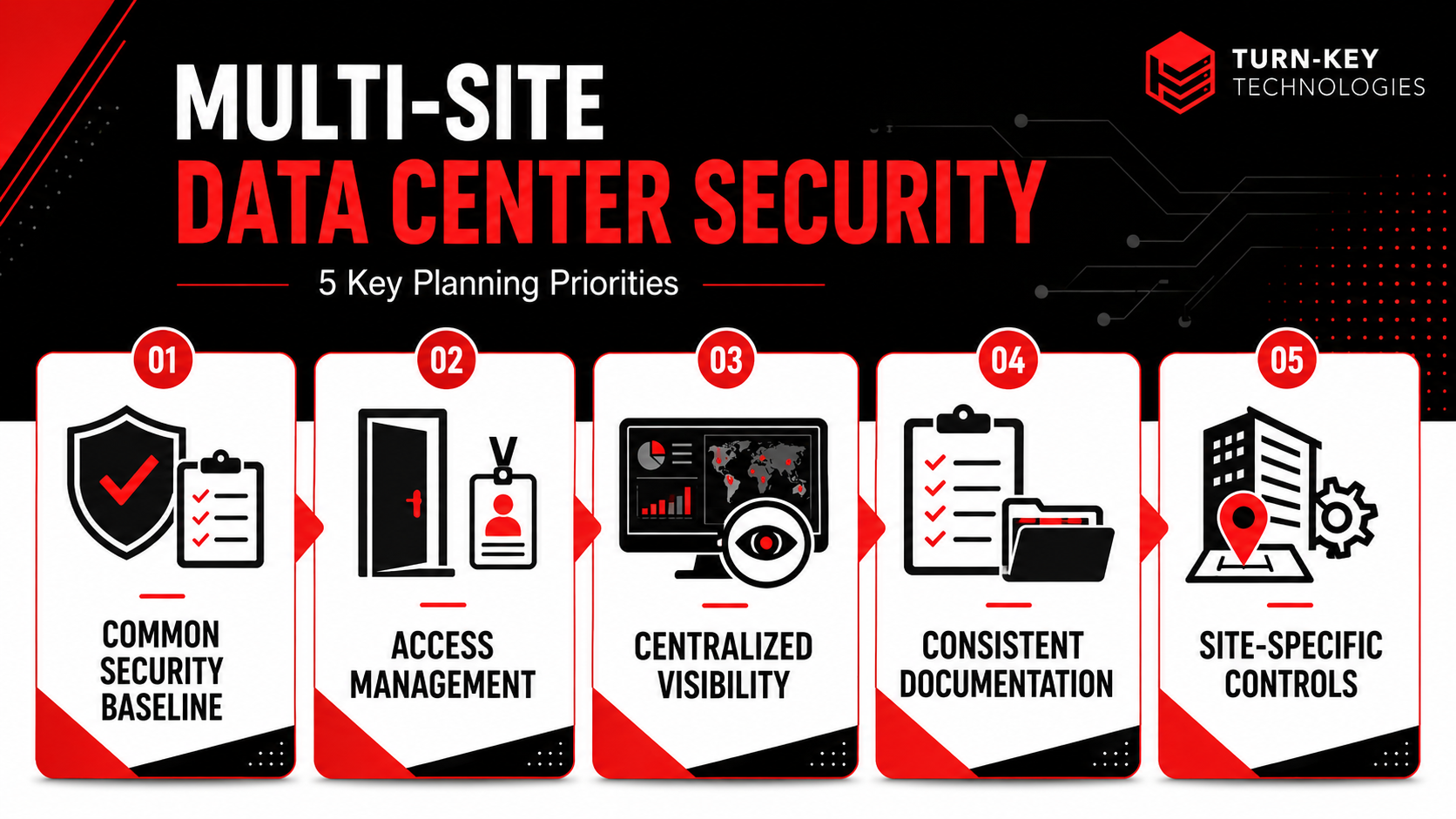
Set a common security baseline. Define minimum requirements for access control, video surveillance, visitor management, alarm handling, retention, and security audits across every facility. Site-specific controls can then be added where higher risk or operational requirements justify them.
Standardize access management. Use the same process for access requests, temporary credentials, contractor access, role changes, and permission reviews. Access to one facility should not automatically provide the same access level at another, especially when responsibilities differ by site.
Centralize visibility where practical. Security teams should be able to review alarms, access activity, and surveillance across multiple locations without relying on separate systems and procedures at every facility. Local responsibilities still need to be clear, including who responds to an event and how after-hours escalation is handled.
Keep documentation consistent. Maintain current records for security zones, credential ownership, camera coverage, access levels, escalation procedures, and system responsibilities. Consistent documentation makes audits easier and reduces the time spent reconstructing how each facility is configured during an incident.
Adapt controls to each facility. Data centers across New York, New Jersey, and Pennsylvania may differ in building design, perimeter exposure, staffing, expansion plans, and shared-space constraints. The security baseline should remain consistent, while physical access, surveillance coverage, environmental monitoring, and supporting infrastructure are adjusted to local conditions.
The goal is to create a repeatable security program without forcing every site into the same physical design. Standard policies provide consistency, while site-level risk determines how those policies are applied.
Read Next: Designing Surveillance for Large Multi-Site Campuses
A physical security review will usually uncover several issues at once. They should not all receive the same priority. Start with findings that could allow unauthorized access to critical infrastructure, reduce detection or response capability, or create a direct risk to data center operations.
Findings that combine high-impact infrastructure, weak access control, and limited detection or response capability often warrant the earliest attention. Lower-risk documentation, standardization, and optimization issues can then be addressed through a phased improvement plan.
Read Next: Physical Security Risk Assessment Checklist: What to Audit and Fix
Before adding new cameras, access controls, sensors, or monitoring tools, confirm that the project is solving a specific security or operational gap.
Which areas create the greatest risk if access is compromised?
Do current access levels still match job responsibilities?
Can security teams detect and verify activity in critical areas?
Can the network, cabling, and PoE infrastructure support the upgrade?
Are retention and audit requirements clearly defined?
Can the design support future expansion without creating new security gaps?
If several issues point to the same root cause, such as outdated permissions, disconnected security systems, or weak supporting infrastructure, address that underlying problem before adding another standalone security control.
Effective data center physical security depends on how well each layer supports the next. Perimeter controls, physical access, surveillance, intrusion detection, environmental monitoring, network segmentation, and security policies should reflect the risks of the facility and the infrastructure being protected.
The security design also needs to account for operational change. Access permissions change, facilities expand, equipment moves, and security systems place new demands on network and cabling infrastructure. Regular reviews help uncover outdated permissions, coverage gaps, infrastructure limitations, and policy inconsistencies before they create larger operational or security problems.
For organizations planning improvements, Turn-Key Technologies’ Physical Security Services include integrated video surveillance and access control solutions that can be tailored to facility security requirements. For data center operators across New York, New Jersey, and Pennsylvania, the practical starting point is to identify the areas with the greatest operational impact, assess the controls already in place, and prioritize improvements around the gaps that carry the most risk.
Data center physical security best practices include using multiple layers of defense, limiting physical access by role, monitoring critical areas with video and intrusion detection, maintaining current security policies, and reviewing permissions regularly. The layers of physical security should become stronger as someone moves from the perimeter toward data halls, server rooms, network spaces, and other high-impact areas.
Data center physical security standards and compliance requirements vary by industry, customer obligations, and the type of sensitive data being stored. Operators should identify which security controls, audit records, retention policies, access logs, and incident procedures their organization must maintain. Compliance should then be built into the security program rather than addressed only when an audit is approaching.
Data center access should follow least-privilege principles. Employees, contractors, vendors, and visitors should only receive physical access to the areas required for their work, with tighter controls around server rooms, network infrastructure, and other sensitive spaces. Higher-risk facilities may also use security checkpoints, escorts, security guards, stronger authentication, or additional approval requirements.
Yes. Unauthorized physical access can expose servers, storage, network equipment, and other systems where sensitive data is stored. Strong server room security, restricted access, surveillance, and equipment-level controls can reduce the risk of unauthorized tampering, theft, or access to data at rest. Physical security remains one layer of defense and should work alongside network and cybersecurity controls.
It depends on the facility's size, risk profile, operating hours, and security requirements. Some data center facilities may require dedicated security personnel, while others can rely more heavily on centralized monitoring and controlled access. A security operations center can help coordinate surveillance, alarms, access events, and security incidents across multiple facilities, but staffing and response procedures still need to match the risks being monitored.
%20(1).png)
Enhancing oil and gas security with advanced surveillance systems is crucial for protecting critical infrastructure from threats like terrorism,...
%20(1).png)
Enhance physical security with surveillance cameras, access control, and security personnel. Learn about common threats, key components, and best...
.png)
Elevate school safety with the School Violence Prevention Program (SVPP) Grant, providing essential funding for improved security measures and...