


Skip to the main content.

13 min read

Self-Driving Networks for Education: What K-12 IT Teams Need to Know

Written by Updated October 16, 2026

                      Picture of
                      Craig Badrick
Craig Badrick

Craig Badrick is President and CEO of Turn-key Technologies, Inc., bringing extensive experience in wireless communications and IT infrastructure across education, healthcare, enterprise, government, and hospitality environments. His expertise includes Wi-Fi and wireless networking, voice over Wi-Fi, wireless telephony, paging, emergency communications, network optimization, load balancing, backup systems, message archiving, data protection, firewalls, and spam filtering. Craig also brings deep ...

Self-Driving Networks for Education: What K-12 IT Teams Need to Know

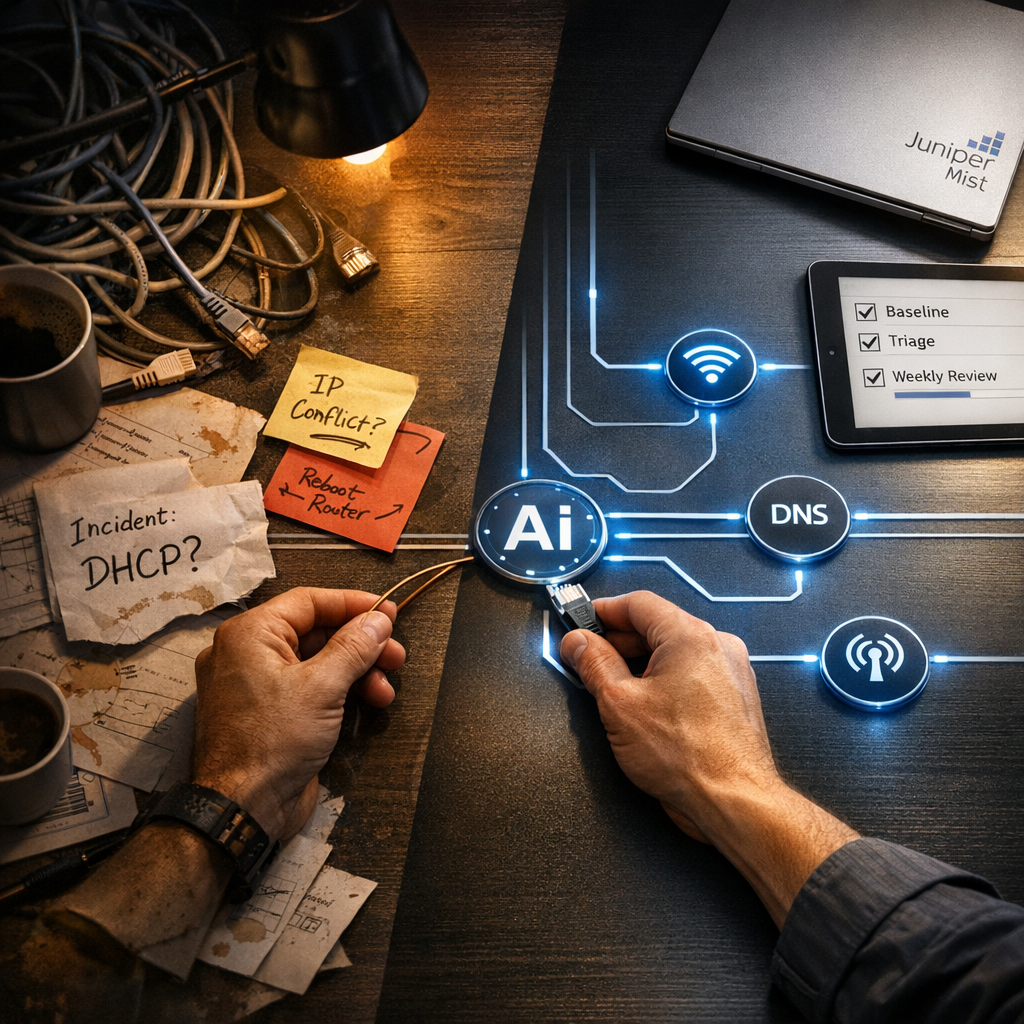
A self-driving network uses AI-native operations, telemetry, and automation to help IT teams identify problems, understand likely causes, and act faster. At Turn-Key, we describe this model as observe, learn, optimize, and act, moving network operations beyond basic alerts toward more proactive, autonomous responses.

For K-12 districts, that can mean better visibility across classrooms and campuses and less time spent troubleshooting recurring issues. HPE reported in May 2026 that the UK Ministry of Justice achieved an approximate 75% reduction in service desk tickets after using HPE Self-Driving Network capabilities and AI-driven automation. That result comes from a public-sector environment, so it should be treated as an example of operational impact rather than a guaranteed K-12 outcome.

For school IT teams, the practical question is where AI-assisted troubleshooting and automation can reduce workload while preserving the oversight needed for network changes, security, and classroom reliability.

💡 TL;DR: What K-12 Technology Leaders Should Know

  • A self-driving network uses AI, telemetry, and automation to identify issues, surface likely causes, and support faster corrective action.

  • For school districts, the biggest value is operational: better visibility across campuses, fewer repetitive troubleshooting tasks, and more consistent network performance.

  • K-12 environments are a strong fit because they combine dense device populations, wireless dependence, cloud applications, IoT, and physical security systems.

  • HPE brings these capabilities together through platforms such as HPE Mist, Marvis AI, and HPE Aruba Central.

  • Self-driving operations still depend on solid network design, accurate telemetry, reliable cabling, and clear security policies.

  • Districts do not need to jump straight to full automation. AI-assisted troubleshooting, stronger visibility, and selective automation are practical starting points.

  • Turn-Key supports that transition through assessment, design, deployment, and ongoing network support.


What is a Self-Driving Network?

A self-driving network continuously analyzes network conditions using telemetry, AI, machine learning, and automation to help identify problems, determine likely causes, and support corrective action with less manual investigation.

For a school district, that means the network can do more than report that an access point, switch, or client is having a problem. It can correlate information across users, devices, applications, topology, and historical behavior to help identify the probable cause and recommend or automate a response.

From Traditional Network Management to AI-Native Operations

Traditional monitoring platforms are good at generating alerts. The harder part is determining which alerts matter, whether several symptoms share the same root cause, and what should be changed to resolve the issue.

AI-native operations reduce that manual analysis. HPE's current self-driving network strategy uses agentic AIOps to extend root-cause analysis, predictive insight, and self-healing automation across supported wired, wireless, WAN, security, and data center environments.

For a K-12 IT team, a practical example might be a classroom reporting intermittent Wi-Fi problems. Instead of an administrator manually checking the client, access point, authentication service, switch, and recent configuration changes separately, the platform can correlate those signals and surface the most likely cause.

That progression can be viewed as a move from alerts to insight to action.

Read More: How AI-Native Networking Redefines Enterprise Network Strategy

How Self-Driving Networks Work

In practice, the process depends on several connected capabilities:

Capability What It Does Practical Value
Continuous Telemetry Collects data from clients, devices, applications, and network services Gives IT teams a broader view of what is happening across the environment
AI and Machine Learning Identifies patterns, anomalies, and probable causes Reduces the time required to correlate symptoms manually
Predictive Analysis Flags emerging performance issues before they become larger problems Helps teams address conditions earlier
Automated Recommendations Suggests configuration or optimization changes Speeds up troubleshooting and decision-making
Autonomous Actions Performs supported and approved remediation Reduces repetitive operational work

The level of autonomy does not have to be the same for every task. A district may allow automatic remediation for a low-risk, well-understood condition while requiring human approval for a broader configuration change. This gives IT teams a practical way to introduce automation gradually while maintaining operational control.

Read More: Mastering AIOps Maturity: The 4 Stages That Drive Intelligent Network Operations

What Does “Self-Driving” Mean for a School District?

For a school district, self-driving networking changes how routine network operations are handled. Instead of requiring staff to manually investigate every alert, performance issue, or client complaint, AI-assisted tools can help narrow the cause, prioritize the issue, and recommend the next action.

The practical benefit is time. District IT teams can spend less effort on repetitive troubleshooting and more on wireless planning, security, device strategy, infrastructure upgrades, and support for instructional technology.

It Does Not Mean Removing IT Teams

Self-driving capabilities still depend on engineers to set policies, approve higher-impact changes, validate recommendations, and decide where automation is appropriate.

Some actions may be safe to automate, such as handling a known low-risk condition. Others, including broader configuration or security changes, may still require review. The level of autonomy should reflect the district’s operational policies and tolerance for risk.

This matters in K-12 environments where a network change can affect classrooms, administrative systems, cameras, access control, and other critical services at the same time.

Moving from Reactive to Proactive Network Management

Traditional support often begins after a user reports a problem. A teacher may submit a ticket about unstable Wi-Fi, and the IT team then has to determine whether the issue involves the client device, access point, authentication service, switch, or another part of the environment.

AI-native network operations can identify unusual conditions earlier and correlate signals across those systems. That can help IT teams investigate emerging issues before they generate a larger volume of support requests.

For districts managing several buildings from a central IT department, that shift can make day-to-day operations more manageable and help staff focus attention on the issues with the greatest impact.

Why Self-Driving Networks Matter for K-12 Education

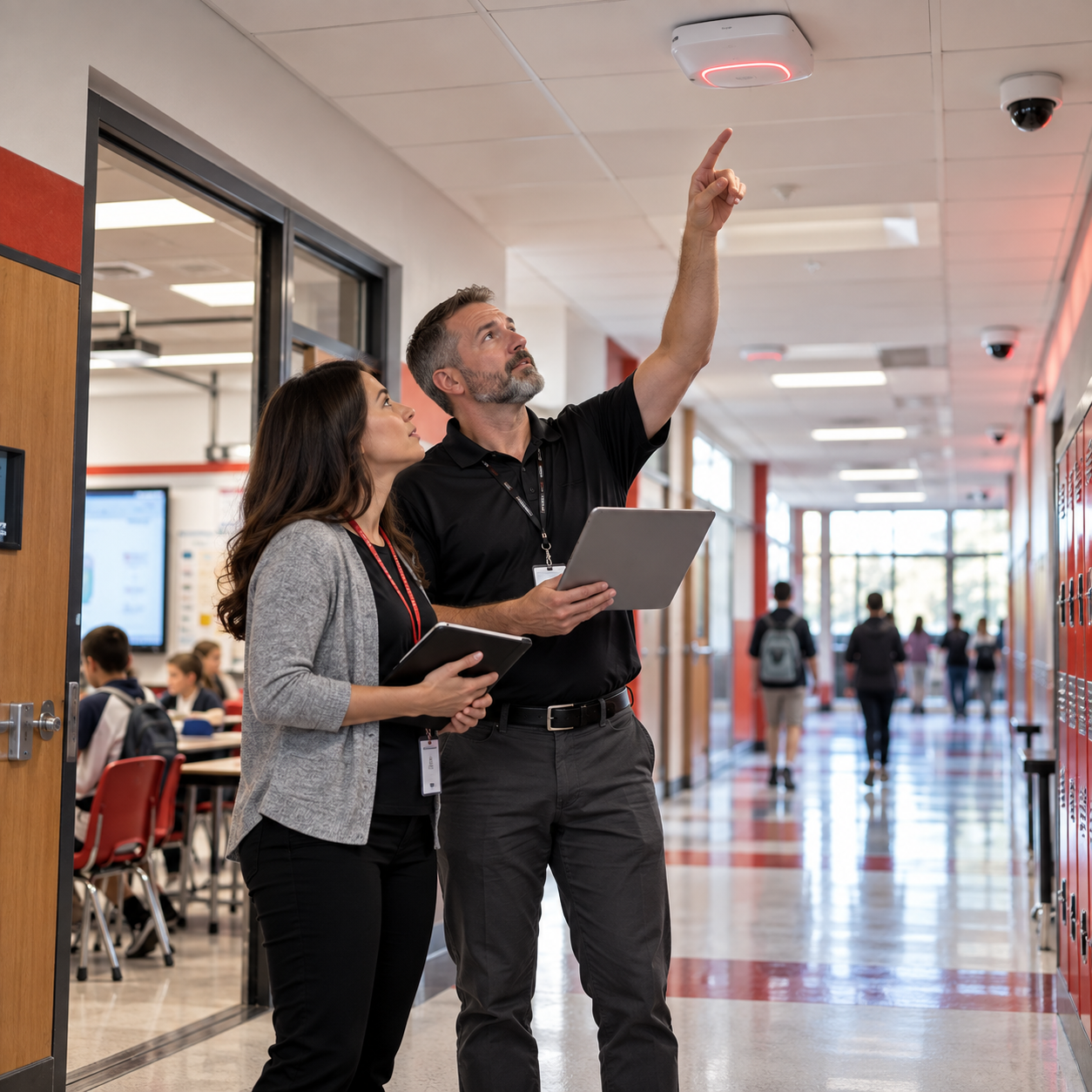
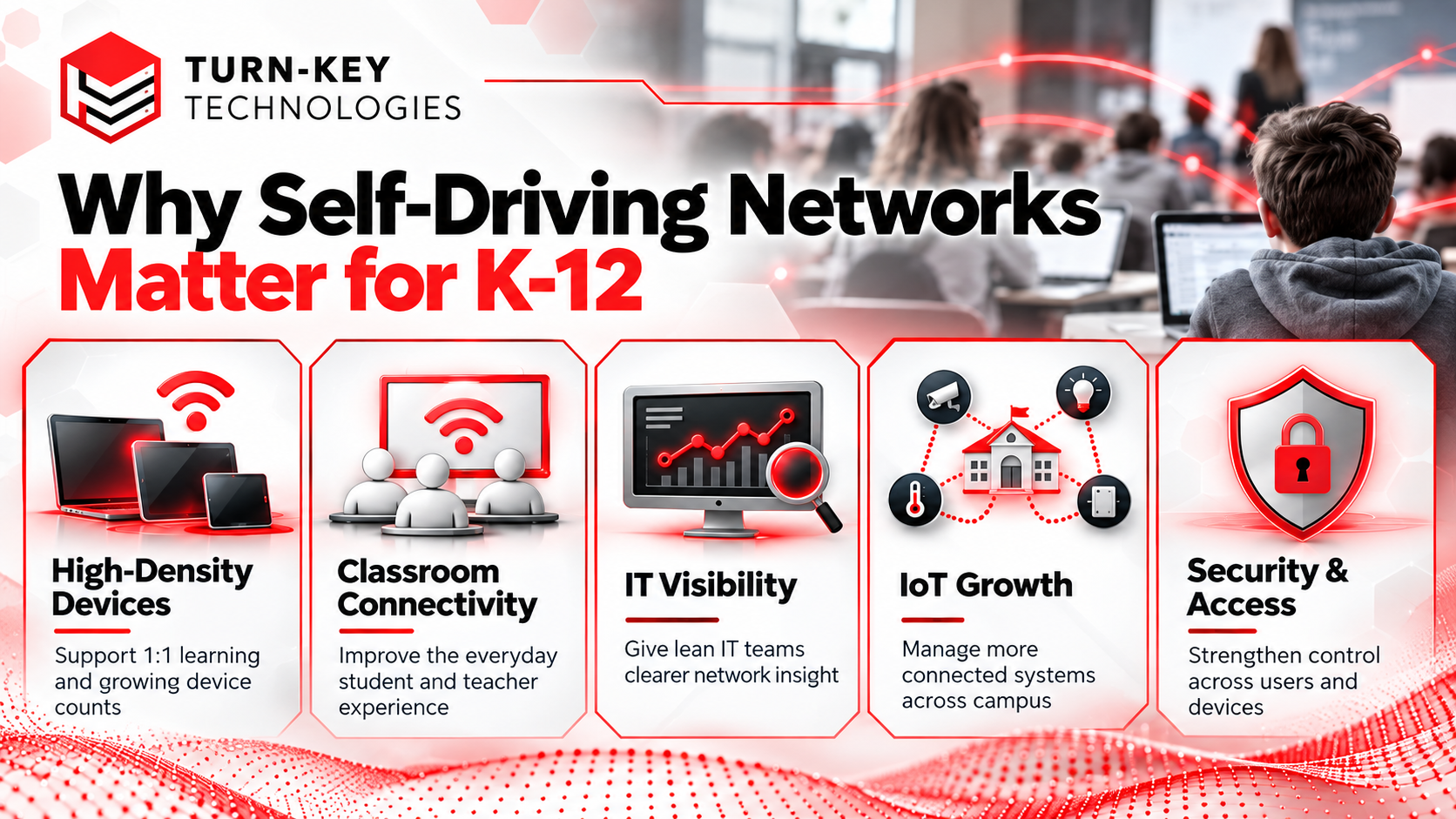
K-12 networks support a growing mix of student devices, classroom technology, cloud applications, IoT, physical security systems, and administrative services. Turn-Key’s K-12 practice reflects that broader environment, with work spanning wireless design, site surveys, security, and infrastructure planning for school districts.

Supporting High-Density Device Environments

A single classroom may include student laptops or tablets, teacher devices, displays, phones, sensors, cameras, and other connected equipment. Across a district, that creates sustained demand on wireless capacity and network performance.

AI-driven insight can help IT teams identify congestion, roaming issues, authentication delays, and other conditions that affect connectivity. This is especially useful in 1:1 environments where even localized performance problems can quickly disrupt instruction.

Read More: Integrating 1-to-1 Technology in the Classroom: Benefits, Challenges & Fixes for K-12 Schools

Improving the Classroom Connectivity Experience

A device can be connected while the user experience is still poor. Students and staff may encounter slow authentication, unstable roaming, latency, or application delays even when the access point itself is online.

Experience-driven network management helps IT teams evaluate what users are actually encountering. That gives them a better basis for prioritizing issues than device status alone.

Giving Lean IT Teams Better Visibility

District technology teams often manage several buildings from one central location. They need a practical way to understand network health across campuses without manually checking every site.

AIOps and centralized visibility can help surface patterns across devices, wireless conditions, and user experience. That makes it easier to distinguish a local issue from a broader network problem and focus staff time where it matters most.

Read More: Mist AI Network Visibility for Scalable Enterprise Networks

Managing Growing IoT and Connected Infrastructure

School networks increasingly carry traffic from cameras, access-control systems, environmental sensors, printers, displays, and other non-instructional devices.

These systems introduce different traffic patterns, security requirements, and operational dependencies. Better visibility helps IT teams understand how those devices are behaving and where segmentation, policy, or capacity changes may be needed.

Supporting Network Security and Access Control

As automation increases, identity, segmentation, authentication, device access, and configuration policies become even more important.

HPE’s broader self-driving network strategy brings AIOps together with wired, wireless, WAN, and security operations. For school districts, that broader view is useful because instructional devices, administrative systems, IoT, and physical security technologies often depend on the same underlying network.

How AI Changes Day-to-Day Network Operations

Once AI-native capabilities are in place, the operational impact shows up in how teams handle recurring work, prioritize incidents, and make changes across the environment. The value is less about adding another dashboard and more about improving the quality and speed of day-to-day network decisions.

1. Better Prioritization of Network Issues

School IT teams can receive alerts from access points, switches, authentication services, applications, and connected devices at the same time. The challenge is deciding which events require immediate attention.

AI can help rank issues based on scope, severity, and service impact. A problem affecting one device in an unused area should not be treated the same as an issue affecting hundreds of students during instruction or testing.

This kind of prioritization helps teams focus on the problems with the highest operational impact instead of working through alerts in the order they appear.

2. More Consistent Configuration Management

Configuration changes are a common source of instability, especially in distributed environments where multiple buildings may have different hardware generations, policies, or deployment histories.

AI-assisted operations can help compare current configurations with expected network behavior, identify inconsistencies, and flag changes that may introduce performance or security problems.

For school districts, this can be useful when maintaining consistent wireless, switching, and access policies across multiple campuses without relying entirely on manual comparisons.

3. Detecting Patterns That Are Easy to Miss

Some network problems are difficult to diagnose because they occur only under specific conditions.

A wireless issue may appear during certain periods of the school day. Congestion may occur only in particular buildings or applications. Authentication failures may rise after a device or policy change.

By analyzing historical and real-time data together, AI can identify recurring patterns that may not be obvious from a single incident. This gives engineers a clearer basis for deciding whether the issue calls for a configuration change, capacity upgrade, policy adjustment, or further investigation.

4. Supporting Safer Change Validation

Network changes can solve one problem while unintentionally creating another. AI-assisted operations can help teams evaluate the effect of a change after it is made by comparing network conditions before and after implementation.

That creates a more disciplined validation process. Instead of assuming a configuration change worked because the original alert disappeared, engineers can check whether performance, connectivity, or service quality actually improved.

For environments supporting instructional systems, administrative services, and security technology on the same infrastructure, that added validation can reduce the risk of unnoticed side effects.

5. Improving Operational Consistency Across Campuses

Multi-site districts often inherit differences between buildings due to phased upgrades, older infrastructure, or inconsistent configuration practices.

AI-assisted analysis can help identify where one site is behaving differently from comparable locations. That can reveal configuration drift, unusual device behavior, capacity imbalances, or inconsistent policy enforcement.

Over time, this gives IT teams a clearer picture of which differences are intentional and which should be corrected, making network operations more consistent across the district.

6. Turning Network Data Into Planning Input

The same operational data used for daily management can also support longer-term decisions.

Recurring capacity issues, repeated client failures, chronic congestion, and persistent performance degradation can indicate where the district may need additional access points, switching capacity, updated hardware, or a different network design.

That makes AI useful beyond incident handling. It can help turn operational data into evidence for refresh planning, budgeting, and infrastructure decisions.

Read More: How AI Predictive Maintenance Is Slashing Network Downtime and Boosting Reliability

How Turn-Key and HPE Support Self-Driving Networking for Education

At Turn-Key, our approach to self-driving networks combines HPE’s AI-native networking capabilities with the engineering and operational work required to apply them effectively in a school environment.

The technology provides the intelligence, visibility, and automation layer. Our role is to help districts determine how those capabilities fit within the network they already operate, what needs to change to support them, and how they should be introduced without creating unnecessary complexity.

HPE Mist, Marvis, and Aruba Central

HPE Mist brings AI-native operations to supported wireless, wired, WAN, and related network environments. Marvis builds on that foundation with conversational assistance, AI-driven analysis, recommendations, and autonomous actions. HPE Aruba Central provides centralized management across campus and branch infrastructure, giving IT teams a common place to manage and evaluate wired and wireless environments.

For K-12 districts, these technologies can provide a more complete operational picture across schools instead of requiring administrators to evaluate each device, site, or network layer independently. The specific value will depend on the district’s existing HPE environment, management tools, infrastructure, and operational priorities.

Read More: Marvis AI Best Practices: A Practical Playbook for Juniper Mist Network Operations

Assess and Design

We begin by understanding how the district’s network is currently built and operated. That includes infrastructure, management platforms, applications, security requirements, building conditions, device populations, and known operational challenges.

From there, we can determine where self-driving capabilities fit into the broader architecture and which changes, if any, should happen first. Our K-12 technology practice spans the networking and infrastructure requirements that schools need to coordinate as classroom technology and connected systems continue to grow.

The design stage also establishes how the district intends to manage the environment once it is deployed. That includes decisions around centralized management, policy enforcement, automation, and the operational responsibilities that remain with the IT team.

Deploy and Integrate

We then implement the network components and management tools defined in the design.

Depending on the project, that can involve wired and wireless infrastructure, switching, configuration, physical connectivity, platform integration, testing, and documentation. The objective is to make sure the management and AI layers have a consistent environment to operate against once the network enters production.

Integration is particularly important in school environments where instructional technology, administrative systems, IoT, and physical security may all rely on the same network infrastructure.

Support and Optimize

The network continues to change after deployment. New devices are introduced, applications evolve, policies are updated, and infrastructure moves through its lifecycle.

We support districts through those changes by helping maintain configuration consistency, review network conditions, address operational issues, and evaluate where additional automation may provide useful value. Through our Managed Services, we can also help maintain network health, troubleshoot operational issues, monitor changing conditions, and support the technologies already running across the environment.

Over time, the aim is to give the district an environment that is easier to operate, easier to understand, and more consistent across campuses. That provides a practical foundation for expanding AI-assisted and autonomous capabilities as the district’s technology, processes, and operational requirements evolve.

See How Self-Driving Networking Can Fit Your District


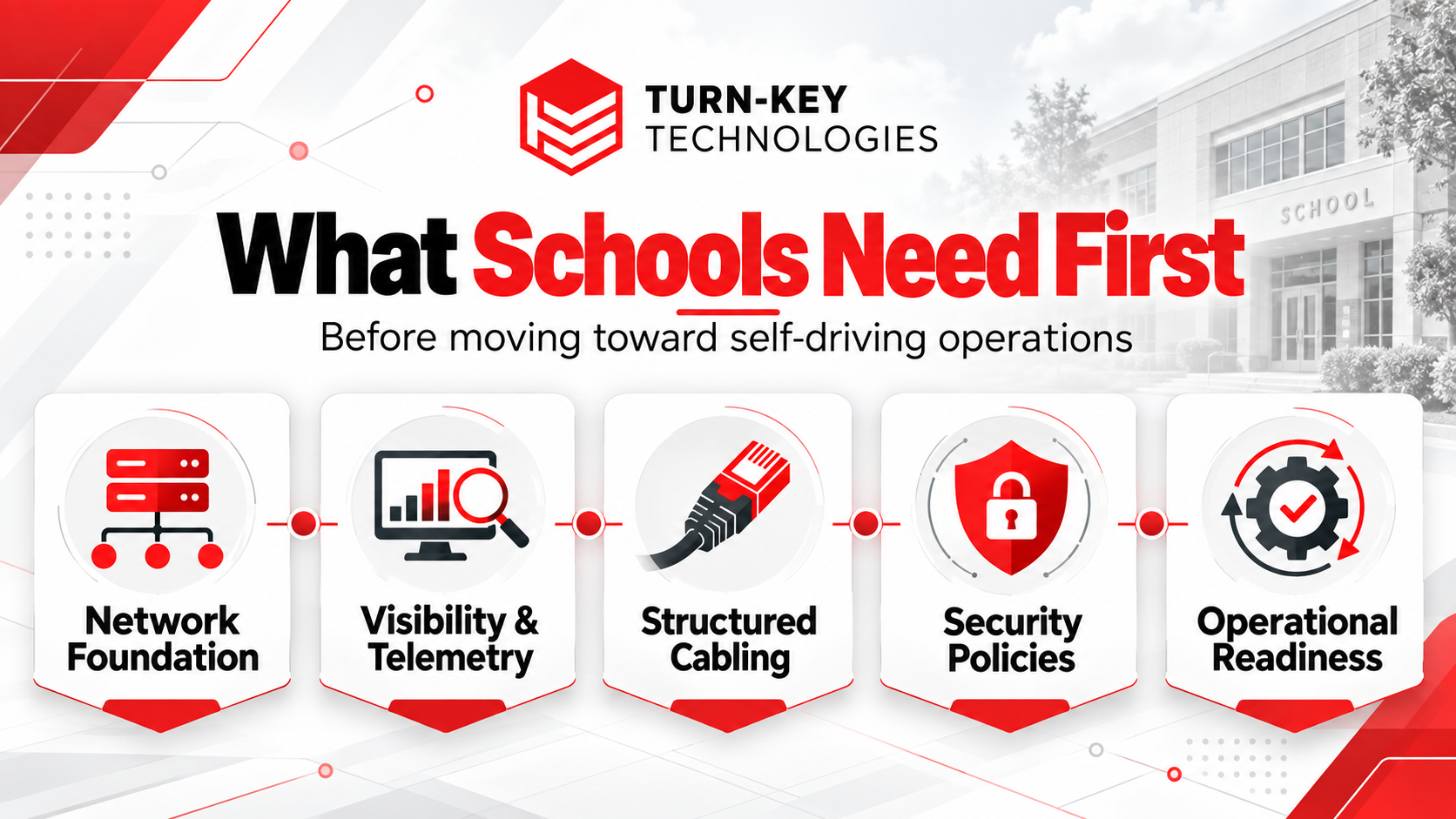
What Schools Need Before Moving Toward Self-Driving Operations

Self-driving capabilities work best when the underlying network is stable, well documented, and observable. Before adding more automation, districts should make sure the infrastructure and operating practices beneath it are ready to support reliable decisions.

A Well-Designed Network Foundation

Automation cannot correct basic design limitations such as insufficient wireless coverage, undersized switching capacity, weak redundancy, or aging hardware. Districts should first identify bottlenecks, coverage gaps, single points of failure, and equipment approaching end of life. This is especially important in mixed environments where newer cloud-managed systems are operating alongside older infrastructure.

For districts addressing coverage, capacity, or wireless design limitations, our Wireless Networks services cover areas such as wireless site surveys, network design, and infrastructure planning.

Read More: Optimizing Network Uptime: Key Strategies Pros Use to Enhance Performance & Reliability

Accurate Network Visibility and Telemetry

AI depends on complete and reliable data.

That includes device inventories, topology, client behavior, application performance, configuration history, and network health information. If parts of the environment are poorly documented or not visible to the management platform, the quality of analysis and recommendations will be limited.

Reliable Structured Cabling

Wireless and AI-driven operations still depend on the physical layer.

Access points, switches, cameras, sensors, and access-control devices all rely on stable copper or fiber connections. Damaged cable, poor terminations, inconsistent labeling, and undocumented pathways can create recurring issues that appear to be network problems but cannot be resolved through software alone.

For districts planning broader modernization, structured cabling services should account for cabling condition, testing, documentation, pathways, and how the physical infrastructure will support switching and wireless requirements.

Clear Security and Access Policies

Districts also need defined rules for how different users and devices connect. Students, staff, guests, administrative systems, IoT devices, and security equipment often require different levels of access. Segmentation, authentication, network access control, and policy enforcement provide the structure that allows automation to operate within clear boundaries.

Operational Readiness

Before enabling autonomous remediation, IT teams should decide which actions can happen automatically and which still require approval. They should also define how changes are documented, validated, and rolled back if necessary. The right level of autonomy will vary by district based on infrastructure maturity, staffing, and risk tolerance.

For most schools, readiness comes from improving the foundation first, then expanding automation as the network becomes more consistent and easier to manage.

Where Should a K-12 District Start?

Moving toward self-driving operations does not require a district-wide overhaul. A better approach is to identify where the network is struggling today, target the highest-value opportunities, and modernize in phases.

  1. Assess the Current Environment. Review recurring connectivity complaints, wireless coverage and capacity, aging infrastructure, visibility gaps, configuration inconsistencies, security requirements, and upcoming technology initiatives. The goal is to understand where operational friction is coming from before introducing more automation.

  2. Prioritize Repetitive, High-Impact Work. Look for issues that consume staff time repeatedly, such as authentication problems, recurring wireless complaints, manual health checks, or frequent alert correlation. These are often the best candidates for AI-assisted analysis or selective automation.

  3. Build a Phased Modernization Plan. Sequence improvements around budget cycles, E-rate planning, infrastructure refreshes, construction projects, and instructional priorities. As visibility and network consistency improve, districts can expand automation where the workflow is predictable and the operational risk is low.

Read Next: What Are Managed Internal Broadband Services (MIBs): E-Rate's Hidden Funding Opportunity for K-12

Building Toward Smarter K-12 Network Operations

Self-driving networking gives K-12 technology teams a practical way to manage increasingly complex environments with greater consistency and better operational context. AI, telemetry, predictive analytics, and selective automation can help districts identify issues sooner, prioritize work more effectively, and make better use of the network data they already generate.

The shift does not need to happen all at once. For many districts, the right starting point is understanding where the current network creates the most friction and where better visibility or automation can remove repetitive work without adding unnecessary complexity.

At Turn-Key, we see self-driving networking as a progression. The goal is to help districts move toward more intelligent and manageable network operations at a pace that fits their infrastructure, staffing, and priorities.

Meet Turn-Key Technologies at NYSCATE 2026

If your district is planning a network refresh or evaluating where AI-assisted operations could fit into its environment, meet with the Turn-Key Technologies team at NYSCATE 2026 to discuss your current infrastructure, operational challenges, and next steps.

Ready to Explore Self-Driving Networking for Your District?


Frequently Asked Questions About Self-Driving Networks for Education

What Is AIOps in a K-12 Network?

AIOps applies artificial intelligence and machine learning to network operations, so IT teams can analyze conditions, identify patterns, and turn network data into more actionable insights. Instead of relying only on individual alerts or static metrics, AIOps can evaluate information across users, devices, applications, and infrastructure in real time.

For school districts, that can mean less time troubleshooting recurring problems and more context around where an issue is occurring, how many users it affects, and what action may be appropriate.

How Much Autonomy Should a School District Allow?

The right level of autonomy depends on the task, the maturity of the environment, and the district’s tolerance for operational risk.

Some low-risk workflows may be able to run autonomously or complete routine remediation without human intervention. Changes that could affect security, critical applications, or large numbers of users may still require human review or approval. The goal is to maintain enough control and flexibility to decide which actions can be automated and which should remain under IT review.

Can Network Automation Help Reduce Downtime and Outages?

Automation can help shorten the time between detecting a problem and taking corrective action, particularly when the condition is known and the appropriate response is already defined.

That can support better uptime, service continuity, and network assurance, but it does not eliminate the possibility of an outage. Self-driving networks rely on sound architecture, reliable infrastructure, accurate data, and well-defined operational policies. Automation is most effective when it is working within a stable environment rather than compensating for unresolved infrastructure problems.

What Makes a Self-Driving Network Resilient and Scalable?

A resilient self-driving network combines reliable wired and wireless infrastructure with consistent configuration, visibility, security policy, and management practices.

Scalability also matters as districts add campuses, devices, applications, and connected systems. AI and automation can help maintain consistency as the environment grows, but network teams still need to design and configure the infrastructure around capacity, redundancy, segmentation, and operational requirements. Districts with legacy systems may need to modernize certain components before advanced automation can be used consistently across the environment.

How Do AI Agents and Intent-Based Networking Fit Into Self-Driving Networks?

AI agents and autonomous agents can analyze network conditions, recommend actions, and in supported situations perform defined operational tasks. Intent-based networking approaches the problem from another direction: the IT team defines the desired state of the network, while automation and programmability help maintain that state.

As these technologies mature, more adaptive and agentic capabilities may become part of network operations. For K-12 teams, the useful question is not whether every task should become autonomous. It is where AI and automation can improve operational consistency, provide better insight, and reduce manual effort while preserving appropriate oversight.

How AI-Native Networking Redefines Enterprise Network Strategy

How AI-Native Networking Redefines Enterprise Network Strategy

Explore how AI-native networking platforms, conceived and developed with AI, enable enterprise operators to shift toward AI-driven network automation.
Read More
The Power of Proactive Network Monitoring: A Smarter Approach for Remote Sites

The Power of Proactive Network Monitoring: A Smarter Approach for Remote Sites

Proactive network monitoring protects remote sites from costly downtime. Explore proven strategies to keep your network running reliably.

Read More
Marvis AI Best Practices: A Practical Playbook for Juniper Mist Network Operations

Marvis AI Best Practices: A Practical Playbook for Juniper Mist Network Operations

Juniper Mist AI with Marvis delivers proactive network troubleshooting and better user experience for enterprise business networks, from campus to...

Read More