


1 min read
School Security Ecosystem: Why Modern School Security Systems Need More Than Cameras
 Matt Hawthorne : Jun 11, 2026, 2:30:00 PM
A parent calls the school office in a panic. Their child never arrived home after school.
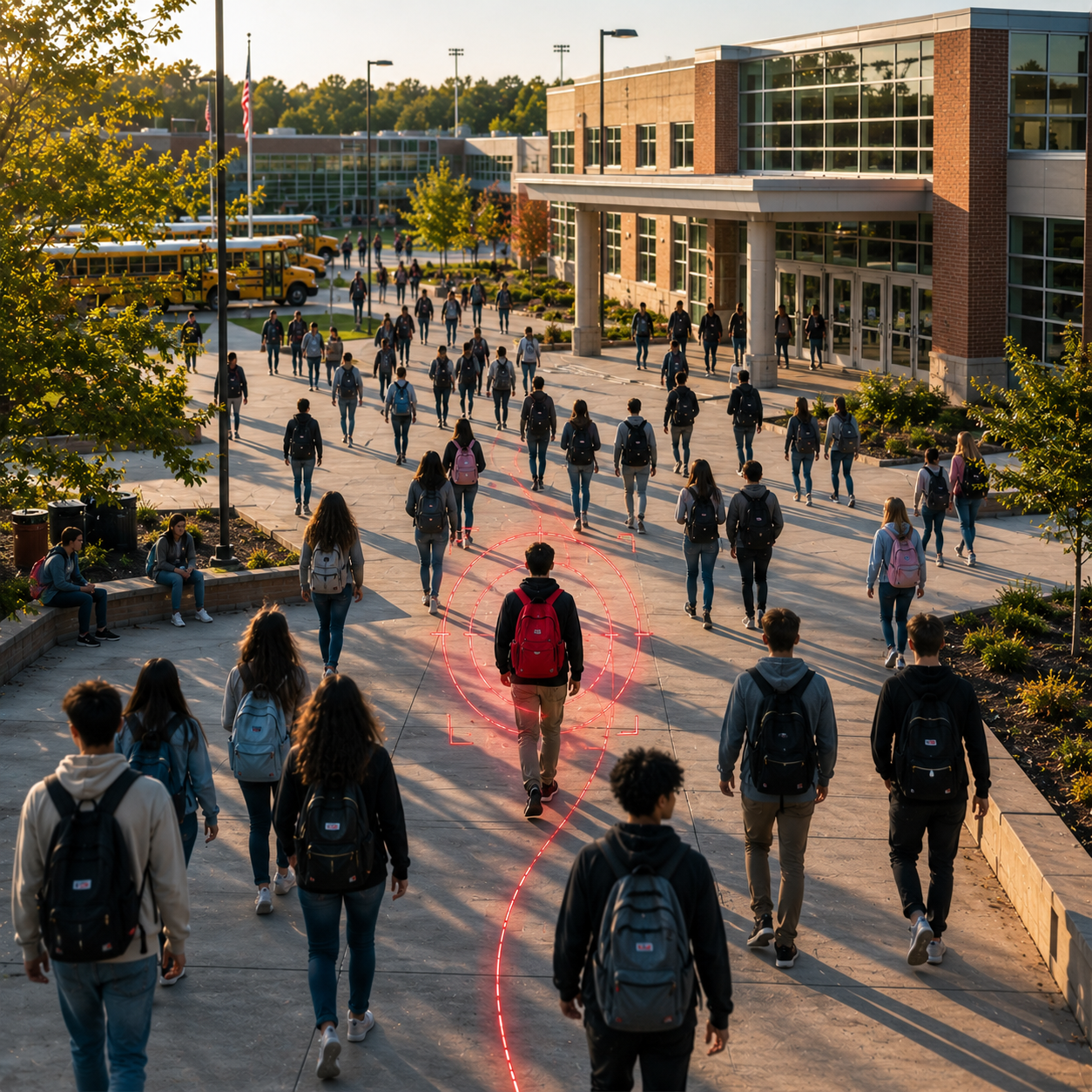
A parent calls the school office. Their child never arrived home after school. Within minutes, school administrators need answers: Did the student leave campus? Did they board the correct bus? Where were they last seen?
In many schools, finding those answers means staff manually reviewing surveillance footage, jumping between camera feeds, and reconstructing events one clip at a time. What should be a quick investigation can take hours.
Modern video surveillance can change that. Using appearance search, video analytics, and timeline reconstruction, school staff can often locate a student, verify movement through school buildings, confirm exit points, and determine what happened in a fraction of the time.
The challenge for many schools is no longer capturing video. It is finding answers quickly when incidents occur. As school security camera systems continue to evolve, the most valuable systems are often the ones that help administrators investigate incidents faster, not simply record more footage.
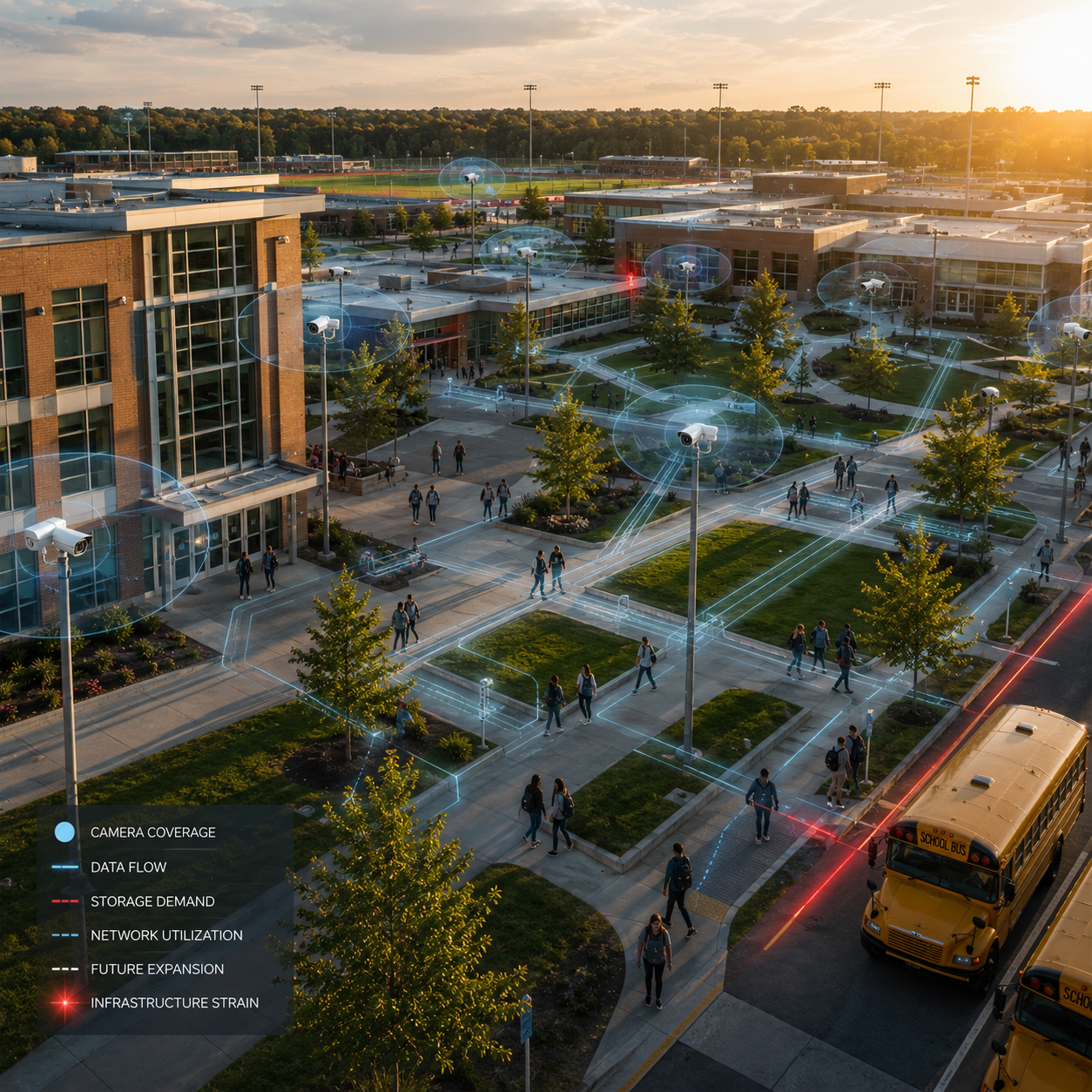
Many schools have invested heavily in school security cameras and video surveillance systems. Yet when an incident occurs, investigations often remain frustratingly slow. Modern surveillance systems generate enormous amounts of footage, making storage, retrieval, and retention planning critical parts of system design.
A typical school security camera system may include dozens or hundreds of cameras across school buildings, entrances, parking lots, athletic facilities, and school grounds. When administrators need answers, they often have to locate the right camera, identify the correct timeframe, and manually review footage. Common investigation bottlenecks include:
Multiple camera feeds to review
Hours of recorded school video
Manual timeline reconstruction
Difficulty tracking movement across cameras
Limited staff resources
The misconception is that more security cameras automatically improve school safety. In reality, more cameras often create more footage to search. The schools achieving better outcomes are not necessarily recording more video. They are finding relevant evidence faster.
Read Next: Top Security Cameras for Schools: Advanced School Security Camera Systems & Surveillance Solutions
Traditional video surveillance systems are designed to record events. Video analytics helps schools find those events faster. Using artificial intelligence, modern video surveillance platforms analyze footage and create searchable information about people, vehicles, objects, movement patterns, and activities captured across the campus.
That changes how investigations are conducted. Instead of manually reviewing footage camera by camera, administrators and security teams can search for specific people, attributes, movements, or events across multiple cameras and timeframes.
Tasks that once required hours of manual review can often be narrowed down much more quickly by identifying where someone was seen, how they moved through the building, and when key events occurred. The result is a video surveillance system that does more than record footage. It helps schools find relevant evidence faster, reconstruct events more efficiently, and make informed decisions when incidents occur.
Read Next: How AI is Transforming Video Analytics & Surveillance Technology: Proactive & Built for the Future
One of the most practical applications of modern video surveillance in schools is appearance search. Rather than manually reviewing footage from camera to camera, appearance search allows investigators to locate individuals based on visible characteristics and quickly identify relevant footage across a campus.
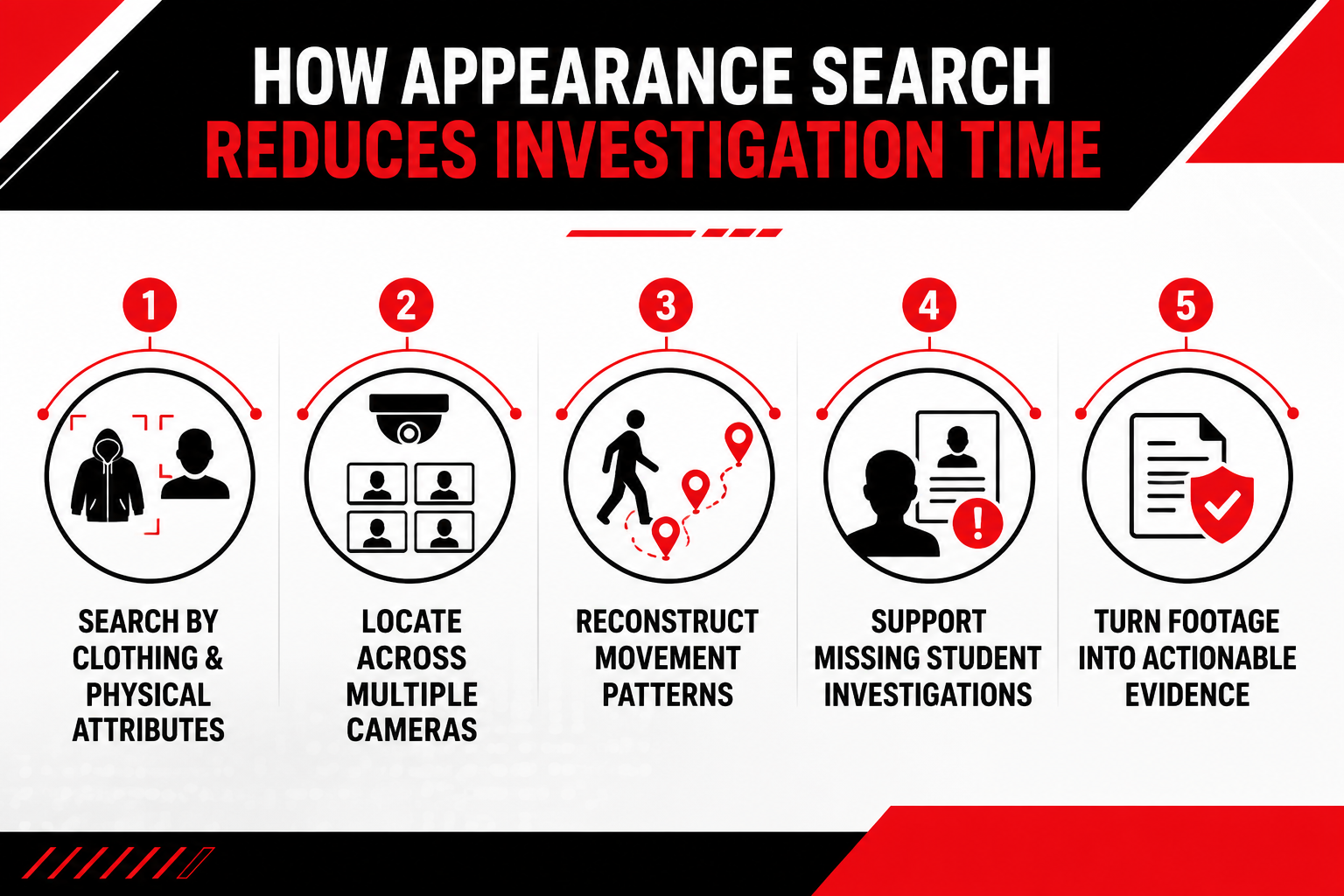
Traditional school security investigations often require staff to identify an individual on one camera and then manually search for that same person across additional cameras.
Appearance search changes that process. Instead of relying solely on timestamps and camera locations, investigators can search using visible characteristics such as clothing color, clothing type, backpack presence, physical attributes, and direction of travel. By narrowing results to likely matches, administrators can focus on the most relevant footage instead of reviewing hours of recorded video.
Finding a person on a single camera is only part of the challenge. School administrators often need to determine where an individual moved after they left a particular area. In traditional video surveillance environments, this may require staff to review multiple camera feeds individually and manually track movement from one location to the next.
Modern video surveillance systems can help identify matching appearances across multiple cameras and create a connected view of movement throughout a campus. This capability becomes particularly valuable in large school buildings, multi-building campuses, athletic facilities, and transportation areas where individuals frequently move between coverage zones.
Finding a person is often only the beginning of an investigation. Administrators and security personnel also need to understand where someone came from, which routes they used, where they went, and whether their movements help explain what occurred.
Video analytics can assist by connecting events across multiple cameras and helping investigators build a timeline of activity. Instead of reviewing isolated clips, staff can focus on understanding the sequence of events that led to an incident.
One of the most valuable applications of appearance search occurs when administrators need to quickly locate a student. Whether responding to a parent inquiry, verifying dismissal procedures, or investigating a student welfare concern, time is often a critical factor.
Appearance search can help staff determine where a student was last seen, identify their movement through the building, and establish a clearer understanding of what occurred without requiring hours of manual footage review. The result is faster access to information and a more efficient investigative process during situations where administrators need answers quickly.
Appearance search helps administrators identify where a person appeared across multiple cameras, reducing the time required to investigate an incident. Modern school security camera systems generate significant amounts of video every day. Appearance search helps transform that footage into usable investigative information by reducing the time required to locate evidence, verify events, and reconstruct timelines.
That shift from recording footage to finding relevant information is one of the reasons video analytics has become such a valuable tool for modern school security investigations.
Read Next: Video Surveillance Best Practices: Implementing a Security Camera System for Business
The value of modern video surveillance becomes most apparent when administrators need answers quickly. Many school investigations are not major security incidents. They are everyday situations that require staff to verify what happened, establish a timeline, and respond with accurate information. The challenge is that traditional video review can turn even routine investigations into time-consuming exercises.
Video analytics helps reduce that effort by making relevant footage easier to find.
Consider the parent call described earlier. A student was expected home but never arrived. Administrators need to determine where the student was last seen, whether they left campus, and what occurred between dismissal and departure.
Without video analytics, staff may spend significant time reviewing footage from multiple cameras and locations. With appearance search and timeline reconstruction tools, investigators can often locate the student, track movement through school buildings, verify exits, and establish a clearer understanding of events much more quickly.
The goal is not to replace established school procedures. The goal is to reduce the time required to gather accurate information when answers are needed quickly.
Visitor-related investigations often involve determining when someone arrived, which entrances they used, where they traveled throughout the building, and whether they followed established visitor procedures.
Traditional video surveillance may require staff to review footage from several cameras individually. Video analytics can help connect those events and provide a more complete picture of visitor movement across the campus. This improves accountability while reducing the amount of time required to conduct an investigation.
Not every investigation involves a security threat. Many involve routine policy violations such as unauthorized area access, after-hours building use, property misuse, student conduct concerns, or vandalism.
In these situations, the challenge is often locating the relevant footage quickly. Video analytics can help investigators isolate specific events, narrow search results, and focus attention on the footage most likely to provide answers.
Schools also use video surveillance to investigate incidents involving restricted areas, after-hours access, and other access-related concerns. When video analytics is integrated with access control systems, investigators can often establish a clearer timeline of who entered a particular area, when the activity occurred, and what happened before and after the event.
That additional context helps administrators and security personnel move beyond reviewing isolated video clips and toward understanding the full sequence of events.
Across these investigations, speed often determines how quickly administrators can understand what happened and respond appropriately. When administrators spend less time searching through footage, they can spend more time communicating with parents, coordinating with staff, documenting findings, and determining appropriate next steps.
That is why many schools are shifting their focus from simply recording video to improving how quickly they can locate and use the information their surveillance systems already capture.
Read Next: Guide to Physical Security: Threats, Barriers & How to Mitigate
Faster investigations help schools use limited staff time more effectively.
When an incident occurs, administrators, security personnel, IT staff, and front-office teams may all become involved. If the video surveillance system requires hours of manual review, those people are pulled away from the rest of the school day while they search for footage.
A faster investigation process reduces that burden.
In many districts, the original camera discussion centers on coverage: which doors need cameras, which hallways have blind spots, and how long footage should be retained. Those details matter, but they do not answer one practical question: when something happens, how long will it take staff to find the evidence?
That question becomes especially important for schools with lean security and IT teams. A system that records everything but slows down every investigation still creates operational strain. A system that helps staff locate relevant footage faster can reduce disruption, improve documentation, and support better decisions during the school day.
We often see schools focus heavily on camera coverage during planning discussions. Through our Physical Security Services, we help districts evaluate the entire investigative workflow, including how quickly staff can locate footage, verify events, and respond when questions arise.
Video analytics platforms often look similar during product demonstrations. The difference becomes apparent when administrators need to investigate a real incident.
A parent calls about a student. A visitor's movements need to be verified. An after-hours event requires review. In those situations, schools need a system that helps staff locate evidence quickly and build a clear understanding of what happened. When evaluating video analytics platforms, focus on how the system performs during an investigation, not how many features appear on a specification sheet.
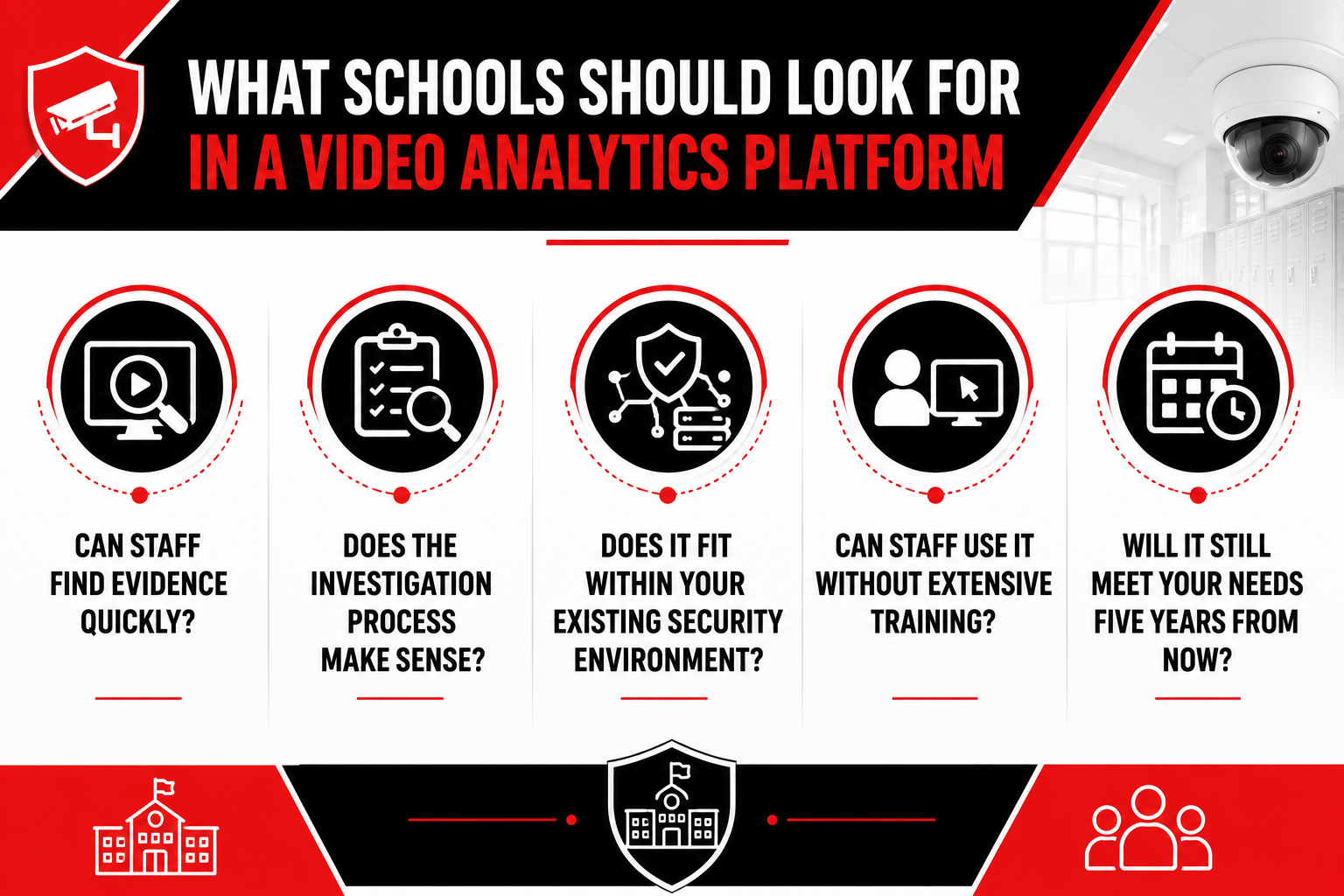
The first question is simple: how quickly can someone locate the footage they need? A platform should make it easy to search for people, events, and activities without requiring staff to manually review large amounts of video. Appearance search, event filtering, and intelligent search tools can all help reduce the amount of footage investigators need to review before finding relevant evidence.
Some systems provide advanced capabilities but require investigators to navigate multiple screens, workflows, and reporting tools. Schools should evaluate how easily staff can reconstruct timelines, track activity across multiple cameras, export evidence, and document findings. During an active investigation, simplicity often matters more than the number of available features.
Video surveillance rarely operates as a standalone system. Most schools already have networks, storage infrastructure, access control systems, visitor management processes, and other security technologies in place. A video analytics platform should fit within that environment rather than creating additional complexity.
Schools should assess how the platform integrates with existing security systems, operational workflows, and infrastructure requirements before making a purchasing decision. Through our Physical Security Services, Turn-Key Technologies helps schools evaluate how video surveillance, access control, and related technologies fit within broader security initiatives.
A platform may offer powerful investigative tools, but those tools provide little value if staff struggle to use them. Administrators, security personnel, and technology teams should be able to perform common investigative tasks without relying on specialized expertise. Search functions, evidence retrieval, and reporting workflows should be intuitive enough to support real-world investigations.
School security systems often remain in place for many years. Before selecting a platform, schools should consider future growth plans, additional camera deployments, campus expansion, and evolving security requirements. A system that works well today should also be capable of supporting future operational and investigative needs.
The goal is not to purchase the platform with the longest feature list. It is to select a system that helps staff find information efficiently, supports day-to-day operations, and continues to deliver value as school security requirements evolve.
Read Next: Physical Security Risk Assessment Checklist: What to Audit and Fix
When schools evaluate video surveillance systems, the conversation often focuses on camera counts, storage retention, image quality, and coverage areas. Those factors matter, but they only tell part of the story.
A more practical question is how well the system performs during an investigation. If administrators can quickly locate evidence, establish timelines, and verify what happened, the system is supporting school operations. If staff spend hours searching through footage to answer basic questions, additional cameras and longer storage periods may not solve the underlying problem.
For many schools, the most useful measure of a surveillance system is not how much video it records, but how efficiently it helps staff find the information they need.
Most schools already have cameras. The more important question is whether those cameras help administrators find the information they need when an incident occurs.
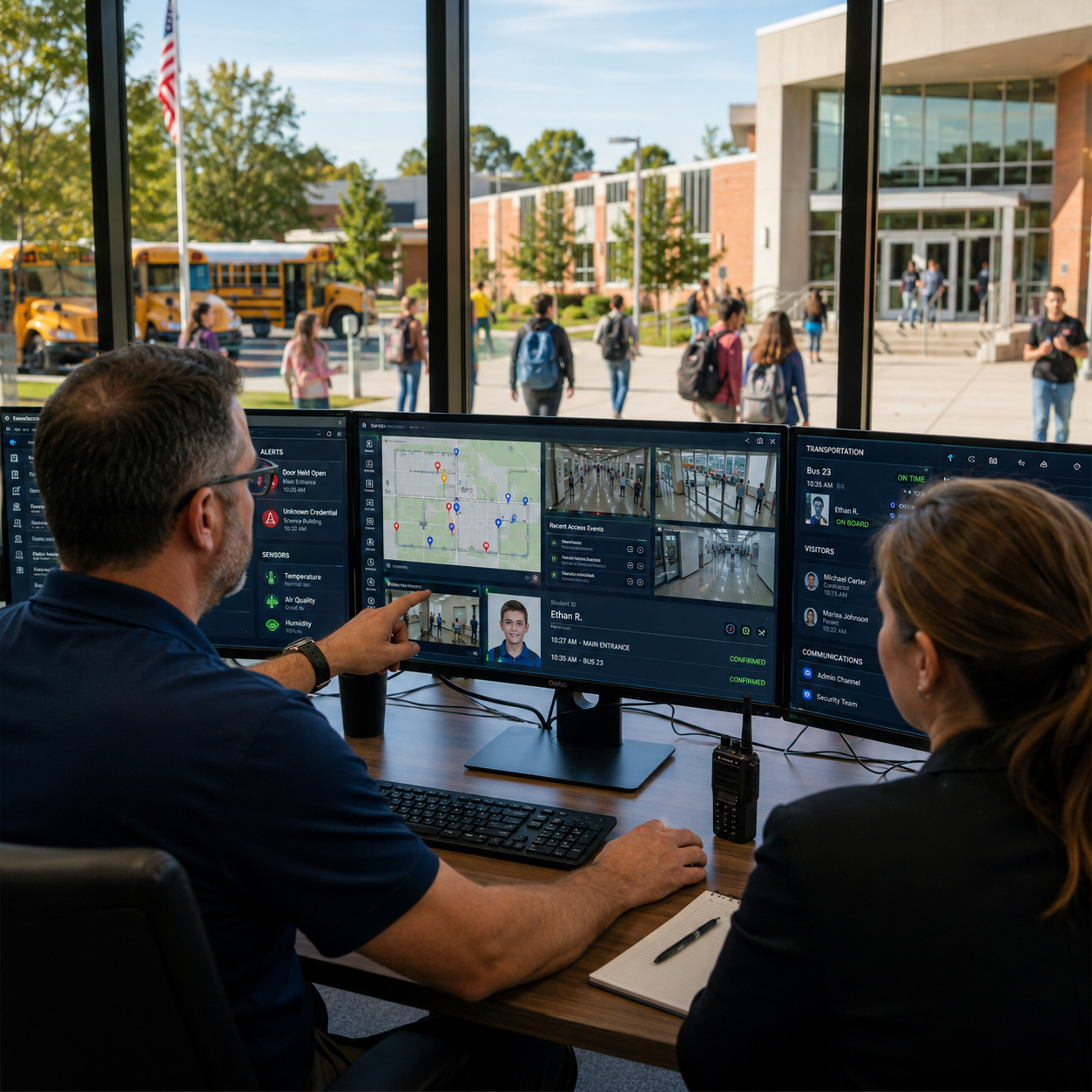
A video surveillance system becomes far more valuable when staff can quickly locate relevant footage, verify what happened, and communicate accurate information to parents, teachers, transportation teams, and security personnel. Investigation speed affects more than security operations. It affects how efficiently schools respond, document events, and support day-to-day decision-making.
Key Takeaways
More cameras do not automatically lead to better investigations.
Manual video review can consume significant staff time during routine incidents.
Appearance search and video analytics can help schools locate relevant footage more efficiently.
Faster investigations support better communication and documentation.
Schools should evaluate surveillance systems based on investigative effectiveness, not just camera counts or storage capacity.
Video surveillance works best when it is supported by the right security, network, and infrastructure foundation.
Review a recent investigation at your school. How long did it take the staff to locate the relevant footage, reconstruct the timeline, and answer the questions they were asked? The answer may reveal more about the effectiveness of your video surveillance system than camera count, image quality, or storage retention.
Turn-Key Technologies helps K-12 organizations design and support the infrastructure behind modern video surveillance systems, including Physical Security Solutions that help schools improve visibility, performance, and operational efficiency.
If your team spends more time searching for footage than reviewing it, it may be worth evaluating whether your current system supports the way investigations actually occur. Contact Turn-Key Technologies to discuss your video surveillance, physical security, and network infrastructure requirements.
Video surveillance can help schools investigate incidents, verify events, support campus security, and provide valuable evidence when questions arise. Modern video surveillance systems can also reduce the time required to locate footage and reconstruct timelines during investigations.
School security camera placement should be based on security objectives, traffic patterns, and operational needs. Common locations include entrances, hallways, parking lots, athletic facilities, common areas, and other high-traffic locations. Schools should evaluate camera placement as part of a broader school security strategy rather than treating cameras as standalone security measures.
The use of cameras in classrooms depends on district policies, operational goals, privacy considerations, and local requirements. Some schools use surveillance cameras in classrooms for specific security or monitoring purposes, while others focus coverage on common areas, entrances, and campus access points.
A school video surveillance policy should define where cameras are installed, how surveillance footage is stored, who can access recordings, retention requirements, investigation procedures, and how video evidence is used during incidents. Clear policies help schools maintain consistency and accountability.
Schools should look beyond camera counts and storage capacity. A useful evaluation considers how quickly staff can locate footage, verify events, support investigations, and communicate findings. The most effective school security camera systems help administrators find relevant information efficiently when incidents occur.
1 min read
Matt Hawthorne : Jun 11, 2026, 2:30:00 PM
A parent calls the school office in a panic. Their child never arrived home after school.
1 min read
 Tony Ridzyowski : Jun 18, 2026, 3:00:00 PM
How does a $95,000 surveillance project turn into a $250,000 problem?
.png)
1 min read
The School Violence Prevention Program (SVPP), managed by the COPS Office within the U.S. Department of Justice, functions to significantly improves...