


1 min read
The Hidden Cost of Treating Network Design and Structured Cabling as Separate Projects
Network design and structured cabling should be planned together because the decisions made during network design directly affect how the physical...
9 min read
Tony Ridzyowski leads the Inside Sales Team at Turn-key Technologies, Inc., where he also supports marketing, partner strategy, training, and CRM operations. Since joining TTI in 2014, Tony has earned top producer honors and President’s Club recognition. With a background in network cabling and experience working with Fortune 500 clients like Wells Fargo and Countrywide Home Loans, Tony brings decades of industry insight to every customer conversation.
Tony Ridzyowski
Updated on July 31, 2026
Structured cabling forms the foundation of every modern physical security system, providing the infrastructure that keeps surveillance cameras, access control, intrusion detection, and other connected security technologies operating as intended.
That foundation is becoming increasingly important as physical security technologies converge into unified platforms. According to the Genetec 2026 State of Physical Security Report, more than 70% of organizations now use unified or integrated physical security systems, while 60% say integrating new capabilities is the primary reason for replacing legacy technology. As cameras, access control devices, sensors, analytics, and management platforms share more data across a common network, the cabling infrastructure connecting them directly affects system reliability, power delivery, scalability, and long-term performance.
In this guide, you'll learn how structured cabling affects surveillance, access control, Power over Ethernet (PoE), system reliability, scalability, and long-term security performance. We'll also explain why organizations often achieve better outcomes by working with a provider that designs, installs, and supports both the physical security system and its underlying cabling infrastructure.
Before deploying or upgrading a physical security system, keep these six best practices in mind:
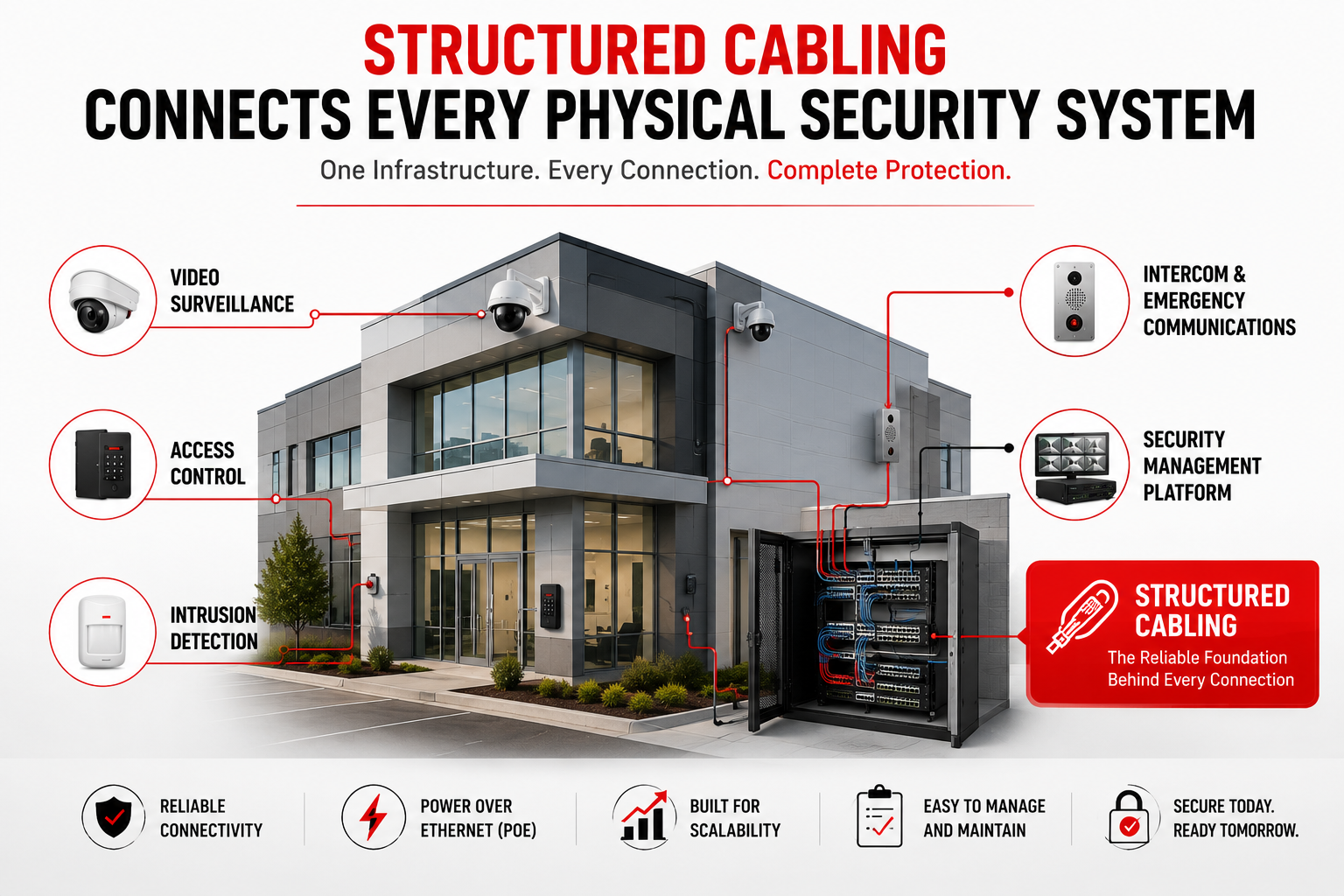
Every physical security system depends on the infrastructure connecting its devices. Surveillance cameras, access control systems, intrusion detection, intercoms, and management platforms all rely on structured cabling to transmit data, deliver power, and communicate across the network.

A properly designed Structured Cabling system gives these technologies a reliable foundation for consistent connectivity, power delivery, maintenance, and future expansion. It supports consistent connectivity, simplifies maintenance, and makes it easier to add new devices as security requirements change. Poorly planned cabling, on the other hand, can lead to intermittent connectivity, power limitations, and costly upgrades later.
Rather than treating cabling as a separate part of the project, it should be planned alongside the physical security system. Decisions about cable pathways, network closets, switch locations, and future capacity influence how well the entire system performs over its lifetime.
| Security System | Role of Structured Cabling |
|---|---|
| Video Surveillance | Connects IP cameras and delivers network connectivity and PoE. |
| Access Control | Links readers, controllers, and management software across the network. |
| Intrusion Detection | Connects sensors and alarm panels for reliable communication. |
| Intercom & Emergency Communications | Supports voice, video, and emergency notification devices. |
| Security Management Platform | Connects servers, storage, switches, and operator workstations. |
Read More: What Is Structured Cabling? Complete Guide for Business Networks
Modern IP cameras generate significantly more network traffic than earlier generations, especially when recording in high resolutions or using analytics such as facial recognition, object detection, or license plate recognition. While camera specifications often receive the most attention, the cabling infrastructure determines whether those features can operate reliably.
Poor cable quality, excessive cable lengths, improper terminations, or inadequate network capacity can lead to intermittent connectivity, dropped video streams, packet loss, or cameras that frequently disconnect from the network. These issues may appear sporadically, making them difficult to diagnose once the system is in operation.
Selecting the right cabling for the environment is equally important. Category 6 or Category 6A cabling is commonly used for IP surveillance networks, while fiber optic cabling is often the better choice for long-distance connections between buildings or remote security devices. Planning for bandwidth and future camera upgrades during the design phase helps reduce costly infrastructure changes later.
These infrastructure decisions should be coordinated with the design of the Video Surveillance system so camera resolution, recording requirements, analytics, network capacity, and power requirements are evaluated together.
Organizations upgrading an existing physical security system may not need to replace every cable run. Existing structured cabling can often support newer IP cameras and connected security devices, provided it has been properly installed and maintained. Before relying on legacy infrastructure, it's important to verify cable condition, available bandwidth, PoE capacity, pathway availability, and compliance with current performance requirements.
Choose cabling that supports current and future bandwidth requirements.
Keep cable runs within recommended distance limits to maintain signal integrity.
Use fiber optic cabling where copper distance limitations become a concern.
Test and certify every cable before cameras are commissioned.
Allow capacity for additional cameras and higher-resolution video as security needs evolve.
Read Next: The Role of Surveillance Cameras in Enhancing Physical Security
Power over Ethernet (PoE) allows a single Ethernet cable to deliver both data and electrical power to IP cameras, access control readers, intercoms, and other connected security devices. It simplifies installation and reduces the need for separate power circuits, making it a standard approach for many modern physical security systems.
Reliable PoE performance depends on more than the devices themselves. Cable type, cable length, switch capacity, and the total power required across the network all influence whether connected devices receive consistent power. As organizations deploy higher-resolution cameras, video intercoms, and other power-hungry devices, these considerations become even more important during the design phase.
Verifying PoE requirements before installation helps prevent problems that can be expensive to correct later. A structured cabling design that accounts for current power needs and future expansion gives organizations greater flexibility as their security systems evolve.
| Mistake | Potential Impact |
|---|---|
| Underestimating the total PoE power required | Cameras, readers, or intercoms may restart unexpectedly or fail to operate reliably. |
| Reusing existing network switches without verifying PoE capacity | Available power may be insufficient as additional devices are added. |
| Exceeding recommended cable distances | Voltage drop can affect device performance and long-term reliability. |
| Planning only for today's devices | Future camera upgrades or additional security devices may require costly switch or cabling upgrades. |
Access Control Systems rely on consistent communication between card readers, door controllers, electronic locks, and management software, making the condition and design of the supporting cabling an important part of system reliability. When the underlying cabling isn't properly designed or installed, organizations may experience communication failures, delayed authentication, or more time spent troubleshooting connectivity issues.
A structured cabling system provides a reliable foundation for these devices while making it easier to expand the system as facilities grow. Planning cable pathways, controller locations, and future capacity before installation also helps reduce costly modifications later.
As with any networked system, documentation matters. Clearly labeled cables and accurate records allow technicians to identify problems faster, complete maintenance more efficiently, and support future upgrades with minimal disruption.
Physical security requirements rarely stay the same. Organizations often expand camera coverage, add access-controlled doors, deploy new analytics, or integrate additional security technologies as facilities grow or operational needs change.
A structured cabling system designed with future expansion in mind makes these upgrades easier to implement. Planning for spare cable pathways, available switch capacity, backbone connectivity, and equipment room space allows new devices to be added without extensive rework or disruption to existing operations.
Building scalability into the initial design also helps reduce future project costs. Instead of replacing undersized infrastructure or installing temporary solutions, organizations can expand their physical security systems using an infrastructure that was designed to support long-term growth.
Read More: Structured Cabling Expansion Planning for Future Growth
Installing structured cabling is only part of the process. Before surveillance cameras, access control devices, and other security technologies are commissioned, the cabling infrastructure should be tested and certified to verify that it performs as designed.
Testing can identify issues such as damaged cables, improper terminations, wiring errors, or excessive signal loss before they affect system operation. Correcting these problems during installation is typically faster and less expensive than diagnosing intermittent faults after the security system is in service.
Certification also provides documented proof that the cabling meets recognized performance standards. These test results establish a baseline that can simplify troubleshooting, support warranty requirements, and provide valuable documentation for future system expansions or infrastructure upgrades.
| Without Testing | With Testing & Certification |
|---|---|
| Hidden installation issues may not appear until the system is operational. | Installation issues are identified and corrected before devices are commissioned. |
| Troubleshooting often requires additional site visits and investigative work. | Certified test results provide a documented baseline for future troubleshooting. |
| Future upgrades may require additional verification of the existing infrastructure. | Organizations have confidence that the cabling can support future expansion. |
| Warranty or compliance documentation may be incomplete. | Test reports provide documentation that supports project closeout and long-term maintenance. |
Read Next: Structured Cabling Performance Testing: A Guide for IT Leaders
Project documentation often receives the most attention during installation, but it's used far more often after the security system is operational. As cameras are added, access control points are expanded, equipment is replaced, or network upgrades are performed, technicians rely on accurate records to understand how the infrastructure was originally built.
For example, replacing a failed network switch that supports dozens of IP cameras is relatively straightforward when cable labels, patching records, and as-built drawings are current. Without that information, technicians may need to trace cable runs, identify connected devices, and verify network paths before the replacement can even begin. What should be a routine maintenance task can quickly take longer than expected.
Keeping documentation up to date throughout the life of the system helps reduce troubleshooting time, simplifies future expansion projects, and gives internal teams or service providers a reliable reference whenever changes are required.
Physical security systems perform best when the supporting infrastructure is planned alongside the devices they connect. Separating structured cabling from the security installation can create coordination challenges, particularly when cable pathways, equipment locations, network infrastructure, and device placement are managed by different contractors.
Turn-Key Technologies delivers both structured cabling and Physical Security Solutions as part of a coordinated deployment. By designing and installing the underlying infrastructure alongside surveillance cameras, access control systems, and other connected security technologies, our team helps reduce project complexity and provides a consistent approach from planning through installation and testing.
This integrated approach also supports future expansion. As security requirements change, organizations have a partner that understands both the physical security system and the infrastructure supporting it, making upgrades, troubleshooting, and ongoing maintenance more efficient.
Read Next: What No One Tells You About Unified Physical Security for Modern Facilities
A physical security system is expected to perform reliably for years, even as facilities expand, technologies evolve, and operational requirements change. Achieving that level of performance depends on more than selecting the right cameras or access control platform. The underlying cabling infrastructure plays a significant role in how easily the system can be maintained, expanded, and upgraded over time.
Before starting a new installation or expanding an existing deployment, it's worth evaluating whether the supporting infrastructure is ready for what's ahead. Reviewing cable pathways, network capacity, power requirements, equipment locations, and documentation during the planning stage can help prevent design compromises that are far more difficult to correct after installation.
Turn-Key Technologies designs and installs both Structured Cabling and Physical Security Systems, giving organizations a single partner responsible for the infrastructure as well as the technologies that depend on it. From project planning and installation to testing, documentation, and ongoing support, our team helps deliver integrated solutions that are built for long-term reliability and future growth.
Planning a physical security project? Contact Turn-Key Technologies to discuss your structured cabling and physical security requirements.
Structured cabling doesn't replace cybersecurity tools, but it provides the physical foundation they rely on. A properly organized and documented cabling infrastructure makes it easier to identify unauthorized connections, verify network changes, and maintain consistent security controls across the physical network. Combined with sound cybersecurity practices, secure cabling helps organizations strengthen their overall security posture and reduce the risk of unauthorized access to connected security devices.
The appropriate cabling standards depend on the devices being installed, network performance requirements, and the building environment. Most modern physical security systems use structured low-voltage cabling that follows recognized industry standards for copper or fiber installations. Following established cabling standards supports reliable data transmission, simplifies maintenance, and provides a consistent foundation for future expansion.
It depends on the condition and design of the existing infrastructure. Many organizations can reuse portions of their physical cabling, while others may need upgrades to support higher-bandwidth security cameras, Power over Ethernet (PoE), biometric readers, or additional access points. Assessing the cabling before installation helps determine whether the existing infrastructure can support modern security technologies without compromising system performance.
A properly designed cabling plan makes it easier to add security cameras, physical access control devices, sensors, and IoT devices as operational requirements change. Maintaining organized cabling, available pathway capacity, and documented cabling also simplifies future upgrades, allowing new technologies to integrate seamlessly without extensive rework. This approach creates a more scalable infrastructure that can support evolving security needs over time.
Yes. Many physical security platforms rely on servers, storage systems, and network equipment located in server rooms or a data center environment. Reliable data center cabling supports communication between security devices, security management software, storage platforms, and live video feeds. Organizations implementing integrated physical security solutions should consider both the field cabling and the infrastructure supporting these critical systems to help ensure reliable operation and long-term performance.
Project documentation becomes increasingly valuable after installation. As cameras are relocated, access control points are added, or network equipment is replaced, technicians rely on cable labels, as-built drawings, and test reports to understand how the infrastructure was originally deployed. Without accurate documentation, even routine maintenance can require additional time to trace cable runs or verify network connections before work can begin. Keeping these records current helps simplify troubleshooting, supports future upgrades, and reduces disruption when changes are required.
1 min read
Network design and structured cabling should be planned together because the decisions made during network design directly affect how the physical...
1 min read
Designing data center cabling for a Northeast facility starts with the physical layout. Planning the fiber and copper architecture, pathway capacity,...
1 min read
Networks scale fast, and cabling choices shape reliability, speed, and future costs. This guide explains the essentials, including the components,...