




Skip to the main content.

12 min read

Structured Cabling Project Documentation: What Your Provider Should Deliver

Written by August 26, 2026
Picture of Tony Ridzyowski
Tony Ridzyowski

Tony Ridzyowski leads the Inside Sales Team at Turn-key Technologies, Inc., where he also supports marketing, partner strategy, training, and CRM operations. Since joining TTI in 2014, Tony has earned top producer honors and President’s Club recognition. With a background in network cabling and experience working with Fortune 500 clients like Wells Fargo and Countrywide Home Loans, Tony brings decades of industry insight to every customer conversation.

Structured Cabling Project Documentation: What Your Provider Should Deliver

A structured cabling provider should deliver a closeout package that shows what was installed, where each connection terminates, and how the cabling performed. That package should include cable and port labels, certification test results, rack elevations, port maps, pathway records, and accurate as-built documentation.

Those records become essential when the network changes. Switch replacements, workstation moves, port reassignments, and new equipment are easier to manage when the physical records are accurate. Without them, technicians may have to trace cable runs manually through racks, ceilings, and telecommunications rooms, especially in older or multi-site facilities where years of changes have accumulated.

Current industry guidance supports that level of documentation. BICSI’s 2025 ICT Cabling Installation Handbook includes field documentation, labeling, and copper cable testing among the expected competencies for Installer 2, Copper professionals. TIA also advanced work in 2025 on TIA-606-E, the Administration Standard for Telecommunications Infrastructure, while moving to reaffirm ANSI/TIA-1152-A field-testing requirements. Together, these practices give IT and facilities teams a reliable baseline for troubleshooting, moves and changes, managed support, and future upgrades.

💡 TL;DR: What Should Your Structured Cabling Provider Deliver?

  • Consistent cable and port labels: Every outlet, patch-panel port, rack, and telecommunications room should use identifiers that match the project records.

  • Certification test results: Copper and fiber links should have applicable test results tied to the same cable IDs used in the field.

  • Accurate rack elevations and port maps: Final records should show where patch panels, network equipment, and individual connections were actually installed.

  • Pathway and backbone records: Documentation should identify major cable routes, risers, conduits, trays, and backbone connections so future work can be planned without rediscovering the infrastructure.

  • As-built documentation: Final drawings should reflect field changes made during installation rather than simply repeating the original design.

  • An organized closeout package: IT and facilities teams should receive accessible digital records they can use for troubleshooting, moves and changes, audits, managed support, and future upgrades.

  • A process for keeping records current: Documentation loses value when later cabling, port, rack, or pathway changes are never recorded.


What is Structured Cabling Project Documentation?

Structured cabling project documentation is the final record of how the cabling system was installed. It should show where cables terminate, how ports and pathways are identified, what is installed in each rack, and whether copper and fiber links passed the required testing.

For IT and facilities teams, those records provide a reliable way to trace the physical network. A technician should be able to start with an outlet, cable label, or patch-panel port and determine where that connection leads without manually tracing the entire cable run.

The documentation also needs to reflect the finished installation. Cable routes, rack locations, and port assignments often change during construction because of field conditions or coordination with other trades. Those changes should appear in the final records rather than leaving the customer with drawings that only show the original design.

Project Documentation vs. Installer Notes

Installer notes are working records used during construction. They may capture temporary cable numbers, field changes, testing issues, or corrections that still need to be made.

A closeout package should turn that information into a usable set of final records, such as cable and port labels, certification test results, rack elevations, port maps, pathway records, and as-built drawings. Consistency matters across those records. If a cable uses one identifier at the outlet, another on the patch panel, and a third in the test report, technicians still have to investigate which record is correct.

Documentation Should Work for the Team That Inherits the Network

The person using these records later may not have been involved in the original structured cabling installation. It could be an internal network engineer, facilities technician, managed service provider, or another cabling contractor brought in for an upgrade.

They should be able to use the documentation to answer basic operational questions: where a connection terminates, which fiber link serves a telecommunications room, whether a link was certified, and what infrastructure is available for future work.

That becomes increasingly important as a facility ages. Complete records give future teams a dependable starting point for troubleshooting and expansion. Incomplete records force them to reconstruct parts of the cabling system each time something changes.

What Structured Cabling Documentation Should Your Provider Deliver?

A structured cabling closeout package should give your team a clear record of the installed system. It should make it easy to trace connections, verify cabling performance, understand rack and pathway layouts, and see what changed during installation.

1. Cable and Port Labels

Every cable, outlet, patch-panel port, rack, and telecommunications room should use a consistent identification scheme. Those same identifiers should also appear in the test reports, port maps, and drawings delivered at project closeout.

The practical test is whether a technician can start at an outlet or patch-panel port and trace that connection through the documentation without having to confirm labels manually in the field. Consistent labeling also reduces errors during moves, adds, and changes, especially in larger facilities where hundreds or thousands of cable runs may terminate across multiple telecommunications rooms.

2. Certification Test Results

Applicable copper and fiber links should have test results tied to the same cable IDs used in the field. Those records show whether the installed cabling met the required performance criteria when the project was completed.

The test results also provide a useful troubleshooting baseline. If a link begins showing intermittent errors, poor throughput, or connectivity problems later, the team can compare current conditions against the original certification results. That can help narrow the issue to the cabling, a connector, patching, or another network component instead of troubleshooting without a baseline.

Read More: Structured Cabling Performance Testing: A Practical Guide

3. Rack Elevations and Port Maps

Rack elevations should reflect the final placement of patch panels, switches, fiber enclosures, cable management, and other installed equipment. Port maps should show how work-area outlets and other endpoints correspond to patch-panel positions and network ports.

These records become especially useful during switch replacements, rack reorganizations, port activations, and equipment upgrades. They also help teams understand available rack space and port capacity before new hardware is ordered or additional cabling is installed.

Read More: Structured Cabling Patch Panel Setup Guide for Your Network

4. Pathway and Backbone Records

The documentation should identify the major routes used for horizontal cabling, backbone cabling, and fiber between telecommunications rooms, floors, or buildings. Depending on the project, that may include cable trays, risers, conduits, sleeves, and inter-building pathways.

Accurate pathway records reduce the amount of investigation required before future work begins. A team planning new access points, additional work areas, or a fiber expansion can see which routes already exist and where capacity may be limited before contractors begin opening ceilings or tracing pathways on site.

Read More: Cabling Pathways and Routing Design Best Practices

5. As-Built Drawings

As-built drawings should reflect the finished installation rather than the original design alone. If a cable route was changed, a rack was relocated, or a telecommunications room layout was revised during construction, those changes should appear in the final drawings.

This matters because field conditions often require adjustments during a structured cabling installation. A drawing that was accurate during design can become unreliable for operations if those changes are never documented. The as-built set should give future teams a dependable picture of the infrastructure that is actually in service.

6. Final Digital Closeout Package

The final documentation should be delivered in an organized digital package that IT, facilities, and future contractors can access. Test reports, rack elevations, port maps, pathway drawings, and as-built records should follow the same naming conventions so the information can be cross-referenced quickly.

The goal is straightforward: someone who was not involved in the original structured cabling project should be able to open the closeout package, identify the infrastructure they are working on, and understand how it connects to the rest of the cabling system.

How Good Cabling Documentation Improves Day-to-Day IT Operations

Structured cabling documentation proves its value after installation, when the network starts changing. Accurate records give IT and facilities teams a dependable reference for troubleshooting, moves, support work, audits, and future upgrades.

Operational Need How Documentation Helps What Happens Without It
Incident Response Labels, port maps, and test results help technicians isolate whether a problem is tied to the endpoint, patch panel, switch port, or cable path More time is spent tracing connections and verifying basic infrastructure before troubleshooting can move forward
Moves, Adds, and Changes Current records show available ports, cable terminations, and existing pathways that can be reused Port maps and physical patching drift apart, making each future change harder to complete cleanly
Managed Support Rack elevations, cable IDs, and pathway records give remote and onsite support teams context before they begin work Support teams depend more heavily on site-specific knowledge or manual discovery
Audits and Facility Reviews Test reports, as-builts, and pathway records provide evidence of what was installed and how it was documented Teams may need to recreate records or perform additional field verification
Network Refreshes Accurate records show rack capacity, existing cabling, backbone routes, and available pathways before new equipment is deployed Planning starts with uncertainty, which can lead to added site surveys, rework, or unexpected installation scope
Multi-Site Operations Consistent documentation gives teams a common way to understand racks, rooms, ports, and backbone connections across locations Each facility develops its own naming and recordkeeping habits, making centralized support more difficult

For organizations that rely on outside operational support, Turn-Key Technologies’ Managed Services provide ongoing troubleshooting, lifecycle guidance, and infrastructure support. Current cabling records give those teams a clearer starting point for diagnosing issues or planning changes.

Faster Troubleshooting Starts With Better Records

When a user loses connectivity or a device drops off the network, the first few minutes often determine how quickly the issue is resolved. If the technician can confirm the outlet, patch-panel port, switch connection, and original test result from the documentation, the search area becomes much smaller.

If those records are missing or inaccurate, the team may need to physically trace the cable before they can even confirm where the connection terminates.

Read Next: How to Troubleshoot Structured Cabling & Connectivity Issues

Documentation Also Reduces Rework

The same principle applies to upgrades and moves. A project team planning a switch replacement, additional access points, new fiber, or a floor renovation can use current records to see what infrastructure already exists and what can be reused. When that work is part of a broader network refresh, Turn-Key Technologies’ Wired Networks Services can help teams coordinate network design, switching, existing connections, and physical infrastructure before deployment begins.

That reduces the amount of rediscovery required before work begins and makes it easier to identify where new cabling, pathway capacity, or rack space will actually be needed.

Over time, one of the biggest operational advantages of strong project documentation is that future work starts from a known environment instead of requiring teams to rebuild their understanding of the cabling system after every change.

Where Documentation Problems Become Expensive

Documentation gaps usually become costly during troubleshooting, upgrades, or renovations, when teams have to verify the cabling before they can move forward.

BICSI has specifically identified unclear labeling, incomplete documentation, and inconsistent testing records as installation issues that can lead to longer troubleshooting, project delays, coordination problems, and rework. In practice, that can mean tracing active and abandoned runs, confirming which ports are still in service, or rechecking pathways before a technician can safely make a change.

The problem is especially common in older facilities and multi-site environments, where years of moves, additions, and contractor work can leave records out of sync with the physical cabling. Renovations create similar gaps when routes, rack layouts, or outlet locations change in the field but never make it into the as-built documentation.

When technicians regularly have to validate the records before they can trust them, routine network work takes longer, and future projects start with unnecessary discovery work.

Not Sure Your Cabling Records Match What’s Actually Installed?


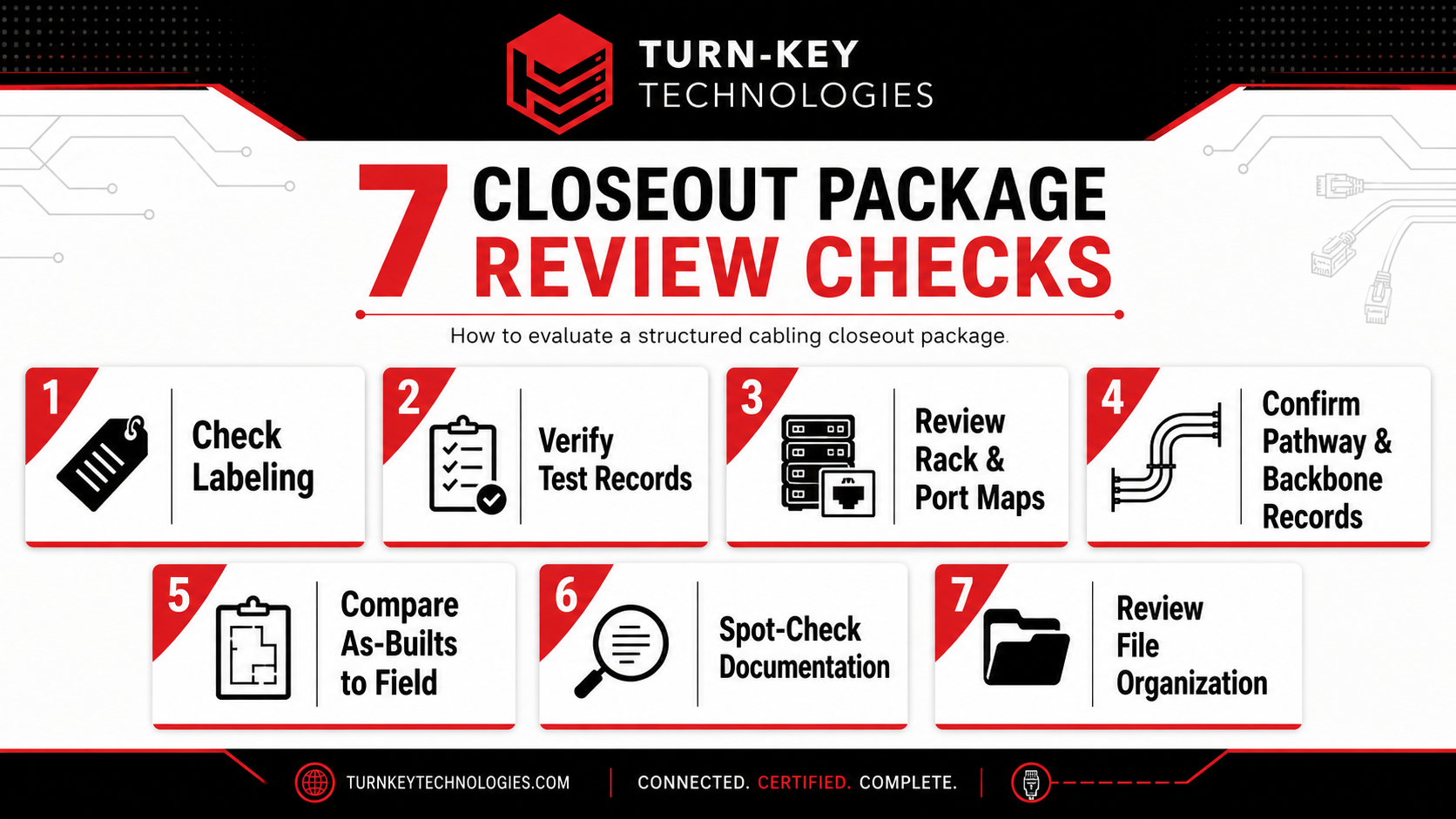
How to Evaluate a Structured Cabling Closeout Package

A closeout package should be reviewed before the project is considered complete. The goal is to confirm that the records are accurate, consistent, and usable by someone who was not involved in the installation. This review is especially important because documentation errors are much easier to correct while the contractor is still engaged and the installation details are still fresh.

The review does not need to become a second project. A focused check of labeling, test records, drawings, port maps, and a small sample of physical connections can reveal whether the package is dependable enough for long-term use.

  1. Check the labeling: Cable, outlet, patch-panel, rack, and telecommunications room identifiers should match across the physical installation, drawings, and test records. Inconsistent naming is one of the fastest ways to make otherwise good documentation unreliable.

  2. Verify the certification records: Applicable copper and fiber test results should be complete and tied to the correct cable IDs. If results are missing or difficult to match to installed links, the documentation is not ready for handoff.

  3. Review rack elevations and port maps: Confirm that patch panels, switches, fiber enclosures, and port assignments reflect the final installed environment rather than the original design.

  4. Confirm pathway and backbone records: Major cable routes, risers, conduits, and backbone connections should be documented where required. Future teams should not have to rediscover those paths during an upgrade or renovation.

  5. Compare as-built drawings against the field: Any changes made during installation should appear in the final drawings. If the as-builts still match the preconstruction plans exactly despite known field changes, they deserve a closer review.

  6. Spot-check the documentation: Select a few outlets, patch-panel ports, backbone links, and rack locations and confirm that the records lead to the correct physical connection. If several samples cannot be traced reliably, the rest of the package may need additional validation.

  7. Review how the files are organized: Drawings, test reports, port maps, and supporting records should use consistent naming and be easy to locate. A technically complete closeout package still creates problems if the information is scattered or difficult to retrieve.

A strong handoff should give IT and facilities teams confidence that the documentation reflects the network they are actually inheriting. When the records are complete, consistent, and easy to navigate, they become a practical operating resource rather than something that only gets opened during an audit or major project.

That makes future troubleshooting, support work, and infrastructure changes easier to plan. It also gives the organization a reliable baseline that can be updated as the cabling system evolves.

Maintaining Accurate Cabling Records Over Time

Project closeout establishes the baseline, but the records only stay useful if they are updated as the network changes. Switch replacements, port reassignments, new cabling, rack changes, fiber additions, and renovations can all make accurate documentation outdated surprisingly quickly.

The easiest way to prevent that drift is to tie documentation updates directly to the infrastructure changes being made.

Change or Trigger Documentation to Review Why It Matters
New Cable Installation

Cable labels, port maps, test results, pathway records

Keeps new connections traceable and adds their certification records to the existing system

Port Reassignment or Workstation Move Port maps, outlet records, patching information Prevents documented port assignments from falling behind active connections
Switch or Patch-Panel Replacement Rack elevations, port maps, equipment records Confirms that rack layouts and port relationships still reflect the installed environment
Fiber or Backbone Expansion Backbone records, pathway drawings, test results Documents new routes and terminations between telecommunications rooms, floors, or buildings
Rack or Telecommunications Room Changes Rack elevations, room records, as-built drawings Keeps equipment locations and physical layouts accurate
Renovation or Construction Work Pathway records, outlet locations, as-builts Captures field changes that may affect future cabling work
Major Network Refresh Full documentation set Provides a natural opportunity to identify outdated records and reconcile them with the current environment

Responsibility for maintaining the documentation should also be assigned after the cabling contractor leaves. That responsibility may sit with IT operations, facilities, a managed service provider, or another infrastructure team, but it should be clear who updates the records and where the current versions are stored.

Consistent naming matters just as much as regular updates. New cables, racks, rooms, and ports should follow the same labeling conventions already in use, particularly across multi-site environments.

The objective is to keep the documentation aligned with the physical network so technicians can trust it when they need it. As undocumented changes accumulate, the organization may eventually need to rebuild that record through tracing, testing, and field verification.

Read Next: Structured Cabling Expansion Guide

Structured Cabling Documentation Checklist

The records delivered at project closeout should be reviewed against the completed structured cabling installation. Use the checklist below to confirm that management and labeling, testing and documentation, and planning for current and future network needs are all addressed before the project is considered complete.

The checklist provides a practical way to verify that future teams can understand and support the installed structured cabling system after the installation team leaves. Any gaps identified during the review should be corrected while project details are still accessible, particularly when cable identifiers, certification records, as-built drawings, or pathway information do not match the physical environment.

For organizations managing older facilities or multiple locations, the same checklist can also be used during infrastructure reviews to identify records that need to be updated before troubleshooting, renovations, or future network upgrades begin.

Read Next: Structured Cabling Installation Guide: Process, Best Practices + Expert Checklist

Better Documentation Makes Cabling Easier to Manage

A structured cabling project should leave IT and facilities teams with a reliable record of the infrastructure they are taking over. Accurate labeling, certification test results, port maps, rack elevations, pathway records, and as-built documentation make it easier to troubleshoot connectivity problems, manage changes, and plan future network upgrades without repeatedly rediscovering the physical environment.

That record becomes more valuable as the structured cabling system changes. Renovations, new equipment, additional fiber optic connections, and port reassignments can gradually make the original documentation inaccurate. Keeping those records current gives future technicians a dependable starting point and helps organizations make better use of the cabling infrastructure already in place.

For organizations managing older buildings, expanding facilities, or multiple locations across New York, New Jersey, and Pennsylvania, Turn-Key Technologies’ Structured Cabling Services support projects from planning and installation through labeling, testing, certification, and documentation. A documentation review can help identify gaps before the next network upgrade, renovation, or expansion begins.

Build Better Documentation Into Your Next Cabling Project


Frequently Asked Questions

What documentation should a structured cabling contractor provide after installation?

A structured cabling contractor should provide records that show how the completed system was installed, tested, and labeled. That typically includes cable and port identification, certification test results, rack elevations, port maps, pathway and backbone cabling records, and final as-built drawings. The documentation should use consistent identifiers so IT and facilities teams can trace connections throughout the structured cabling system without relying on the original installer.

How should horizontal cabling and backbone cabling be documented?

Horizontal cabling records should identify connections between individual work-area outlets and the appropriate telecommunications room, while backbone cabling documentation should show the major copper or fiber optic connections between telecommunications rooms, floors, or buildings. Both should use consistent labeling and correspond with pathway records, port maps, and test results so technicians can understand the overall cabling layout.

Do structured cabling installations need to follow industry standards for documentation?

Structured cabling installations should follow the applicable industry standards, project specifications, and organizational requirements for administration, labeling, testing, and documentation. Standards can provide a consistent framework, but the final closeout package still needs to reflect the actual installed environment. Documentation also should not be treated as proof of regulatory compliance by itself; specific compliance requirements depend on the facility, industry, and project scope.

How does cabling documentation support current and future network needs?

Accurate documentation helps teams understand existing network infrastructure before adding new equipment, expanding connectivity, or adopting new technologies. Records showing available rack space, port capacity, cable routes, and fiber or backbone connections can reveal where infrastructure can be reused and where additional capacity may be required. This makes future cabling and capacity planning more predictable and reduces unnecessary disruption during network upgrades.

What should organizations require when planning structured cabling for a new commercial facility?

For a new commercial structured cabling project, documentation requirements should be established before installation begins. The project scope should define management and labeling conventions, testing requirements, rack and telecommunications room records, cable routes, as-built drawings, and the final digital closeout package. Setting those expectations early gives the cabling contractor a clear standard for project handoff and helps ensure the installed structured cabling system can support ongoing business operations and future technology needs.

The Hidden Cost of Treating Network Design and Structured Cabling as Separate Projects

1 min read

The Hidden Cost of Treating Network Design and Structured Cabling as Separate Projects

Network design and structured cabling should be planned together because the decisions made during network design directly affect how the physical...

Read More
Data Center Cabling Design: What Northeast Facilities Should Get Right Before Installation

1 min read

Data Center Cabling Design: What Northeast Facilities Should Get Right Before Installation

Designing data center cabling for a Northeast facility starts with the physical layout. Planning the fiber and copper architecture, pathway capacity,...

Read More
What Is Structured Cabling? Complete Guide for Business Networks

1 min read

What Is Structured Cabling? Complete Guide for Business Networks

Networks scale fast, and cabling choices shape reliability, speed, and future costs. This guide explains the essentials, including the components,...

Read More