

Best for
Banks, credit unions, branch offices, corporate financial facilities, operations centers, administrative offices, and multi-location financial organizations.
Turn-key Technologies designs and installs structured cabling infrastructure for banks, credit unions, and financial institutions across New Jersey. From fiber backbones and copper cabling to telecommunications rooms, pathways, testing, labeling, and documentation, we help organizations build infrastructure that supports network connectivity, wireless, physical security, branch technology, and future expansion.
A financial institution structured cabling solution is the organized fiber and copper infrastructure connecting branch offices, corporate locations, network equipment, wireless access points, surveillance cameras, access-control devices, workstations, and other connected systems. Proper planning creates infrastructure that is easier to manage, troubleshoot, document, and expand across individual facilities or multiple locations.
Banks, credit unions, branch offices, corporate financial facilities, operations centers, administrative offices, and multi-location financial organizations.
Create reliable, organized, and scalable connectivity for business, security, and operational technology.
Fiber and copper cabling, backbone and horizontal connectivity, telecommunications rooms, pathways, racks, patch panels, labeling, testing, certification, and documentation.
Banks and credit unions depend on connectivity across workstations, wireless networks, surveillance systems, controlled-access areas, administrative spaces, and branch technology. When infrastructure has evolved through years of separate upgrades, inconsistent cabling and documentation can make troubleshooting, expansion, and system modernization more difficult.
Limited Room for Growth
Existing racks, patch panels, pathways, and backbone connections may leave insufficient capacity for additional devices, new applications, or future branch upgrades.
Inconsistent Cabling
Cabling installed during different technology projects may use inconsistent routing, termination, labeling, or documentation standards.
Difficult Troubleshooting
Poor labeling and incomplete documentation can make it harder for IT teams to identify connections and isolate physical-layer issues.
Different Standards Between Locations
Branches acquired, renovated, or upgraded at different times may have substantially different cabling layouts, telecommunications spaces, and documentation practices.
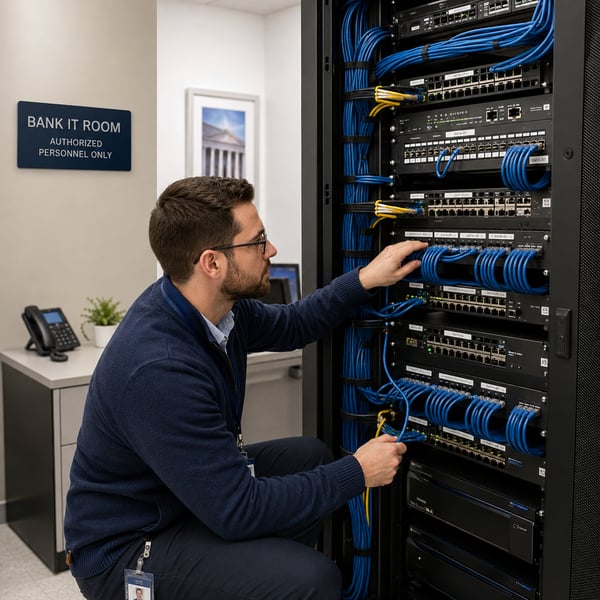
The cabling environment should support more than basic office connectivity. Fiber, copper, telecommunications rooms, pathways, testing standards, and documentation should work together to support business systems, wireless connectivity, physical security, and future technology changes.
Connect network distribution points, telecommunications rooms, buildings, and critical infrastructure with fiber designed around bandwidth, distance, and future requirements.
Provide organized connections for workstations, wireless access points, cameras, access-control devices, phones, and other network endpoints.
Plan racks, patch panels, cable management, equipment locations, and available capacity so network spaces remain organized and serviceable.
Design trays, conduits, sleeves, and cable routes that keep infrastructure accessible while supporting future additions.
Test installed fiber and copper cabling before turnover to verify performance and establish a documented infrastructure baseline.
Create consistent cable identifiers, port records, rack information, pathway documentation, certification results, and as-built records.
Well-planned structured cabling gives financial organizations a more consistent physical foundation for technology upgrades, troubleshooting, branch renovations, security projects, and long-term growth.
Reserve backbone, pathway, rack, and patch-panel capacity so future networking, wireless, and security projects require less infrastructure redesign.
Clear labeling and accurate documentation help technicians identify connections and investigate physical infrastructure issues more efficiently.
Align structured cabling with networking, wireless, physical security, facilities, and construction requirements before installation begins.
Create repeatable cabling, labeling, testing, rack, and documentation practices across branches and corporate locations.
Each phase moves the project from existing infrastructure and business requirements
toward an installed, tested, documented, and easier-to-manage cabling environment.
01
Review fiber and copper cabling, telecommunications rooms, pathways, rack capacity, connected systems, documentation, known issues, and anticipated expansion.
02
Plan backbone and horizontal cabling, network spaces, pathways, media selection, labeling standards, equipment connectivity, and future capacity.
03
Install, terminate, organize, test, certify, and validate the approved structured cabling infrastructure.
04
Deliver updated labeling, certification results, cable schedules, rack information, and as-built documentation to support maintenance and future changes.
Turn-key Technologies combines structured cabling with wired networking and physical security expertise. This allows cabling to be coordinated around wireless access points, cameras, access-control devices, switches, workstations, and other technologies rather than installed as an isolated component.
Highly certified
engineers*
Support options
available*
Core regional service
area
Best-of-breed
technology approach
“Turn-key Technologies helped us standardize cabling across several locations that had been upgraded at different times. The cleaner labeling and documentation made an immediate difference for our IT team, and we now have a much better foundation for future branch technology projects.”
Daniel Mercer
VP of Information Technology
Coordinate network spaces, backbone connectivity, workstations, wireless access points, security devices, pathways, and future capacity before construction is complete.
Modernize cabling while accounting for existing infrastructure, occupied areas, construction phasing, and changing technology requirements.
Verify that current fiber, copper, equipment spaces, and pathways can support updated switching, wireless access points, and connectivity requirements.
Create repeatable cabling, rack, labeling, testing, and documentation standards across multiple financial locations.
A structured cabling project may include fiber backbone cabling, copper horizontal cabling, telecommunications rooms, racks, patch panels, cable pathways, workstation and device connections, labeling, testing, certification, and as-built documentation.
Yes. Properly designed network cabling can support IP cameras, access-control devices, wireless access points, monitoring systems, and other network-connected technology. Requirements should be planned around device location, bandwidth, power, distance, and future expansion.
Yes. Organizations can establish repeatable standards for cable types, labeling, racks, patch panels, network spaces, documentation, and testing. Standardization can make infrastructure easier to understand and support across different locations.
Not automatically. Existing infrastructure should be assessed for condition, performance, capacity, compatibility, labeling, documentation, and pathway availability before determining what can remain and what should be replaced.
Testing verifies that newly installed cabling performs as intended before it is placed into service. Certification results also establish a documented performance baseline for future troubleshooting and maintenance.
Documentation may include cable schedules, certification reports, rack information, port records, labeling records, pathway information, and updated as-built documentation.
Whether you are opening a new branch, renovating an existing location, upgrading network connectivity, expanding physical security, or standardizing infrastructure across multiple sites, Turn-key Technologies can help build a structured cabling environment designed for today’s systems and tomorrow’s requirements.
.png?width=1920&height=1080&name=TTI%20Web%20background%20(2).png)
Tony Ridzyowski:
Tony Ridzyowski:
Tony Ridzyowski: