




11 min read
How to Choose a Network Cabling Contractor for Projects Across New York, New Jersey, and Pennsylvania
Tony Ridzyowski leads the Inside Sales Team at Turn-key Technologies, Inc., where he also supports marketing, partner strategy, training, and CRM operations. Since joining TTI in 2014, Tony has earned top producer honors and President’s Club recognition. With a background in network cabling and experience working with Fortune 500 clients like Wells Fargo and Countrywide Home Loans, Tony brings decades of industry insight to every customer conversation.
Tony Ridzyowski
Updated on August 14, 2026
Choosing the right network cabling contractor starts with proven experience, design and planning capability, testing and certification practices, documentation standards, project management, and post-installation support. For projects across New York, New Jersey, and Pennsylvania, also consider technician coverage, multi-site scheduling, and consistent installation standards.
These factors affect network reliability and how easily the cabling can be supported after installation. Poor design handoffs, inconsistent terminations, incomplete testing, or weak documentation can lead to rework and longer troubleshooting when switches, wireless access points, cameras, access control systems, or other connected devices are brought online.
BICSI highlighted this risk in 2026, noting that telecommunications infrastructure can fall short of its intended performance because of field issues such as overcrowded pathways, improper bend radius, inconsistent terminations, and incomplete test records. This guide explains how to compare network cabling contractors before awarding work across the region.
💡 TL;DR: What to Look for When Choosing a Network Cabling Contractor
-
Evaluate contractor fit across experience, planning, testing, documentation, project management, and support before comparing price.
-
Confirm the contractor can handle both copper and fiber optic cabling and understands the network infrastructure those systems support.
-
Require clear testing and certification standards, along with complete test results and consistent labeling at project closeout.
-
For projects across New York, New Jersey, and Pennsylvania, evaluate technician coverage, dispatch processes, multi-site scheduling, and consistency between locations.
-
Compare proposals carefully. A lower bid may exclude testing, documentation, project coordination, warranty support, or other work that later becomes an added cost.
-
When networking and cabling scopes are closely connected, an integrated network and cabling provider can reduce handoffs and simplify troubleshooting.
How to Choose the Right Network Cabling Contractor for Your Project
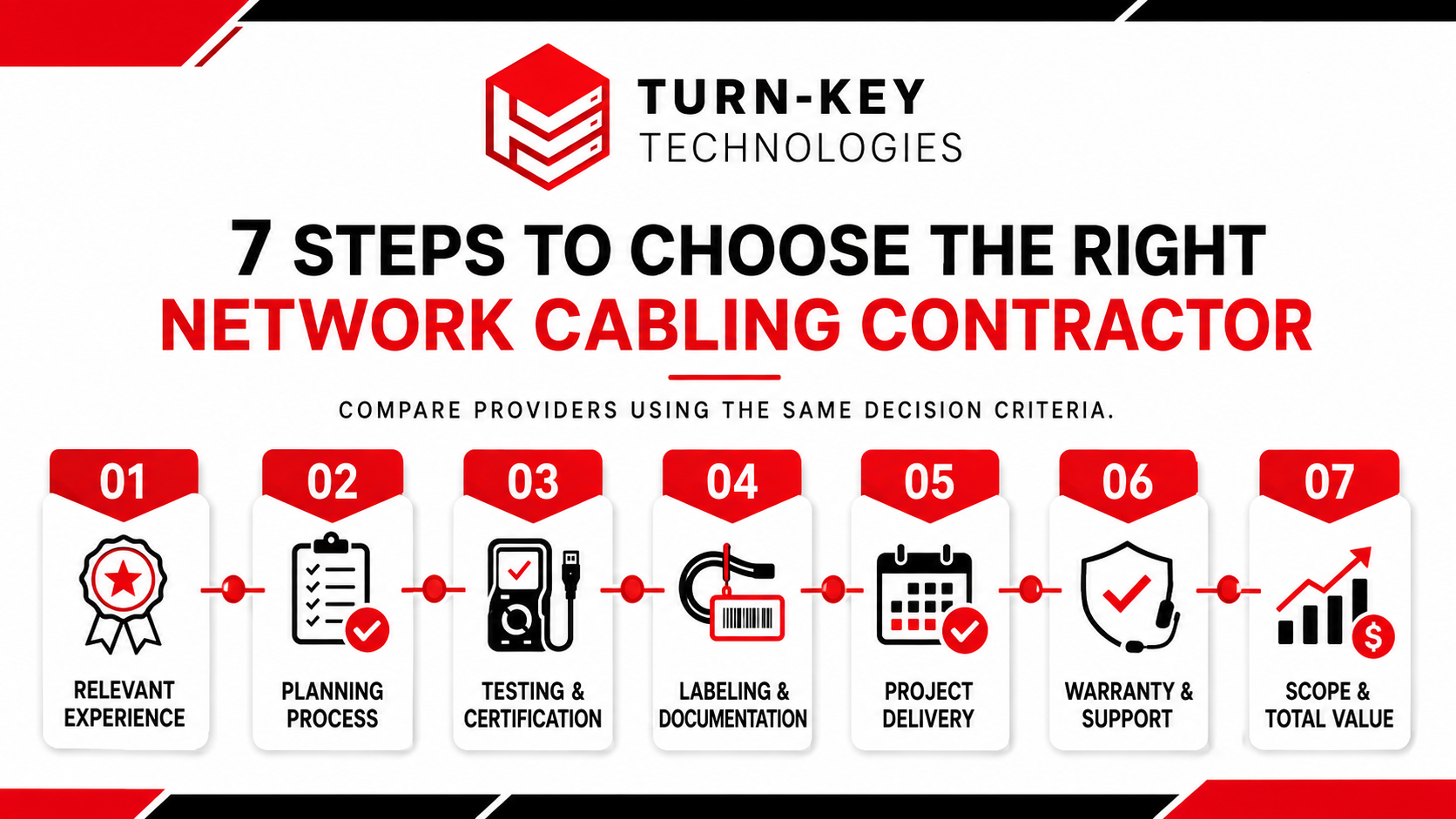
Compare every candidate against the same criteria: relevant experience, planning process, installation standards, and support that fit your network and facilities. Use these seven steps to compare providers before awarding the project.

Step 1. Evaluate Relevant Network Cabling Experience
Start with work that resembles your own project. Ask for examples that demonstrate experience with similar facilities, operating conditions, and technical requirements. Ask whether the team has completed projects with similar:
-
Facility types and operating conditions
-
Project size and number of locations
-
Copper and fiber optic cabling requirements
-
MDF and IDF infrastructure
-
Wireless, surveillance, access control, or other connected systems
-
Construction schedules and access restrictions
For example, a warehouse project may involve elevated pathways, long cable runs, wireless infrastructure, and active operations. A data center may require denser fiber connectivity, stricter labeling, rack coordination, and detailed documentation. The contractor should be able to describe what it actually handled on comparable projects, including planning, installation, testing, and closeout.
Step 2. Review the Design and Pre-Installation Planning Process
Before cable is pulled, the contractor should review the physical environment and confirm that the proposed design can be installed as planned. A pre-installation review should typically address:
| Planning Area | What to Check |
|---|---|
| MDFs and IDFs | Rack space, equipment layout, access, and future capacity |
| Pathways | Conduit, trays, ceiling conditions, and available space |
| Cable Distances | Copper limitations and fiber backbone requirements |
| Device Locations | Workstations, wireless access points, cameras, and access control |
| Existing Infrastructure | Cabling that can remain, needs remediation, or should be replaced |
| Growth | Spare pathway capacity, rack space, fiber strands, and future devices |
This is also the right stage to consider scalability. Reserving capacity in open pathways during the project is usually simpler than expanding them after ceilings, walls, or equipment rooms are complete. A contractor should be able to explain how the proposed cabling system supports both current business needs and reasonable future growth.
Read More: Cabling Pathways and Routing Design Best Practices
Step 3. Verify Testing and Certification Practices
Ask exactly how the contractor will validate the completed network cabling installation. A statement that “we test every cable” does not define how the work will be validated. The project scope should identify the testing method, equipment, acceptance criteria, and records you will receive. At a minimum, make sure to confirm:
-
Copper Cabling: How will installed links be tested or certified against the required cabling standard?
-
Fiber Optic Cabling: What testing method will be used for the type of fiber and link being installed?
-
Failed Results: Who is responsible for correcting and retesting links that do not meet the project requirements?
-
Documentation: Will individual test results be delivered and matched to the corresponding cable IDs?
Test records document whether each link met the project’s acceptance criteria at closeout and provide a baseline for later troubleshooting.
Read More: Structured Cabling Performance Testing: A Practical Guide
Step 4. Examine Labeling and Documentation Standards
Even a well-installed cabling system becomes difficult to support when cables cannot be traced quickly. Before installation begins, define what the contractor will provide at closeout and how that information will be organized.
At a minimum, the documentation should identify cable and port labels, patch-panel assignments, and the corresponding copper and fiber certification results. Depending on the project, it may also include cable schedules, fiber strand assignments, rack or cabinet records, updated floor plans, and as-built drawings. Any approved field changes should be reflected in the final records so the documentation matches what was actually installed.
A useful way to evaluate the closeout package is to consider whether a technician who was not involved in the original installation could trace a connection from the telecommunications room to the endpoint using the records provided. If that still requires extensive manual cable tracing, the documentation is probably not detailed enough for long-term support.
Read Next: Structured Cabling Installation Guide: Process, Best Practices + Expert Checklist
Step 5. Assess Project Management and Regional Delivery Capabilities
This step deserves particular attention for projects across New York, New Jersey, and Pennsylvania. Network cabling work often depends on construction schedules, electrical work, network equipment delivery, security installations, site access, and other trades. Confirm who owns those dependencies and how delays or field changes are escalated. Ask the contractor:
-
Who will serve as the primary project manager?
-
How are installers scheduled across multiple locations?
-
Where are technicians dispatched from?
-
How are travel and return visits handled?
-
Who approves field changes?
-
Can multiple sites be staffed at the same time?
-
Will the same testing, labeling, and documentation standards be used at every location?
-
How are issues escalated when another trade or network component is involved?
For a multi-site rollout, consistency matters as much as geographic reach. Cabling installed in New Jersey should follow the same documentation and quality standards as infrastructure installed for the same organization in New York or Pennsylvania.
Step 6. Review Warranty and Post-Installation Support
Do not wait until a problem occurs to find out what the contractor considers its responsibility. Before signing the contract, confirm what the workmanship warranty covers, how long it remains in effect, and how failed cabling will be reported, corrected, and retested. It should also be clear whether return visits are included, who handles manufacturer warranty issues, and whether the contractor can support moves, additions, and changes after the initial project is complete.
Post-installation response is especially important for organizations that cannot afford long delays when a connection fails. Ask how service requests are handled, how quickly technicians can be dispatched, and what information the contractor will need before sending someone to the site. These details are easier to address during vendor selection than after a problem has already disrupted operations.
Also ask how the contractor approaches faults that may cross the cabling and network layers. A connectivity issue could involve the cable, termination, patch cord, switch port, PoE, network configuration, or the connected device. A network cabling partner with broader infrastructure experience may be able to narrow down the cause more quickly and involve the right technical team without unnecessary handoffs.
Read Next: How to Troubleshoot Structured Cabling & Connectivity Issues
Step 7. Compare the Complete Scope and Total Project Value
After reviewing technical and operational capabilities, compare the proposals line by line. Do not assume two bids describe the same project simply because both list the same number of cable runs. Check whether each proposal includes:
| Scope Item | What to Compare |
|---|---|
| Cabling and Components | Cable type, quantities, patch panels, fiber components, and substitutions |
| Installation | Labor, termination, pathways, equipment, and special access requirements |
| Testing | Testing method, certification, reports, and retesting |
| Documentation | Labels, cable schedules, as-builts, and closeout records |
| Project Management | Scheduling, coordination, communication, and change control |
| Regional Costs | Travel, after-hours work, lifts, and return visits |
| Warranty | Coverage period, exclusions, and remediation process |
| Closeout | Punch-list completion, acceptance, and final documentation |
A lower bid is comparable only when the scope is equivalent. Confirm whether certification, documentation, project management, and post-installation support are included or priced separately. Normalize the scopes first. Then compare cost, execution risk, support, and long-term value.
Read Next: Structured Cabling Upgrade Budget & Cost Planning
Integrated Network and Cabling Provider vs. Separate Contractors
After identifying qualified contractors, the next decision is how the project should be delivered. Some organizations use one provider for both networking and structured cabling, while others assign those scopes to separate contractors. Both approaches can work. The better fit depends on project complexity, internal project-management capacity, procurement requirements, and how closely the physical cabling is tied to the active network.
| Decision Area | Integrated Network + Cabling Provider | Seperate Contractors |
|---|---|---|
| Design Coordination | Network and cabling requirements can be reviewed together | Requires clear handoffs between separate teams |
| Scheduling | Fewer parties may simplify sequencing and site coordination | Customer, GC, or internal PM typically manages dependencies |
| Accountability | Fewer boundaries when an issue crosses network and cabling layers | Responsibility is divided according to each contractor’s scope |
| Procurement | Broader scope under one provider | Individual scopes can be bid separately |
| Troubleshooting | One team may be able to investigate both physical and network causes | Each provider generally investigates its own scope |
| Multi-Site Consistency | One provider can apply common standards across locations | Standards must be coordinated across multiple vendors |
When an Integrated Provider Makes Sense
When cabling changes are tied to switching or broader network design, Turn-Key’s Wired Networks Services cover the active-network side of that infrastructure and provide additional context for projects where the two scopes need to be coordinated.
Consider a wireless project where an access point must be relocated because the planned ceiling location is obstructed. Moving the cable may also affect RF coverage, cable distance, switch-port assignments, and PoE requirements. A provider that understands both the network design and the cabling installation can review those dependencies before the change is approved.
The same coordination can help after go-live. If a device loses connectivity, the cause may be the cable, termination, switch port, PoE, configuration, or the connected device. A provider with visibility into both layers can begin isolating the problem without waiting for separate teams to determine where responsibility falls.
When Separate Contractors May Be a Better Fit
Separate contractors can work well when project boundaries are clearly defined, and the organization has enough internal or construction-management capacity to coordinate them.
This approach is common when procurement requires separate bids, a general contractor controls the construction schedule, or the organization already works with established network, cabling, electrical, or security firms. It can also be useful when a project calls for specialized expertise in distinct areas.
The project team should define responsibilities before work begins. That includes who approves field changes, updates documentation, handles retesting, manages schedule dependencies, and takes the lead when an issue affects more than one scope.
Make Ownership Clear Across Every Scope
A multi-contractor project depends on disciplined coordination between teams. Design ownership, scheduling, testing, documentation, change control, and escalation procedures should be documented before installation begins.
An integrated provider can reduce the number of handoffs when network and cabling decisions are closely connected. Separate contractors can also deliver a successful project when those handoffs are well managed. The delivery model should make it clear who is responsible for each part of the project, especially when an issue crosses between cabling, networking, or other trades.
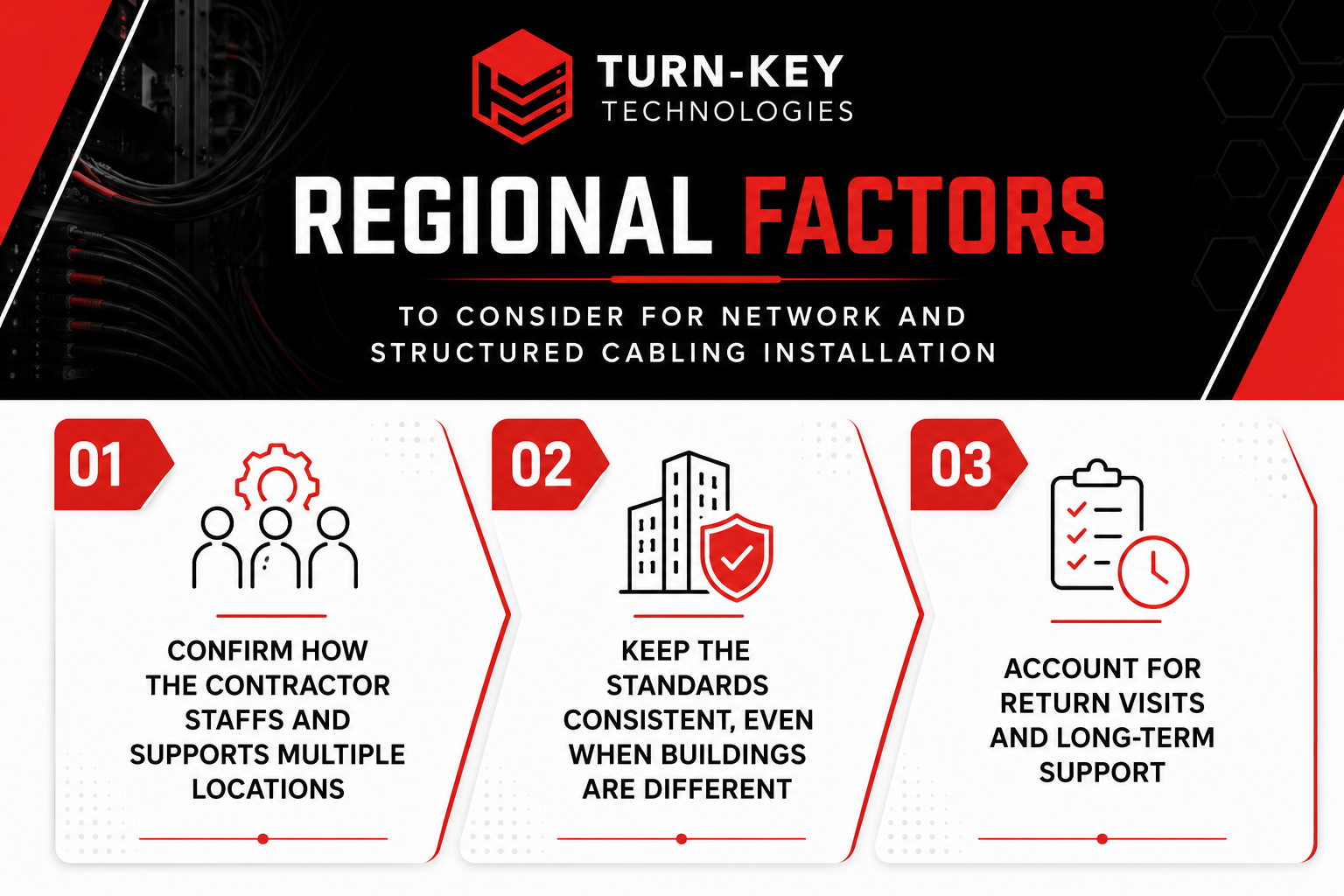
Regional Factors to Consider for Network and Structured Cabling Installation
For organizations with facilities across New York, New Jersey, and Pennsylvania, contractor selection also needs to account for how the work will be delivered across different sites. Regional coverage on a website does not necessarily tell you whether a cabling company can staff multiple locations, maintain consistent standards, or return quickly when follow-up work is required.
A structured cabling installation may also involve different building conditions, access requirements, construction schedules, and existing infrastructure from one location to another. The contractor should be able to adapt the installation plan without changing the quality standards used across the project.

1. Confirm How the Contractor Staffs and Supports Multiple Locations
Ask how cable installers are assigned across the region and whether the same project-management team will oversee the work from site to site. This is especially important when several locations are being upgraded on the same schedule. A regional network cabling partner should be able to explain how it handles:
| Regional Consideration | What to Confirm |
|---|---|
| Technician Coverage | Where installation teams are based and which locations they routinely support |
| Concurrent Projects | Whether multiple facilities can be staffed without delaying the rollout |
| Travel and Dispatch | How travel, return visits, and urgent site needs are handled |
| Project Oversight | Whether one project manager or delivery team coordinates the regional scope |
| Installation Standards | How workmanship, testing, labeling, and closeout requirements stay consistent |
| Follow-Up Support | How quickly the contractor can return after installation if remediation or additional work is needed |
This matters because a multi-site project can become difficult to support when every location is installed differently. Consistent structured cabling systems make it easier for internal IT teams and future cabling professionals to understand what they are looking at, regardless of which facility they are working in.
2. Keep the Standards Consistent, Even When the Buildings Are Different
Standardization does not mean every site should use an identical cabling solution. A Manhattan office, a New Jersey warehouse, and a Pennsylvania campus may have very different pathways, equipment rooms, fiber optic cabling requirements, and operating constraints.
The objective is to keep the installation and documentation practices consistent while allowing the design to reflect each facility's specific needs. That may include common approaches to cable identification, certification records, rack organization, copper and fiber documentation, and final project acceptance.
For organizations managing several locations, this consistency can reduce troubleshooting time and make future moves, additions, and network upgrades easier to plan.
3. Account for Return Visits and Long-Term Support
Regional delivery should also be evaluated after the initial cabling installation is complete. Ask who handles warranty calls, additional cable runs, remediation, and future expansion at each location.
A contractor that can install the project but has limited follow-up coverage may create practical problems later. Selecting the right network cabling partner means confirming that the company can continue supporting the cabling system as business needs change, devices are added, and facilities expand.
Read Next: Structured Cabling Expansion Guide
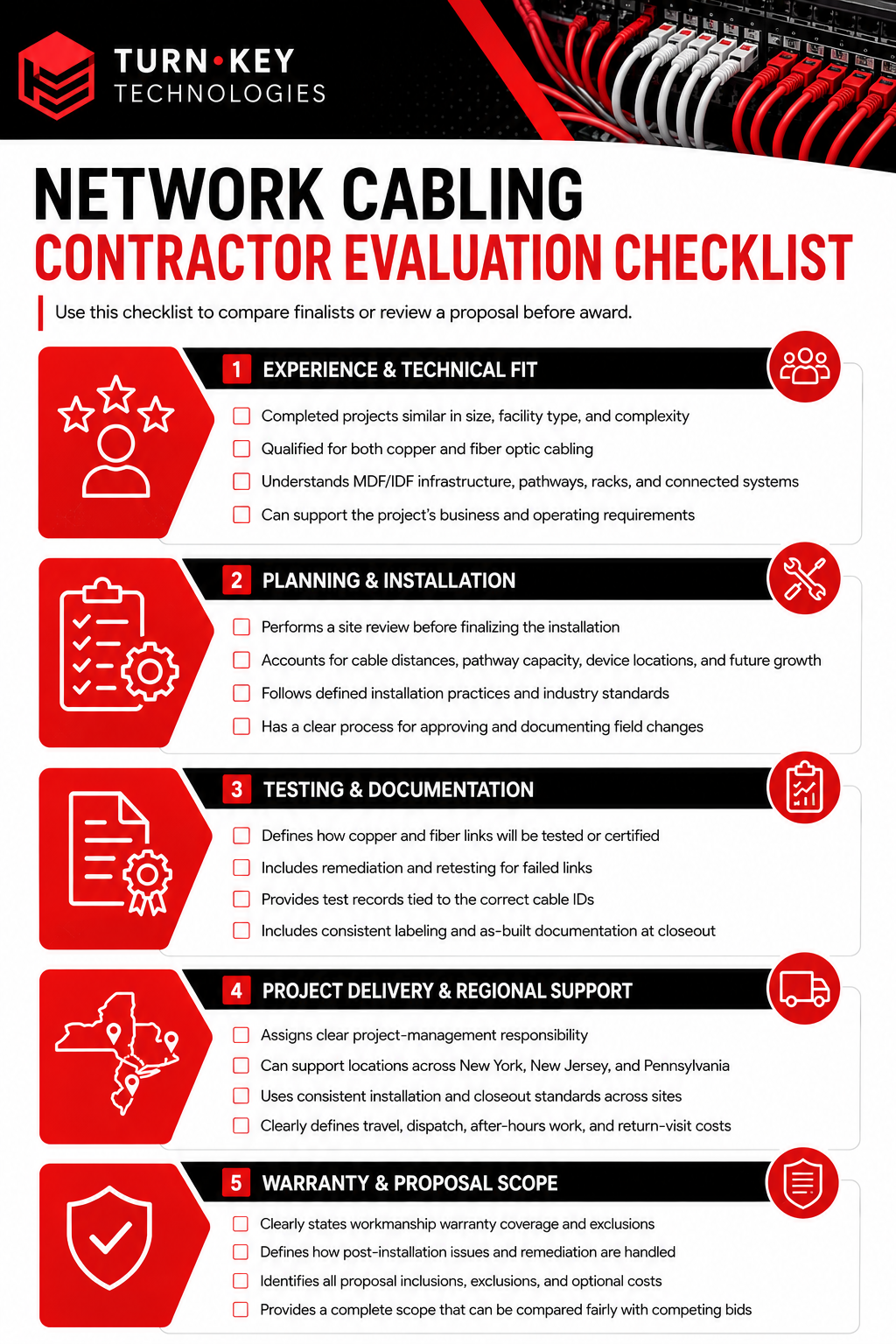
Network Cabling Contractor Evaluation Checklist
Once you have narrowed the field, use the same criteria to compare each finalist. Focus on technical fit, planning, testing, documentation, regional delivery, warranty coverage, and whether the proposal clearly defines what is included. The checklist below can be used during contractor reviews, proposal comparisons, or final vendor selection:

The contractor should meet the requirements that matter for your project and be clear about what it will own. Before making a final selection, confirm that the team can deliver the agreed scope, provide usable documentation, support every required location, and handle issues that fall within its responsibility.
Build a Cabling System Your Team Can Support
A successful network cabling project should leave IT and facilities teams with infrastructure that is easy to identify, troubleshoot, maintain, and expand. That outcome depends on the decisions made before installation begins, including contractor experience, pathway planning, testing requirements, documentation standards, project ownership, and the way field changes are handled.
For organizations with multiple locations, consistency matters just as much as workmanship at any one site. A cabling system becomes easier to manage when technicians encounter familiar labeling, documentation, testing records, and installation practices across New York, New Jersey, and Pennsylvania. Clear ownership also reduces delays when a problem involves both the physical cabling and the network it supports.
Before awarding the project, make sure the contractor can explain how the work will be planned, verified, documented, and supported after turnover. The proposal should give your team enough detail to understand what will be delivered and who will be responsible when conditions change.
Turn-Key Technologies provides Structured Cabling Services for organizations across the region planning new deployments, upgrades, expansions, and multi-site infrastructure projects. The contractor you select will shape how manageable that infrastructure is years after installation. Choose one whose process gives your team confidence in the work before the first cable is pulled.
New York, New Jersey, or Pennsylvania?
Frequently Asked Questions
What is the difference between a network cabling contractor and a structured cabling installer?
The terms are sometimes used interchangeably, but the scope can differ. A structured cabling installer may focus primarily on pulling, terminating, and testing cable, while a network cabling contractor may also provide site assessment, design coordination, project management, documentation, and post-installation support.
Titles alone are not enough to judge capability. Review the actual scope, experience, and responsibilities each company includes in its cabling services.
How do I know if my project needs fiber optic cabling?
Fiber optic cabling is commonly considered for backbone connections, longer distances, building-to-building links, data centers, and applications that require greater bandwidth or room for future growth. Copper Ethernet cabling remains appropriate for many endpoint connections, including workstations, wireless access points, cameras, and access control devices.
The appropriate cabling depends on distance, network performance requirements, physical conditions, equipment, and expected growth. A qualified contractor should explain why a particular cable type fits each part of the network.
What industry standards and best practices should cable installers follow?
Cable installers should work to the standards, codes, manufacturer requirements, and project specifications that apply to the installation. Depending on the project, that may include requirements covering pathways, cable handling, termination, labeling, grounding and bonding, testing, and cable certification.
Ask the contractor which standards apply to your project and how compliance will be verified. A professional network cabling installation should have defined acceptance criteria rather than relying on visual inspection alone.
What should be included in a professional network cabling proposal?
A useful proposal should clearly define the cabling products, installation labor, pathways, termination, testing, certification, labeling, documentation, project management, travel, warranty terms, and exclusions that apply to the project.
The scope should also identify responsibilities for field changes, failed tests, closeout, and post-installation issues. When comparing network cabling companies, review these details before comparing the final price so you know whether each contractor is bidding the same work.
What factors have the biggest impact on network cabling installation cost?
Network cabling costs vary based on the number and type of cable runs, copper versus fiber optic cabling, pathway conditions, cable distances, equipment-room work, testing requirements, documentation, access restrictions, lifts, after-hours scheduling, travel, and project complexity.
Existing conditions can also affect cost. A clean installation in an accessible office is different from work in an active warehouse, data center, hospital, or multi-building campus. A detailed site review gives contractors a better basis for pricing the actual work required.