



Skip to the main content.

12 min read

How to Design a Resilient Data Center Network in New York, New Jersey & Pennsylvania

Written by Updated July 31, 2026
Picture of Tony Ridzyowski
Tony Ridzyowski

Tony Ridzyowski leads the Inside Sales Team at Turn-key Technologies, Inc., where he also supports marketing, partner strategy, training, and CRM operations. Since joining TTI in 2014, Tony has earned top producer honors and President’s Club recognition. With a background in network cabling and experience working with Fortune 500 clients like Wells Fargo and Countrywide Home Loans, Tony brings decades of industry insight to every customer conversation.

How to Design a Resilient Data Center Network in New York, New Jersey & Pennsylvania

Designing a data center network starts with decisions that affect the infrastructure long after the equipment is installed. If you're planning a new facility or upgrading an existing data center in New York, New Jersey, or Pennsylvania, your design should account for network architecture, redundancy, structured cabling, security, monitoring, and future capacity before procurement begins. Addressing these elements early helps reduce costly redesigns, supports higher availability, and gives your infrastructure room to grow as business requirements change.

Many network issues trace back to planning rather than technology. For example, adding redundant switches provides little benefit if both fiber paths share the same conduit, and increasing bandwidth won't solve performance problems caused by an aging cabling plant or undocumented network changes. Organizations that coordinate network engineering, physical infrastructure, and operational planning from the outset are typically better positioned to simplify future expansions, shorten maintenance windows, and reduce the risk of unplanned outages.

Those decisions carry real financial consequences. Uptime Institute's 2025 Annual Outage Analysis found that 54% of organizations said their most recent significant data center outage cost more than $100,000, while 20% reported losses exceeding $1 million. Many of those incidents involved failures that infrastructure planning and operational processes can help reduce. This guide walks through a practical framework for designing resilient, scalable data center networks that support long-term business operations across New York, New Jersey, and Pennsylvania.

💡 TL;DR: The Data Center Network Design Priorities That Matter Most

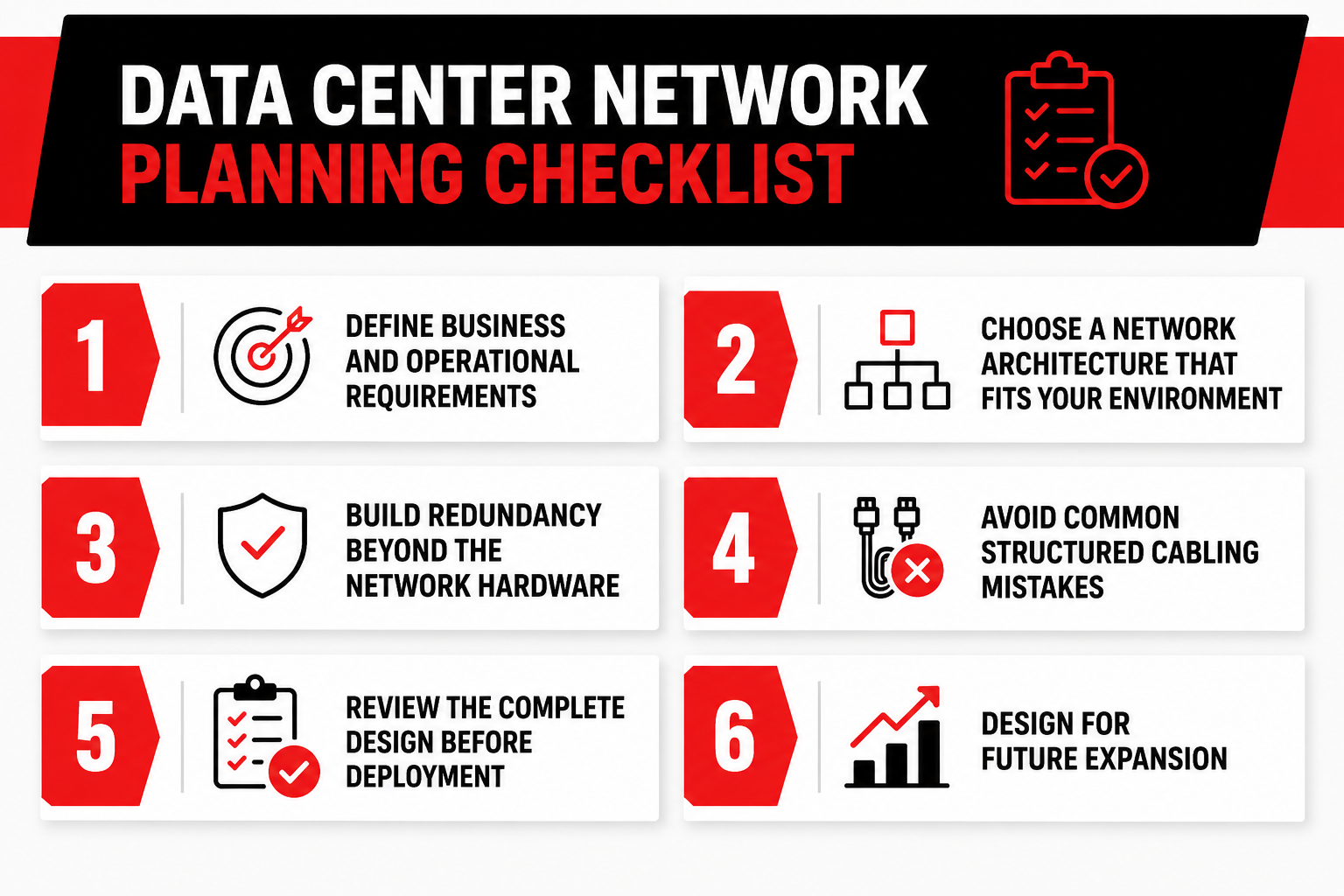
Before planning a data center network in New York, New Jersey, or Pennsylvania, keep these six priorities in mind:

  • Start with business requirements. Define uptime, performance, security, and growth goals before choosing network equipment.
  • Select the right network architecture. Your switching design should match your applications, traffic patterns, and expansion plans.
  • Build redundancy into the entire infrastructure. Plan for backup paths, power, and connectivity to reduce the impact of equipment or carrier failures.
  • Include structured cabling in the design phase. Well-planned pathways, fiber, and labeling make future upgrades and maintenance much easier.
  • Plan for monitoring and documentation. Accurate network records and proactive monitoring help teams resolve issues faster and reduce downtime.
  • Leave room for future growth. Reserve capacity for additional bandwidth, racks, and fiber so the network can expand without major rework.

Why Data Center Network Design Requires Careful Planning

Organizations across New York, New Jersey, and Pennsylvania continue to invest in new and existing data center facilities to support cloud services, AI workloads, enterprise applications, and business growth. Whether building from the ground up or upgrading an existing environment, many of the challenges are decided long before the first switch or server is installed.

Unlike a typical office network, a data center must support continuous operations while accommodating future expansion. Network architecture, structured cabling, power, fiber pathways, rack layouts, and physical space all need to work together. Decisions made during the planning stage affect performance, resiliency, maintenance, and the cost of future upgrades.

Many organizations also face real-world constraints, including legacy infrastructure, limited rack capacity, aging telecommunications rooms, or congested cable pathways. Identifying these limitations early helps avoid costly redesigns, reduces implementation delays, and creates a stronger foundation for long-term growth.

Common Planning Challenges

Planning Challenge Why It Matters Planning Consideration
Aging Infrastructure Existing equipment or cabling may limit performance and expansion. Assess the current environment before finalizing the design.
Limited Physical Capacity Rack space, conduit, and cable pathways can restrict future growth. Validate available space during site assessments.
Resiliency Requirements Single points of failure increase the risk of downtime. Design redundancy across both logical and physical infrastructure.
Hybrid Environments Many organizations operate across on-premises, cloud, and colocation environments. Plan connectivity and security as part of the overall architecture.
Future Growth Capacity requirements rarely remain static. Reserve space, bandwidth, and fiber for future expansion.

A Practical Checklist for Planning Your Data Center Network

Every data center has different operational requirements, but the planning process follows many of the same principles. Before selecting hardware or approving a deployment, evaluate the network, physical infrastructure, and long-term operational needs together. Working through the following checklist can help reduce costly design changes, improve resiliency, and create a network that supports future growth.

1. Define Business and Operational Requirements

Every network design decision should support a business objective. Before selecting switches, fiber, or cloud connectivity, define what the data center needs to support today and how those requirements are expected to change over the next several years.

Identify the applications and services that are critical to the business, the level of availability they require, acceptable downtime, and expected growth in users, storage, compute, or AI workloads. These priorities establish the foundation for every design decision that follows.

Operational planning is just as important. Decide who will manage the environment, how changes will be documented, and what tools will be used to monitor the network after deployment. A network that's easy to operate and maintain is far more valuable than one that's simply built with the latest hardware.

Planning Questions to Answer Early

Planning Question Why It Matters
Which applications and services are business-critical? Determines availability, redundancy, and recovery requirements.
How much downtime can the organization tolerate? Helps define resiliency and maintenance strategies.
What growth is expected over the next three to five years? Supports capacity planning for switching, bandwidth, power, and structured cabling.
Will workloads remain on-premises or extend into cloud and colocation environments? Influences network architecture, connectivity, and security planning.
Are there compliance or regulatory requirements? May affect network segmentation, monitoring, documentation, and access controls.

2. Choose a Network Architecture That Fits Your Environment

The best network architecture is the one that supports your operational requirements without adding unnecessary complexity. While a traditional three-tier design remains a practical choice for many enterprise data centers, environments with higher levels of virtualization, AI workloads, or east-west traffic often benefit from a spine-leaf architecture that scales more efficiently.

Rather than asking which architecture is "best," consider which one will continue meeting your business requirements as the environment grows. Expected workload, server density, cloud connectivity, and in-house expertise should all influence that decision.

This is also the point where logical network design and physical infrastructure need to come together. Switch placement, rack layouts, fiber pathways, and structured cabling all affect how the architecture performs once it's deployed. Planning these elements together helps reduce installation conflicts, simplify future expansion, and improve long-term reliability.

Organizations planning new or expanded data center environments often benefit from evaluating both the logical network and the supporting physical infrastructure together. Through our Wired Networks Solutions, Turn-Key Technologies helps organizations design, deploy, and optimize reliable network environments that align with their operational requirements.

3. Build Redundancy Beyond the Network Hardware

Redundancy is often associated with adding a second switch, firewall, or internet connection. While those components are important, they only provide value if the supporting infrastructure is designed with the same level of resilience.

For example, dual fiber uplinks offer little protection if both cables are installed in the same conduit. Similarly, redundant power supplies cannot prevent downtime if they're connected to the same UPS. These types of dependencies are easy to miss during planning and difficult to correct once the network is in production.

As you review the design, consider how the environment will operate when equipment fails, maintenance is performed, or part of the facility becomes unavailable. Looking at the network through these scenarios often uncovers risks that aren't obvious on a network diagram.

Failure Scenario Design Validation
Core Switch Failure Verify traffic automatically fails over to a secondary switch with minimal service interruption.
Fiber Cable Damage Confirm redundant links use physically separate pathways rather than the same conduit or cable tray.
UPS or Power Circuit Failure Ensure redundant devices receive power from independent UPS systems or power feeds.
Network Maintenance Validate that firmware upgrades or hardware replacements can be completed without taking critical services offline.
Telecommunications Room Outage Confirm critical systems remain connected through alternate network paths or equipment locations.

A resilient data center is designed to keep critical services available even when individual components fail. Reviewing these scenarios before deployment helps identify hidden dependencies while changes are still relatively simple and cost-effective.

Read Next: Building a Network Disaster Recovery Plan: Protecting Your Business Against Interruptions

4. Avoid Common Structured Cabling Mistakes

Many cabling issues don't become apparent until the network is live. By then, adding fiber, rerouting cable pathways, or reorganizing racks often means working around production systems and scheduled maintenance windows. Some of the most common issues include:

  • Installing only enough fiber for current demand. Leaving spare strands and pathway capacity makes future expansion significantly easier.

  • Inconsistent labeling. Poor documentation can turn routine maintenance into a time-consuming troubleshooting exercise.

  • Overlooking cable pathways. Congested trays and poorly planned routing make future installations more difficult and increase the risk of accidental damage.

  • Separating network and cabling design. When these teams work independently, switch locations, rack layouts, and cable runs often need to be revised during installation.

Most of these problems aren't difficult to prevent. They simply require the physical infrastructure to be planned alongside the network instead of after it. Through our Structured Cabling Services, Turn-Key Technologies designs and installs fiber and copper cabling infrastructure that supports reliable network performance today while leaving room for future expansion.

Read More: Structured Cabling Installation Guide: Process, Best Practices + Expert Checklist

5. Review the Complete Design Before Deployment

Many design issues don't appear until different parts of the project are reviewed together. The network diagram may be complete, but a switch doesn't fit the planned rack layout. Fiber pathways look adequate until additional cables are added for redundancy. Maintenance procedures seem straightforward until someone realizes a firmware upgrade requires taking both uplinks offline.

A final design review allows the project team to identify these kinds of conflicts before equipment is ordered or installation begins. Compare the network design with the rack elevations, structured cabling plans, power distribution, and equipment layouts to confirm they support one another. Involving both IT and facilities teams often helps uncover practical issues that wouldn't be obvious when each discipline reviews the project independently.

This is also a good time to walk through routine operational tasks. Consider how failed hardware will be replaced, where temporary equipment can be connected during maintenance, and whether technicians have enough physical space to work safely around racks and cable pathways. Small details like these are easy to overlook during planning but can have a significant impact once the data center is operational.

Finding these issues before deployment is considerably less disruptive than discovering them during installation or after production systems are online.

Read Next: Structured Cabling Performance Testing: A Guide for IT Leaders


6. Design for Future Expansion

Very few data centers remain unchanged after they're commissioned. New applications are introduced, storage requirements increase, additional racks are installed, and network traffic grows as the business evolves. Planning for those changes during the initial design is almost always less disruptive than modifying the infrastructure after it goes into production.

Growth isn't limited to adding more switch ports or increasing bandwidth. Additional fiber pathways, spare rack space, cable tray capacity, power availability, and cooling all influence how easily the environment can expand. If these elements reach capacity before the network does, even relatively small upgrades can require unexpected construction work or service interruptions.

It's also worth considering how technology may change over the next five to ten years. AI workloads, higher-density servers, and faster network speeds continue to place greater demands on both network infrastructure and the physical environment that supports it. While it's impossible to predict every future requirement, designing with reasonable headroom gives organizations more flexibility to adopt new technologies without starting from scratch.

A scalable data center isn't built by anticipating every future need. It's built by leaving enough capacity for the changes you know are likely to come.

Read Next: Structured Cabling Expansion Planning for Future Growth

Why the New York, New Jersey and Pennsylvania Region Continues to Attract Data Center Investment

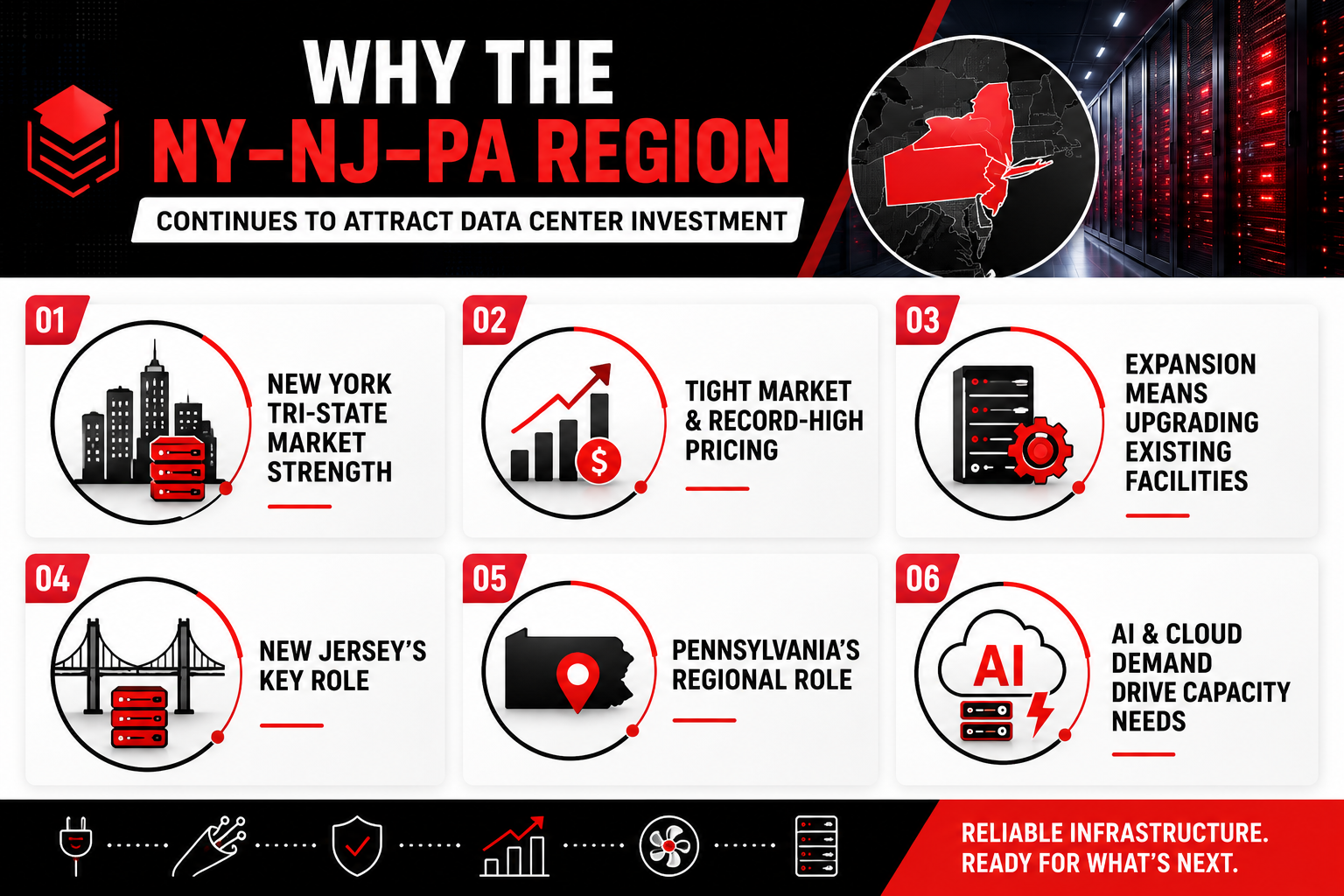
The New York Tri-State data center market remains one of the most important in the United States because it combines concentrated enterprise demand, established carrier infrastructure, and proximity to major financial, healthcare, media, and commercial centers. CBRE continues to identify the New York Tri-State as one of North America's primary data center markets. Its H2 2025 New York Tri-State Market Profile reported tight availability for users seeking 5 MW or more of contiguous capacity, record-high pricing, and continued demand from latency-sensitive financial services organizations.

These challenges reflect a broader market trend. Across North America's primary data center markets, vacancy fell to a record-low 1.4% at the end of 2025, despite total inventory increasing 36% year over year to 9,432 MW. According to CBRE's North America Data Center Trends H2 2025, much of that demand is being driven by hyperscale cloud providers and AI infrastructure.

For many organizations, expansion means upgrading existing facilities rather than building on greenfield sites. Legacy telecommunications rooms, occupied rack space, aging cabling infrastructure, limited pathway capacity, and active production environments all influence how new switching, fiber, power, and cooling systems can be deployed.

New Jersey's Role in the New York Data Center Market

A New Jersey data center gives organizations access to the New York metropolitan ecosystem without locating infrastructure directly in Manhattan. Northern New Jersey has become one of the country's largest concentrations of colocation facilities, carrier connectivity, and interconnection services supporting financial institutions, cloud providers, content providers, and large enterprises.

For example, Equinix's Secaucus Campus includes its NY2 through NY6 facilities and provides direct Fiber Connect access to New York carrier hotels. Digital Realty also operates facilities in Clifton and Piscataway along major fiber routes serving the New York metropolitan area.

Digital Realty reports that its New York and New Jersey portfolio connects more than 335 cloud and network service providers while supporting more than 550 customers. These figures demonstrate why carrier availability and interconnection options often influence site selection as much as available floor space.

New Jersey has also introduced incentives to encourage large-scale AI investment. Under the NJEDA Next New Jersey Program–AI, qualifying projects generally must invest at least $100 million and create at least 100 new full-time jobs. While incentives rarely determine a location on their own, they demonstrate the state's commitment to attracting additional AI infrastructure and data center development.

Pennsylvania's Regional Role

Pennsylvania serves a different role within the Northeast data center market. CBRE has identified Northeast Pennsylvania as an emerging alternative for organizations serving New York City and Northern New Jersey because of its available land and lower development costs. Philadelphia also sits along the communications corridor between New York and Washington, D.C., supporting colocation, interconnection, business continuity, and disaster recovery deployments, as outlined in Equinix's Philadelphia Data Center Overview.

The state also supports qualifying projects through its Computer Data Center Equipment Exemption Program, which may exempt eligible owners, operators, and tenants from sales and use tax on qualifying equipment. Combined with its location and development opportunities, these incentives strengthen Pennsylvania's position within the regional data center market.

AI and Cloud Demand Are Changing Capacity Requirements

Artificial intelligence, cloud computing, and high-density computing continue to increase demand for power, cooling, fiber connectivity, and available data center capacity. CBRE's North America Data Center Trends H2 2025 reported that pricing for requirements between 3 MW and 10 MW increased 12.5% year over year as organizations competed for large blocks of contiguous space with scalable power and connectivity.

Those market conditions affect more than hyperscale campuses. Higher-density compute environments often require additional switch uplinks, more fiber between racks, greater power per cabinet, and cooling systems that many existing facilities were never designed to support. Organizations evaluating existing data center space should assess available power, cable pathway capacity, rack density, cooling capability, and room for expansion rather than relying on square footage alone.

Organizations planning new or expanded data center environments often benefit from evaluating both the logical network and the supporting physical infrastructure together. Through our Wired Networks Solutions, we help organizations design, deploy, and optimize reliable network environments that align with their operational requirements.

Read More: Video Surveillance for Data Centers: How to Build a Secure Facility

Planning a Data Center Project in New York, New Jersey, or Pennsylvania?


Good Planning Is Easier Than Fixing Infrastructure Later

Most data center projects begin with decisions about network architecture, switching, and capacity. Those decisions matter, but they are only part of the picture. Rack layouts, cable pathways, fiber counts, equipment placement, and room for future expansion all affect how the network performs once it is in production.

Many problems don't become apparent until installation begins. A fiber pathway may already be full, a rack may not have enough space for additional equipment, or a redundant network design may require cable routes that were never included in the original plans. Solving those issues during construction often means redesigning part of the project, delaying deployment, or increasing installation costs.

Taking time to review the complete design before equipment is ordered helps identify these issues while changes are still relatively simple to make. When network engineering, structured cabling, facilities, and security teams work from the same plan, projects are typically easier to deploy, easier to maintain, and better prepared for future expansion.

Read More: The Power of Proactive Network Monitoring: A Smarter Approach for Remote Sites

Planning a Data Center Network Project?

Whether you're expanding an existing facility, upgrading network infrastructure, or improving the cabling within a data center environment, reviewing the network design before installation can uncover issues that are difficult to correct later. Verifying rack layouts, cable pathways, fiber capacity, equipment locations, and physical clearances early in the project can help reduce rework and keep deployments on schedule.

Turn-Key Technologies provides Wired Networks, Structured Cabling Services, and Physical Security Solutions throughout New York, New Jersey, and Pennsylvania. From initial planning and system design through installation, testing, and ongoing support, we help organizations build infrastructure that's easier to deploy, maintain, and expand as business requirements evolve.

Planning an upcoming data center project? Contact Turn-Key Technologies to discuss your networking and structured cabling requirements with our team.

Frequently Asked Questions

What should be included in a data center network design?

A well-planned data center network design considers much more than switching capacity and bandwidth. It should account for network architecture, structured cabling, rack layouts, fiber pathways, redundancy, power availability, cooling requirements, and room for future expansion.

The design should also support day-to-day data center operations. Planning for maintenance, equipment replacement, cable management, and documentation makes the environment easier to manage and reduces the risk of downtime as the facility grows.

Why is New Jersey a popular location for data centers?

The New Jersey data center market benefits from its proximity to New York City, extensive fiber connectivity, and access to one of the country's largest concentrations of enterprise customers. Many organizations choose data centers in New Jersey because they provide low-latency access to the New York metropolitan area while offering more flexibility for expansion than facilities located in Manhattan.

The region is also home to many established data center providers, giving organizations a wide range of options for colocation, connectivity, and hybrid infrastructure deployments.

How do you choose the right data center provider?

The right provider depends on your technical, operational, and business requirements. Before selecting a facility, organizations should evaluate network connectivity, carrier diversity, available power, physical security, compliance requirements, scalability, and the provider's ability to support future growth.

Many organizations compare data center providers such as Equinix, Digital Realty, QTS, DataBank, CyrusOne, Iron Mountain, and Flexential. Rather than focusing on the size of the provider, it's more important to determine whether the facility offers the network ecosystem, resiliency, and capacity your environment requires.

How is artificial intelligence changing data center infrastructure?

Artificial intelligence workloads require significantly more computing power than many traditional business applications. As a result, organizations are placing greater demands on electrical capacity, cooling systems, fiber connectivity, and rack density.

Supporting AI infrastructure often requires upgrades to the surrounding data center infrastructure, including power distribution, cable pathways, cooling systems, and network capacity. Organizations planning for AI should evaluate these supporting systems early in the design process instead of focusing only on server hardware.

Why is structured cabling so important in a data center?

Structured cabling provides the physical foundation for every network connection within a data center. A well-designed cabling system makes it easier to install new equipment, troubleshoot connectivity issues, and expand the environment without disrupting existing services.

Poor cable management, limited fiber capacity, or overcrowded pathways can make routine maintenance more difficult and increase project costs over time. Planning the cabling infrastructure alongside the network design supports reliable data processing, efficient data storage, and future expansion.

Is it better to upgrade an existing data center or build a new one?

The answer depends on the condition of the existing facility and the organization's long-term requirements. Many businesses can extend the life of their current environment by upgrading network equipment, improving structured cabling, increasing redundancy, or expanding power and cooling capacity.

Modernization projects often cost less than building entirely new data centers, but they require careful planning because the work is typically performed while production systems remain operational. Reviewing the existing infrastructure before construction begins helps identify physical constraints that could affect the project schedule or budget.

The Hidden Cost of Treating Network Design and Structured Cabling as Separate Projects

1 min read

The Hidden Cost of Treating Network Design and Structured Cabling as Separate Projects

Network design and structured cabling should be planned together because the decisions made during network design directly affect how the physical...
Read More
Data Center Cabling Design: What Northeast Facilities Should Get Right Before Installation

1 min read

Data Center Cabling Design: What Northeast Facilities Should Get Right Before Installation

Designing data center cabling for a Northeast facility starts with the physical layout. Planning the fiber and copper architecture, pathway capacity,...

Read More
What Is Structured Cabling? Complete Guide for Business Networks

1 min read

What Is Structured Cabling? Complete Guide for Business Networks

Networks scale fast, and cabling choices shape reliability, speed, and future costs. This guide explains the essentials, including the components,...

Read More