


Top 5 Challenges of Managing IoT Networks
 Craig Badrick : Jun 12, 2019, 5:53:45 AM
Running a successful IoT network can provide numerous benefits and efficiencies for your enterprise, but also comes with a number of challenges.

Securing a logistics network means protecting every interconnected system: warehouse management platforms, transportation management software, real-time tracking tools, IoT sensors, RFID readers, and the wired and wireless infrastructure tying them together. All of these must be defended from ransomware, phishing, data breaches, and operational disruption.
Cybercriminals now routinely target ports, freight hubs, carriers, and distribution centers because a single breach can halt shipments, tamper with cargo data, divert payments through business email compromise, or encrypt critical systems for ransom. Financial losses and reputational damage follow quickly when supply chains go dark.
This logistics network security guide provides a practical, NIST-aligned framework logistics executives can apply immediately to reduce cyber risk, harden network architecture, protect sensitive shipment and supplier data, and build resilience across high-value, high-risk logistics operations.
Segment warehouse, port, and corporate networks so a single breach can't disrupt entire logistics operations.
Enforce strong identity, MFA, and least-privilege access for WMS, TMS, and real-time tracking tools.
Harden warehouse wired and wireless networks to stop attackers from pivoting through IoT devices and scanners.
Deploy continuous threat monitoring and network analytics to detect anomalies before they disrupt freight flows.
Encrypt sensitive shipment, supplier, and cargo data in transit and at rest across all hubs.
Test incident response plans with realistic ransomware and business email compromise drills for logistics teams.
Audit third-party connections and security clauses to reduce supply chain and vendor-driven cyber risk.
Logistics companies operate in a digitally interconnected environment where every efficiency gain also expands the attack surface cybercriminals can exploit. Real-time tracking, automated warehouse systems, and IoT-driven inventory management all create new vulnerabilities.
Ransomware groups, state-sponsored hackers, and organized crime syndicates now view transportation and logistics as high-value targets. Disrupting a single hub can cascade across global supply chains, and sensitive cargo, shipment, and financial data flow through systems that were never designed with modern cyber threats in mind.
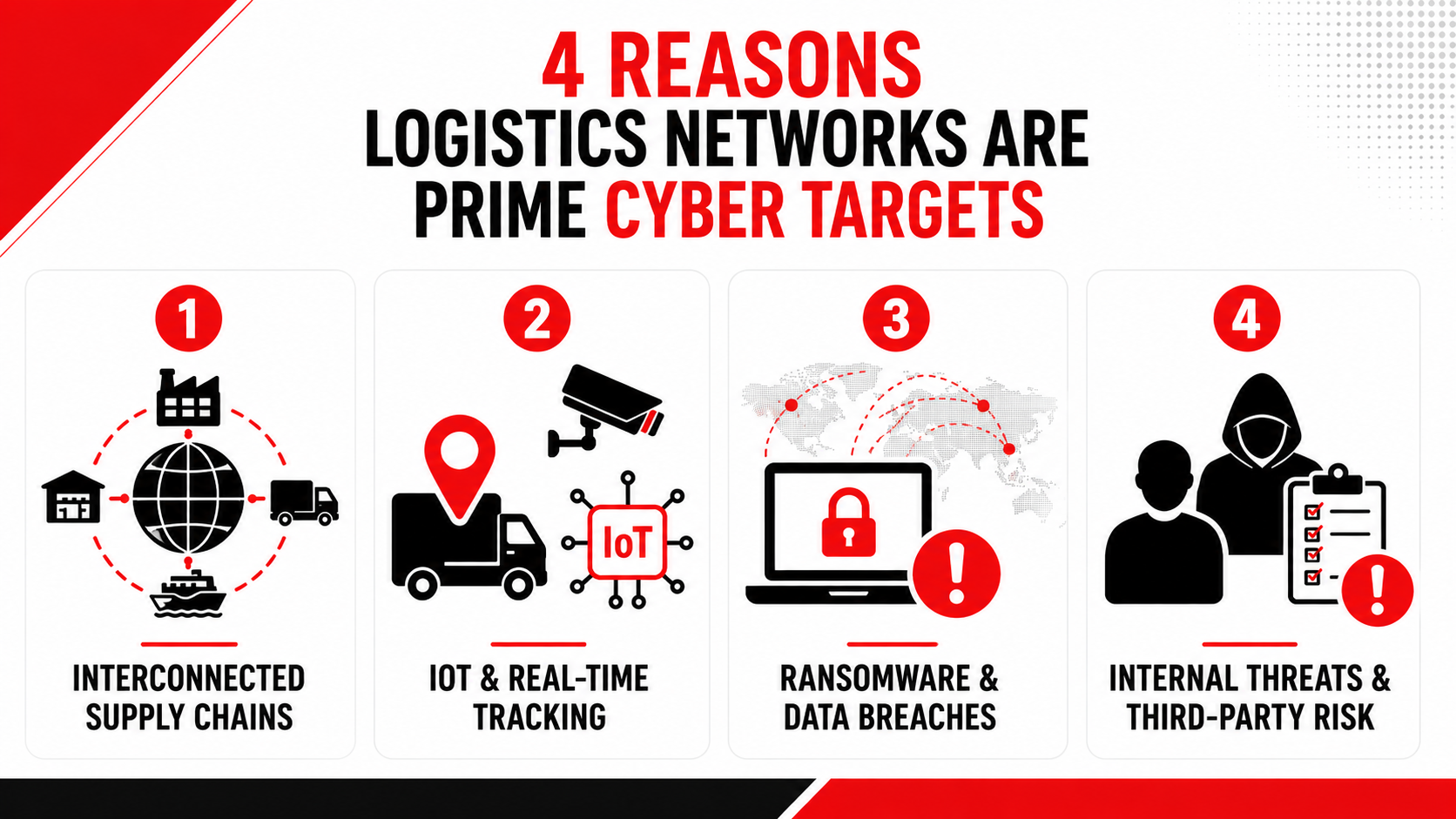
Logistics networks today interconnect warehouses, carriers, ports, customs brokers, suppliers, and customers through APIs, electronic data interchange platforms, cloud-based transportation management systems, and shared visibility tools. Every connection is a potential entry point.
When a freight forwarder's system is compromised, attackers can pivot into the shipper's network. Similarly, when a port's scheduling platform is breached, malware can spread to connected carriers and terminal operators.
The organizational boundaries that once contained cyber risk have dissolved, and a vulnerability at any partner can become your vulnerability.
Warehouses and distribution centers now deploy thousands of IoT devices that improve operations but open additional cyber risk if not properly secured. Sensors monitor temperature and humidity, RFID readers track pallets, wearables coordinate picker routes, and smart cameras secure loading docks.
Unsecured IoT devices: Many sensors and readers ship with default credentials, weak firmware, and no encryption, making them easy targets for malware that can spread laterally across the network.
Weak segmentation: When IoT devices share the same network as warehouse management systems or corporate email, a compromised camera or scanner becomes a gateway to high-value systems.
Spoofed sensor data: Attackers can tamper with real-time tracking feeds, inventory counts, or environmental monitors to hide theft, smuggle contraband, or disrupt operations.
Default credentials and outdated firmware: Logistics providers often lack the IT resources to inventory, patch, and harden every IoT endpoint, leaving known vulnerabilities unaddressed for months.
Ransomware attacks on logistics companies have shut down warehouse management systems, encrypted transportation scheduling platforms, and halted real-time tracking for days or weeks, causing cascading disruption across supply chains. When a major freight carrier or port operator goes offline, shipments stall, customers lose visibility, and financial losses mount quickly.
Data breaches targeting logistics providers expose sensitive shipment manifests, supplier contracts, cargo values, and customer information, leading to regulatory penalties, reputational damage, and loss of competitive advantage.
Cybercriminals know that logistics companies will pay to restore operations quickly, making the sector a lucrative target for extortion.
Logistics relies on frontline warehouse staff, drivers, contractors, and a web of third-party logistics providers, each with varying levels of access to systems and data. Internal and supplier risk is real and often underestimated.
Read Next: Why Most Warehouse Wireless Network Design Plans Fail Under Pressure
Logistics executives need a concrete, logistics-specific network security framework that maps where vulnerabilities exist, which security measures close the highest-risk gaps, and how to prioritize investments across wired networks, wireless infrastructure, IoT devices, cloud platforms, and physical security systems.
Network architecture determines whether a single breach can spread across your entire logistics operation or whether segmentation, firewalls, and secure interconnects contain the damage.
Secure architecture is the foundation. Without segmentation and firewalls, every IoT device, every third-party connection, and every warehouse Wi-Fi access point becomes a potential entry point for attackers to reach your most sensitive systems.
Compromised credentials, phishing emails targeting logistics coordinators, and business email compromise schemes that spoof shipment instructions are frequent causes of breaches in logistics providers. Attackers know that warehouse staff, drivers, and freight coordinators often use shared logins, weak passwords, and unmanaged devices to access critical systems.
Multi-factor authentication (MFA): Require MFA for all access to WMS, TMS, real-time tracking platforms, and cloud-based logistics applications. A stolen password alone should never grant access to systems that control shipments or cargo data.
Role-based access and least-privilege: Warehouse pickers should not have access to financial systems; freight coordinators should not have admin rights to network infrastructure. Define roles tightly and grant only the access each role requires.
Strong passwords or passwordless authentication: Enforce password complexity and rotation policies, or move to passwordless authentication using hardware tokens or biometrics to eliminate credential theft.
Hardened handhelds and scanners: Warehouse scanners, tablets, and mobile devices used for inventory management must run updated firmware, have endpoint protection installed, and connect only to authorized networks.
Secure configuration of laptops in warehouses: Laptops used by supervisors or logistics coordinators should have disk encryption, automatic patching, and endpoint detection and response tools to prevent malware from spreading.
IoT devices are essential to modern logistics, but often lack basic security. Sensors monitor cold chain integrity, RFID readers track pallets, wearables coordinate warehouse staff, and smart cameras secure loading docks. Operational technology systems controlling conveyor belts, automated storage and retrieval systems, and sortation equipment were designed for reliability, not cybersecurity, and can be exploited if not properly isolated and monitored.
Network isolation is the first defense: place all IoT devices on a separate, firewalled network segment with no direct access to WMS, TMS, or corporate systems. Firmware updates must be applied regularly, but many logistics providers lack an inventory of every IoT device deployed across warehouses and hubs, making patch management nearly impossible.
Start by creating a complete device inventory, then establish a process for tracking firmware versions, applying updates, and decommissioning obsolete devices.
Malware and tampering are real risks. Attackers can compromise IoT devices to inject false data into real-time tracking systems, hide theft by spoofing inventory counts, or use compromised cameras as entry points to pivot deeper into the network.
Deploy intrusion detection systems that monitor IoT traffic for anomalies, and log all device activity so tampering attempts can be detected and investigated.
Read Next: Logistics Security Systems: The Gaps in Access Control And Surveillance You Can’t Afford
Sensitive shipment data, cargo manifests, supplier contracts, and customer information flow across logistics networks constantly. If that data is intercepted, tampered with, or stolen, the consequences range from financial losses to regulatory penalties and reputational damage.
Encrypt all data in transit using TLS for web-based applications and VPNs or SD-WAN for site-to-site connections between warehouses, ports, and corporate offices. Encrypt data at rest in databases, file servers, and cloud storage platforms so that even if attackers gain access to storage systems, they cannot read sensitive information without decryption keys.
Secure APIs are critical because logistics companies increasingly rely on APIs to exchange shipment status, inventory levels, and tracking data with partners. APIs must require authentication, use encrypted connections, and validate all inputs to prevent injection attacks or unauthorized data access.
Additionally, preventing spoofing of real-time tracking data is essential in high-value logistics operations. Attackers can tamper with GPS coordinates, shipment status updates, or delivery confirmations to hide theft, smuggle contraband, or disrupt operations.
Implement integrity checks, digital signatures, and audit trails that log every change to shipment records so unauthorized modifications are detected immediately.
Constant vigilance and real-time monitoring systems are essential in high-risk logistics environments because cyber threats evolve quickly, and attackers often dwell inside networks for weeks before launching ransomware or exfiltrating data.
Anomaly detection: Deploy systems that baseline normal network traffic patterns in warehouses and hubs, then alert when unusual activity occurs, such as a warehouse scanner suddenly communicating with an external IP address or a spike in data transfers from the WMS to an unknown destination.
Intrusion detection systems (IDS): Monitor network traffic for known attack signatures, malware communication patterns, and suspicious behavior that indicates an attacker is probing defenses or moving laterally.
SIEM alerts on unusual warehouse traffic: Security information and event management platforms aggregate logs from firewalls, servers, IoT devices, and applications, then correlate events to detect multi-stage attacks or insider threats.
Early ransomware detection: Monitor for file encryption activity, unusual process execution, and attempts to disable backup systems, all indicators that ransomware is deploying.
Monitoring for business email compromise targeting logistics teams: Watch for email forwarding rules, login attempts from unusual locations, and spoofed sender addresses that signal BEC attacks aimed at diverting payments or shipments.
Network analytics provide proactive monitoring to avoid disruptions and downtime across logistics facilities. By detecting threats early, logistics providers can respond before ransomware encrypts critical systems or before attackers exfiltrate sensitive cargo and supplier data.
Phishing emails, business email compromise schemes, and social engineering attacks targeting logistics staff handling freight documents, routing instructions, and payment approvals are among the most common entry points for cybercriminals.
Warehouse workers, drivers, and freight coordinators are not cybersecurity experts, but they are on the front lines and must recognize suspicious emails, verify unusual requests, and report potential threats.
Security awareness training should be tailored to logistics roles: teach warehouse staff to recognize phishing emails that spoof supplier communications, train freight coordinators to verify payment changes through a second channel, and educate drivers on the risks of connecting personal devices to company networks.
Incident response plans must be tested regularly with tabletop exercises and realistic drills that simulate ransomware attacks, data breaches, and business email compromise scenarios specific to logistics operations.
Clear escalation paths across warehouses, ports, and corporate offices ensure that when a threat is detected, the right people are notified immediately and response actions are executed without confusion or delay. These actions include isolating infected systems, activating backups, and notifying law enforcement.
Read Next: How to Plan Your Physical Security Strategy for 2026: A Practical Guide
Before investing in new security measures, logistics executives must understand where vulnerabilities exist, which systems are most exposed, and which threats pose the greatest risk to operations. A structured diagnostic process reveals gaps and helps prioritize fixes that deliver the biggest reduction in cyber risk.
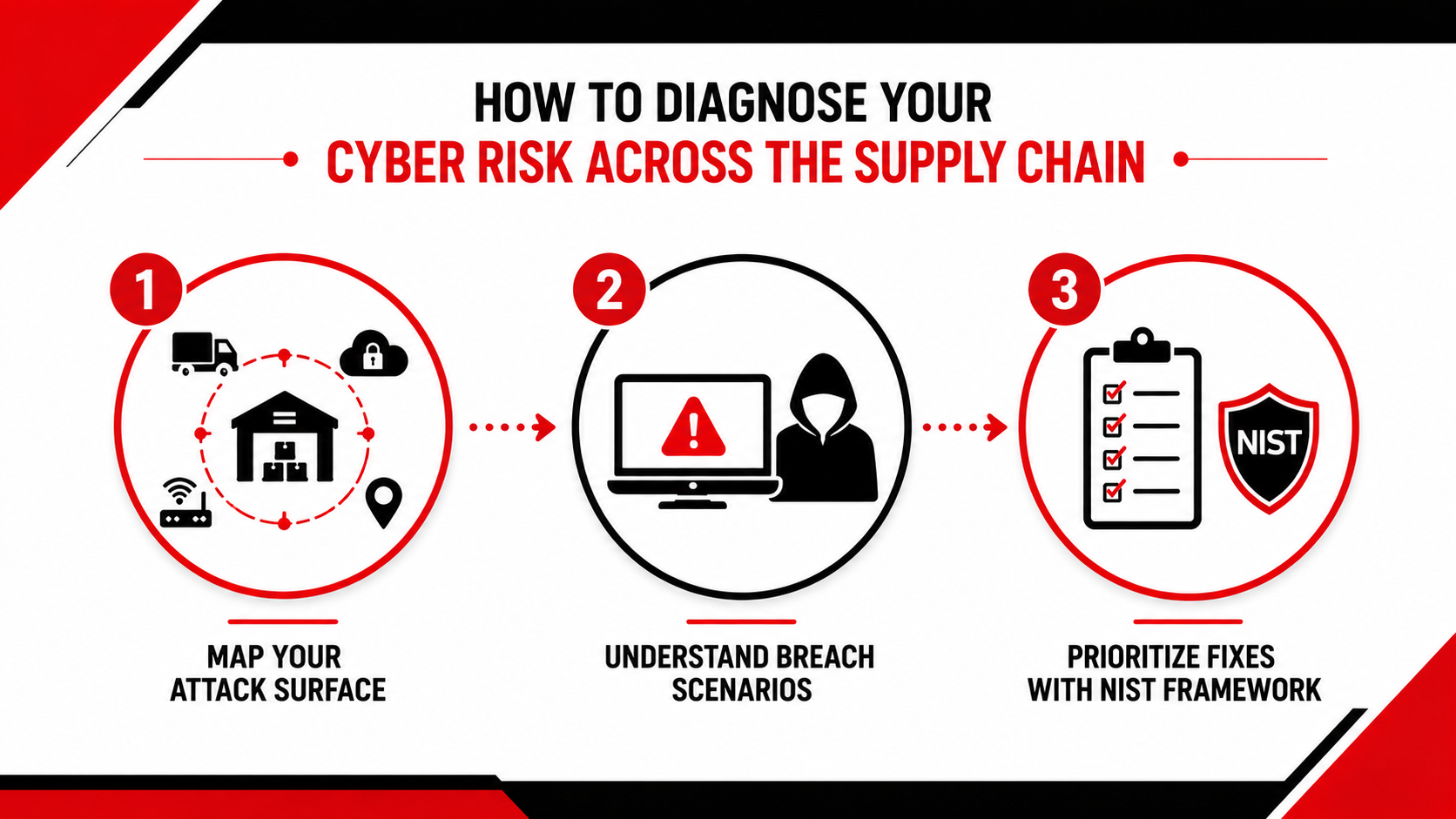
Inventory every network, application, IoT device, supplier connection, and data flow across your logistics operation to understand where attackers could enter and what they could reach once inside.
Warehouses: Catalog wired and wireless networks, warehouse management systems, IoT devices (scanners, sensors, cameras, wearables), and physical security systems at every distribution center and fulfillment hub.
Carriers and transportation: Identify transportation management systems, fleet tracking platforms, driver communication tools, and telematics devices that connect to your network or share data.
Third-party logistics providers: Document every 3PL, freight forwarder, customs broker, and technology vendor with access to your systems, data, or facilities, and assess their security posture.
Ports and freight hubs: Map connections to port scheduling systems, terminal operating systems, and customs platforms that exchange shipment data.
Cloud applications: List all cloud-based logistics, supply chain visibility, and collaboration platforms, and verify that access controls, encryption, and logging are properly configured.
Mapping the attack surface is not a one-time exercise. As new warehouses open, new partners connect, and new IoT devices deploy, the attack surface expands, and the inventory must be updated continuously.
Understanding how breaches unfold in logistics operations helps executives prioritize defenses and prepare response strategies.
Cybersecurity services protect networks and sensitive data by supporting planning, deployment, testing, and training tailored to logistics environments. Logistics providers that work with experienced partners can implement these mitigation measures faster and with greater confidence that controls are properly configured and monitored.
The NIST Cybersecurity Framework provides a practical structure for organizing security actions into five functions: identify, protect, detect, respond, and recover. Logistics executives can use this framework to group fixes, assign ownership, and track progress.
Identifying means understanding your assets, vulnerabilities, and risks through the attack surface mapping and breach scenario analysis described above.
Protect means implementing controls that prevent breaches: network segmentation, firewalls, encryption, MFA, and hardened IoT devices.
Detect means deploying monitoring systems that reveal threats in progress: intrusion detection, anomaly detection, and SIEM alerts.
Respond means having tested incident response plans, clear escalation paths, and the ability to isolate compromised systems quickly.
Recover means maintaining backups, testing restoration procedures, and ensuring operations can resume even after a major cyberattack.
For logistics companies, the controls that typically yield the biggest reduction in cyber risk are network segmentation (limiting blast radius), MFA (stopping credential theft), continuous monitoring (detecting threats early), and tested incident response plans (minimizing downtime). Start with these, then expand to more advanced controls as maturity grows.
Logistics networks are the lifelines of global commerce, and securing them requires a practical, logistics-specific approach that addresses wired and wireless infrastructure, IoT devices, real-time tracking systems, third-party connections, and the human factors that make phishing and business email compromise so effective.
Logistics executives who implement these measures reduce cyber risk, protect high-value cargo and shipment data, and build resilience that keeps supply chains moving even when cyberattacks occur.
Segmenting logistics networks limits the blast radius from any single cyber breach and stops attackers from pivoting to high-value systems.
Continuous threat monitoring and network analytics detect ransomware, malware, and insider threats before they disrupt freight flows or encrypt critical systems.
Testing incident response plans with realistic drills ensures logistics teams know exactly how to respond when cyberattacks occur, minimizing downtime and financial losses.
Turn-Key Technologies offers IT solutions for warehouse and logistics, including wired network design and installation for operational technology, wireless design tailored to enterprise needs, camera systems to protect assets and personnel, lone worker systems to improve employee safety, and network analytics to help avoid disruptions and downtime. TTI also supports modern security through cybersecurity measures, security policies, and training designed to help protect internal WMS and logistics systems from emerging cyber threats.
Book a consultation to assess your logistics network security posture and prioritize practical safeguards.
Ransomware attacks that encrypt warehouse management systems and halt operations, business email compromise schemes that divert payments or spoof shipment instructions, phishing targeting logistics coordinators, data breaches exposing sensitive cargo and supplier information, and compromised IoT devices that provide entry points for attackers to pivot into core logistics systems are the most common and damaging threats.
Implement integrity checks and digital signatures on tracking data, encrypt all data in transit using secure APIs and VPNs, log every change to shipment records with audit trails, and deploy anomaly detection systems that alert when tracking data deviates from expected patterns or when unauthorized modifications occur.
Network segmentation to isolate warehouse management systems from IoT devices and corporate networks, multi-factor authentication for all access to critical logistics applications, endpoint detection and response tools on servers and workstations, offline encrypted backups tested monthly, and a tested incident response plan with clear recovery steps are the highest-impact measures.
Network segmentation divides logistics networks into isolated zones (warehouse IoT devices, warehouse management systems, corporate office systems, third-party connections) so that a breach in one zone cannot spread to others. Firewalls and access controls between segments limit lateral movement, contain ransomware, and reduce the blast radius of any single cyberattack.
Audit third-party access quarterly to verify that credentials are current, access is limited to only what each partner requires, and unused accounts are disabled. Review security clauses in contracts annually and whenever a new third-party logistics provider, freight forwarder, or technology vendor is onboarded to ensure they meet minimum cybersecurity standards and agree to incident notification requirements.
Place all IoT devices on isolated network segments with firewall rules blocking access to warehouse management systems and corporate networks, deploy intrusion detection systems that monitor IoT traffic for anomalies, maintain a complete inventory of every device with firmware versions and patch status, and log all device activity so tampering attempts or unusual behavior can be detected and investigated.
Use the NIST Cybersecurity Framework's five functions (identify, protect, detect, respond, recover) to organize security actions. Identify your assets and risks through attack surface mapping, protect systems with segmentation and access controls, detect threats with continuous monitoring, respond with tested incident plans, and recover using verified backups and restoration procedures. Track progress against each function and adjust priorities as threats and operations evolve.
 Craig Badrick : Jun 12, 2019, 5:53:45 AM
Running a successful IoT network can provide numerous benefits and efficiencies for your enterprise, but also comes with a number of challenges.
 Craig Badrick : Oct 15, 2015, 11:39:00 AM
Which network would work best for your business...wired networks, wireless networks, or how about both?

 Tony Ridzyowski : Aug 8, 2019, 5:36:46 AM
IoT devices are transforming the way enterprises do business, but companies that don’t take the time to secure their networks leave themselves...