




15 min read
Wi-Fi vs Private LTE in Manufacturing: A No Nonsense Guide on How to Choose
Matt Hawthorne
:
Updated on May 28, 2026
Wi-Fi is usually the right choice for fixed sensors, tablets, HMIs, inspection cameras, and other localized manufacturing workloads. Private LTE or private 5G may be better suited for AGVs, forklifts, mobile robots, lone worker safety devices, and plant-wide systems that require seamless roaming, broader coverage, or highly mobile connectivity.
Many manufacturing plants rely on both technologies: Wi-Fi for high-bandwidth local connectivity and private LTE or 5G for mobility-intensive or campus-wide systems. In most environments, a properly designed Wi-Fi 6/6E network remains the primary and most practical platform for day-to-day operations, while private cellular complements it for specialized roaming, coverage, and mission-critical mobility needs.
This guide compares Wi-Fi 6/6E, private LTE, and private 5G, maps each technology to real manufacturing use cases, and provides a practical framework for building the right wireless strategy for your facility.
What Engineers Need to Know: Wi-Fi vs LTE Trade-Offs
-
Wi-Fi 6/6E fits most fixed and semi-mobile use cases: Sensors, tablets, and inspection cameras work well on modern Wi-Fi networks.
-
Private LTE/5G excels at wide-area mobility and mission-critical systems: AGVs, forklifts, and safety devices benefit from seamless cellular handoffs.
-
Unlicensed spectrum introduces interference risk; licensed spectrum costs more but delivers predictability: Choose based on RF environment and budget.
-
Latency and QoS matter for real-time control: Private 5G and LTE offer deterministic scheduling; Wi-Fi 6 can meet many OT needs.
-
Deployment cost and complexity differ significantly: Wi-Fi requires more access points; private cellular needs spectrum access and specialized core infrastructure.
-
Hybrid designs are common on large campuses: Assign traffic to the right network based on mobility, latency, and reliability requirements.
-
Professional wireless design and network analytics reduce deployment risk: Expert planning ensures coverage, capacity, and proactive monitoring from day one.
Why Wireless Choices Matter More in Modern Manufacturing
As manufacturing operations digitize, wireless connectivity shifts from a convenience to a foundational infrastructure. Production lines, mobile equipment, safety systems, and data collection all depend on reliable, high-performance wireless networks. Choosing the wrong technology or deploying it poorly leads to production downtime, safety gaps, and costly retrofits.
From Wi-Fi 5 to Wi-Fi 6/6E on the Factory Floor
Wi-Fi 6 brought OFDMA, which improves spectral efficiency and allows a single access point to serve multiple clients simultaneously with lower latency. Target Wake Time extends battery life for IoT sensors and mobile devices.
Higher modulation (1024-QAM) and better interference management in unlicensed spectrum improve performance in dense environments. Wi-Fi 6E extends these capabilities into the 6 GHz band, adding clean spectrum free from legacy device interference and enabling wider channels for higher bandwidth.
For many indoor, high-density use cases—operator tablets, fixed sensors along a production line, inspection cameras, and HMI terminals—Wi-Fi 6/6E delivers the network capacity, throughput, and device density needed without the cost and complexity of private cellular infrastructure.
Why Private LTE and Private 5G Are Entering Manufacturing
Private LTE networks and private 5G networks address limitations that Wi-Fi networks face in large, RF-challenging, and mobility-intensive environments. Private cellular networks use dedicated spectrum, such as CBRS in the United States or licensed industrial bands in other regions, to deliver more predictable connectivity and extensive coverage with fewer infrastructure points than Wi-Fi requires.
LTE and 5G were designed for mobility, with seamless handoffs between cells, deterministic quality of service, and lower latency under load. Private cellular also simplifies device management and security through SIM-based authentication, carrier-grade encryption, and centralized policy control.
Well-designed enterprise Wi-Fi 6/6E environments can still deliver highly reliable connectivity for most manufacturing workloads, especially for fixed and zone-based operations. In larger facilities or highly mobile use cases, private LTE or 5G may offer advantages for seamless roaming and broader coverage, while Wi-Fi often remains the practical and cost-effective choice for many operational workloads.
Typical Wireless Use Cases in a Manufacturing Campus
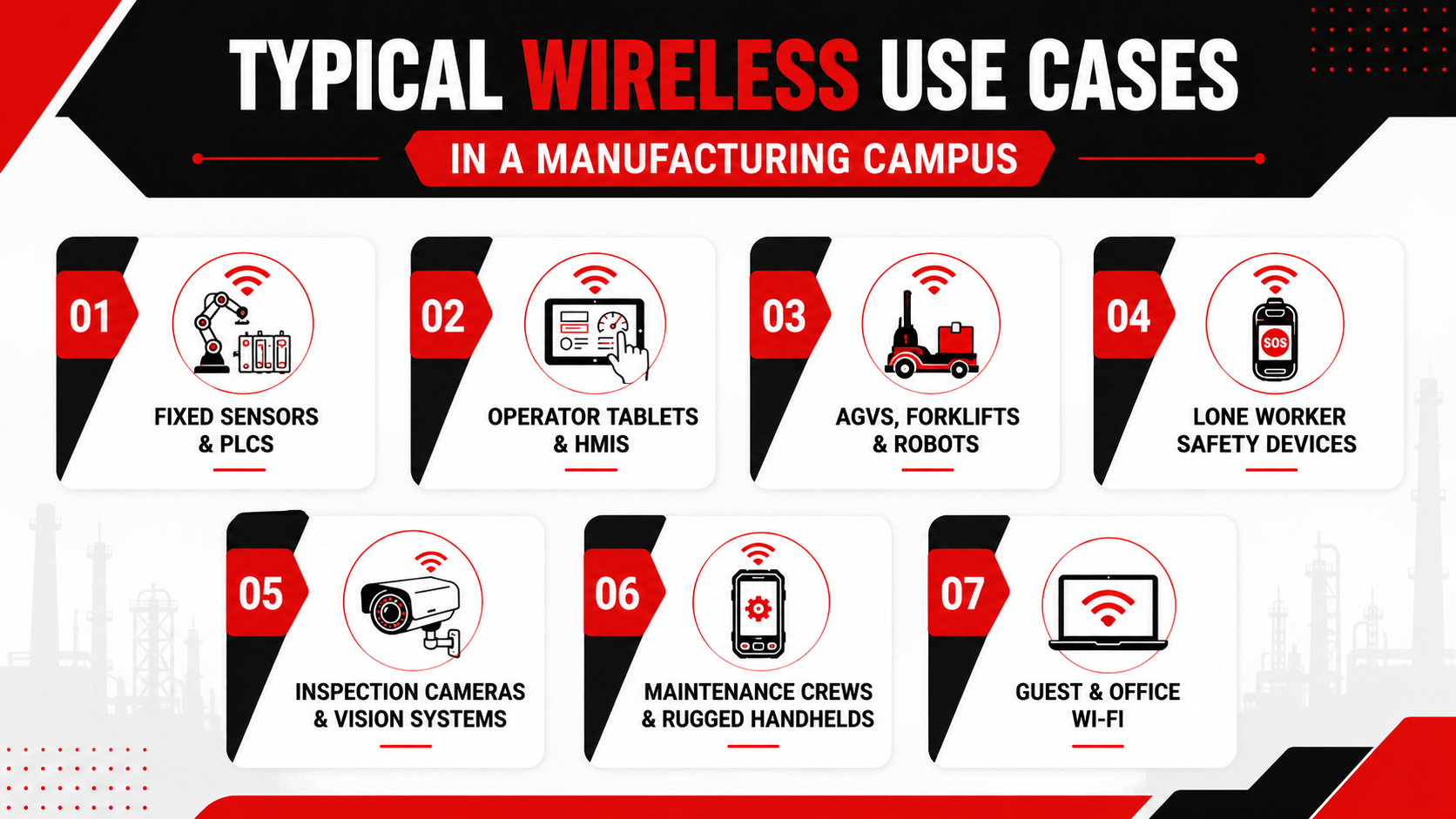
Understanding which devices and systems need wireless connectivity helps frame the LTE vs Wi-Fi decision. Different workloads have different network requirements, and matching technology to use case is the foundation of effective network planning.

-
Fixed sensors and PLCs along a production line: Low mobility, moderate bandwidth, tolerance for occasional interference; Wi-Fi 6 typically sufficient.
-
Operator tablets and HMIs used by line workers: Semi-mobile within a zone, need reliable connectivity for dashboards and data entry; Wi-Fi 6/6E works well.
-
AGVs, forklifts, and mobile robots: High mobility across the campus requires seamless roaming and lower latency for navigation and coordination; private LTE or 5G preferred.
-
Lone worker safety devices and duress alarms: Mission-critical, must maintain network access across the entire facility; private cellular can simplify connectivity across large facilities where continuous roaming and broad coverage are important.
-
High-bandwidth inspection cameras and vision systems: Fixed or semi-mobile, high data rates, can tolerate some latency; Wi-Fi 6E offers the bandwidth at a lower cost.
-
Plant-wide maintenance crews with rugged handhelds: Moderate mobility, need voice and data across indoor and outdoor zones; private LTE simplifies coverage and handoffs.
-
Guest and office Wi-Fi for administrative staff: Separate from OT traffic, standard enterprise Wi-Fi networks on isolated VLANs.
These use cases set the stage for the detailed technical comparison in the next section, where we examine how spectrum, interference, latency, capacity, security, and cost differences between Wi-Fi and private cellular map to real deployment decisions.
Read Next:
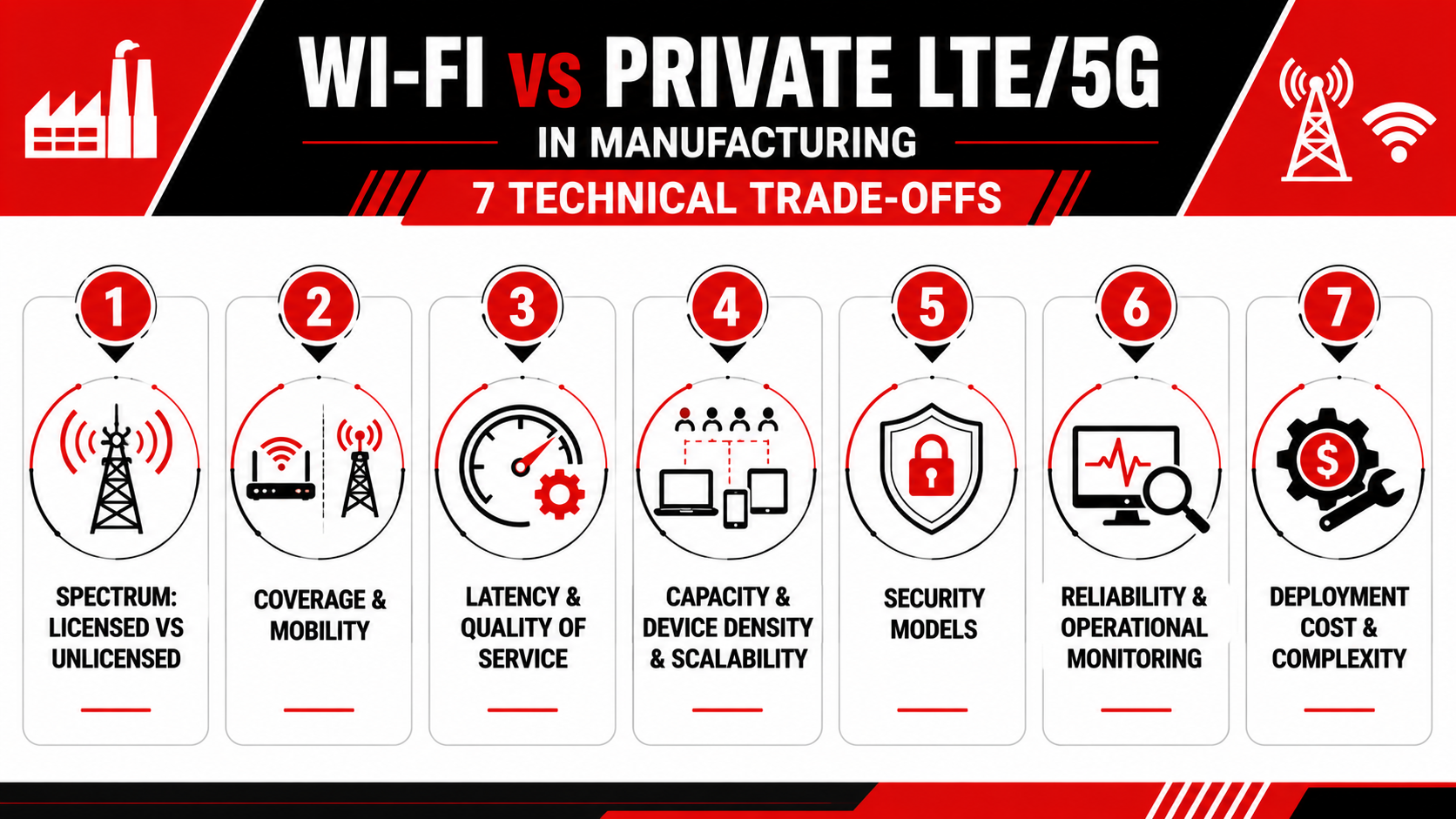
Wi-Fi vs Private LTE/5G in Manufacturing: 7 Technical Trade-Offs
Decision makers evaluating wireless technologies for manufacturing face a decision shaped by competing priorities: cost versus predictability, deployment speed versus long-term scalability, and familiar IT infrastructure versus purpose-built industrial connectivity. Wi-Fi 6 and Wi-Fi 6E deliver high throughput and dense device support using unlicensed spectrum and commodity hardware. Private LTE and private 5G networks trade higher upfront investment for licensed spectrum, deterministic performance, and seamless campus-wide mobility.
The right choice comes down to how each workload behaves on the floor: where it moves, how much latency it can tolerate, how much interference risk is acceptable, and how critical the connection is to production or safety.

#1) Spectrum: Licensed vs Unlicensed and What It Means for Interference
Wi-Fi operates in unlicensed spectrum—2.4 GHz, 5 GHz, and 6 GHz bands—where any device can transmit without a license. This open access creates interference risk from neighboring Wi-Fi networks, Bluetooth devices, microwave ovens, and other RF sources. In manufacturing plants with metal structures, moving equipment, and dense wireless deployments, unlicensed spectrum can become congested and unpredictable.
A production line running smoothly at 7 AM may experience connectivity drops by 10 AM as more devices come online or as RF conditions shift.
Proper Wi-Fi network planning mitigates interference through careful channel selection, access point placement, power tuning, and real-time spectrum monitoring. Wi-Fi 6E's access to the 6 GHz band provides cleaner spectrum with less legacy device interference and wider channels for higher bandwidth. However, even well-designed Wi-Fi networks remain vulnerable to external RF noise, rogue access points, and denial-of-service conditions because the spectrum is shared and uncontrolled.
Private LTE and private 5G networks typically use licensed or managed frequency bands. In the United States, CBRS operates in the 3.5 GHz range with a tiered access model: Priority Access Licenses provide exclusive use in specific geographic areas, while General Authorized Access offers shared access with protection from interference. Licensed spectrum provides exclusive or priority access, eliminating interference from consumer devices and neighboring networks.
This spectrum predictability is critical for mission-critical applications where connectivity loss can halt production, compromise safety, or disrupt real-time control systems.
#2) Coverage and Mobility: Access Points vs Cellular Cells
Coverage area and mobility behavior differ fundamentally between Wi-Fi and private cellular, shaping how many infrastructure points you need and how well devices maintain connectivity as they move.
-
Coverage per infrastructure point: Wi-Fi access points cover a few thousand square feet indoors; achieving campus-wide coverage requires many access points, extensive cabling, and careful RF design. Private LTE and 5G cells cover tens of thousands of square feet indoors or several square miles outdoors with fewer infrastructure points.
-
Handoff and roaming at speed: Wi-Fi handoffs work reasonably well at walking speed, but become disruptive at higher speeds—AGVs moving at 5–10 mph or forklifts navigating across a campus can experience dropped packets or temporary connectivity loss. LTE and 5G were designed for mobility, with seamless handoffs that maintain active sessions without interruption, even at vehicle speeds.
-
Infrastructure density for campus-wide coverage: A 500,000-square-foot campus might require 150–200 Wi-Fi access points for reliable coverage, depending on building layout. The same campus might need only 10–20 LTE or 5G cells, reducing cabling, switch ports, and ongoing maintenance.
-
Indoor vs outdoor propagation: Wi-Fi signals attenuate quickly outdoors and struggle with long-distance propagation. Private cellular networks use lower frequency bands that propagate better outdoors and penetrate buildings more effectively, simplifying mixed indoor-outdoor deployments.
Read Next: Optimizing Network Performance in Urban Areas: A Guide for High-Density Connectivity
#3) Latency and Quality of Service for Real-Time Operations
Latency and quality of service determine whether a wireless network can support real-time control systems, mobile robots, and mission-critical safety devices. Wi-Fi 6 and Wi-Fi 6E reduce latency through OFDMA and better scheduling, but Wi-Fi remains a contention-based protocol. Multiple devices compete for airtime, and under heavy load or interference, latency can spike unpredictably. Wi-Fi QoS mechanisms (WMM) provide traffic prioritization but do not guarantee delivery time or bandwidth for any given packet.
For many OT applications—operator tablets, fixed sensors, inspection cameras—Wi-Fi 6 latency (typically 10–30 MS under normal conditions) is acceptable. The challenge arises when mission-critical traffic shares the network with general-purpose devices. A Wi-Fi network serving both AGV control commands and employee smartphones may experience congestion that delays critical packets, even with WMM prioritization enabled.
Private LTE and private 5G networks offer deterministic quality of service through traffic scheduling, bearer management, and QoS Class Identifiers. Network operators can assign different QCI values to different traffic types, guaranteeing bandwidth, latency, and packet loss characteristics for each class.
Private 5G takes this further with network slicing, which creates isolated virtual networks with guaranteed bandwidth, latency, and reliability for specific use cases. This level of deterministic control can be more challenging to maintain in shared Wi-Fi environments, especially across large facilities with highly mobile systems.
#4) Capacity, Device Density, and Scalability
Network capacity and device density are shaped by both the wireless technology and the types of devices connecting to the network. How each technology scales as device counts grow determines long-term viability and operational complexity.
-
Wi-Fi 6/6E handles many clients per access point efficiently: OFDMA allows a single access point to serve multiple clients simultaneously. Wi-Fi 6E access points can support dozens of clients with good performance, ideal for dense deployments in localized areas.
-
Private LTE/5G scales to thousands of devices per cell: LTE cellular networks handle large numbers of devices, each identified by a SIM and managed through centralized policy control. A single LTE cell can support thousands of devices with consistent performance.
-
Scaling models differ fundamentally: Wi-Fi scales by adding access points and managing channels to avoid co-channel interference. Private cellular scales by adding cells and managing spectrum allocation, which is more predictable in licensed spectrum.
-
Device type considerations matter: Wi-Fi supports a wide range of consumer and industrial devices with built-in Wi-Fi radios. Private cellular requires SIM-capable hardware, which may mean purchasing industrial-grade devices with LTE or 5G modems or using LTE gateways.
-
Hybrid designs leverage both strengths: Many plants assign high-density, fixed workloads to Wi-Fi and mobile, mission-critical workloads to private cellular, balancing cost, performance, and operational complexity.
#5) Security Models: WPA3 vs SIM-Based Authentication
Security architecture differs significantly between Wi-Fi and private cellular, affecting how devices authenticate, how traffic is encrypted, and how vulnerable the network is to external threats. Wi-Fi security has improved with WPA3, which provides stronger encryption, protection against brute-force attacks, and forward secrecy. Properly segmented Wi-Fi networks—using VLANs, role-based access control, and network access control solutions—can isolate OT traffic from IT and guest traffic, reducing attack surface.
However, Wi-Fi networks remain vulnerable to certain attack vectors because they operate in unlicensed spectrum. Rogue access points can be deployed by malicious actors or careless employees. Denial-of-service attacks, such as deauthentication floods, can disrupt connectivity. Wi-Fi's broadcast nature means that anyone within RF range can see network traffic and attempt to attack the network.
Private LTE and private 5G networks use SIM-based authentication, which ties device identity to a physical SIM card. Each device must present a valid SIM and authenticate with the private core before accessing the network. Cellular networks employ carrier-grade encryption and mutual authentication between devices and the network core.
Because private cellular operates on licensed or managed spectrum, it is less vulnerable to external interference and denial-of-service attacks. Traffic stays within the plant's private core and does not traverse the public internet unless explicitly routed.
Read Next:
-
Network Segmentation for Security: Best Practices to Stop Cyberattacks Cold
-
Common Network Security Threats: How to Mitigate Cyber Attacks and Vulnerabilities
#6) Reliability and Operational Monitoring
Reliability depends on spectrum predictability, infrastructure redundancy, and proactive monitoring. Wi-Fi reliability is shaped by unlicensed spectrum conditions, which can change as neighboring networks are added, as devices move, or as RF interference sources appear.
A Wi-Fi network that performs well during initial deployment may degrade over time if new access points are installed nearby, if metal equipment is relocated, or if device counts grow beyond original capacity planning.
Private LTE and private 5G networks benefit from licensed spectrum's predictability. Because interference from external sources is eliminated or minimized, licensed spectrum can reduce interference variability in complex RF environments. Cellular networks also use centralized management and policy control, making it easier to monitor device health, track connectivity issues, and enforce QoS policies across the entire campus.
For either design, manufacturers benefit from Network Analytics services that avoid network disruptions and downtime with a proactive IT system, giving engineers real-time visibility into wireless performance, device health, and potential issues before they affect production. Without proactive monitoring, even well-designed wireless networks can degrade over time as devices are added, RF conditions change, or configuration drift occurs.
#7) Deployment Cost and Complexity Trade-Offs
Cost and deployment complexity often determine which technology is feasible for a given plant, regardless of technical superiority. The trade-offs shift based on campus size, use case requirements, and long-term growth plans.
-
Upfront cost comparison: Wi-Fi access points cost $500–$2,000 per unit, unlicensed spectrum is free, and most IT teams have Wi-Fi experience. Private LTE/5G access points cost $5,000–$20,000+ per unit, private cores add $50,000–$500,000+, and spectrum access requires licensing fees or CBRS registration.
-
Deployment complexity and skillsets required: Wi-Fi deployment is familiar to most IT teams. Private cellular requires specialized skills: RF planning for cellular propagation, core network configuration, SIM provisioning, and ongoing spectrum management.
-
Lifecycle and operational costs: Wi-Fi operational costs include access point maintenance, controller licensing, and ongoing RF monitoring. Private cellular operational costs include spectrum fees, SIM lifecycle management, and core infrastructure maintenance, but licensed spectrum eliminates interference-related troubleshooting.
-
When each model makes economic sense: For small plants or localized coverage zones, Wi-Fi delivers reliable connectivity at a fraction of the cost. For large campuses, greenfield sites, or environments with high mobility and mission-critical systems, private cellular can deliver better long-term reliability and total cost of ownership.
-
Hybrid approach balances cost and performance: Many plants deploy Wi-Fi for general-purpose connectivity and private LTE or 5G for AGVs, mobile robots, and mission-critical systems, allowing each technology to serve the use cases it handles best.
Read Next:
Decision Framework: When to Choose Wi-Fi, Private LTE/5G, or Both
Choosing the right wireless technology requires mapping your plant's use cases, coverage requirements, and operational constraints to the strengths and limitations of Wi-Fi and private cellular.
Map Use Cases to the Right Wireless Technology
Wireless decisions should start with the workload, not the technology. Fixed sensors, operator tablets, HMIs, and inspection cameras usually need reliable local coverage, strong bandwidth, and broad device compatibility, which makes Wi-Fi 6/6E a practical fit. AGVs, mobile robots, lone worker safety devices, and plant-wide maintenance tools place more pressure on roaming, coverage consistency, latency, and reliability, which is where private LTE or private 5G becomes more useful.
| Use Case | Example Devices | Primary Requirements | Recommended Technology |
|---|---|---|---|
| Fixed Sensors and PLCs | Temperature sensors, pressure sensors, PLCs with wireless adapters | Low to moderate bandwidth, low mobility | Wi-Fi 6/6E – Cost-effective for fixed, non-mission-critical devices |
| Operator Tablets and HMIs | Tablets, handheld HMIs, mobile workstations | Moderate bandwidth, semi-mobile within a zone | Wi-Fi 6/6E – Good balance of performance and cost |
| AGVs and Mobile Robots | Autonomous guided vehicles, automated forklifts, and mobile robots | High mobility, seamless roaming, lower latency, mission-critical | Private LTE/5G – Seamless handoffs, extensive coverage, deterministic QoS |
| Lone Worker Safety Devices | Wearable safety devices, panic buttons, and location trackers | Mission-critical, campus-wide coverage, low bandwidth | Private LTE/5G – Better coverage, reliability, and SIM-based identity |
| Inspection Cameras | Fixed or mobile inspection cameras, quality control vision systems | High data rates, moderate mobility | Wi-Fi 6E – High bandwidth at lower cost |
| Plant-Wide Maintenance Crews | Rugged smartphones, tablets, and two-way radios with data | Moderate mobility, voice, and data across indoor/outdoor zones | Private LTE – Simplifies coverage and handoffs |
In most manufacturing environments, Wi-Fi 6/6E is the practical choice for fixed, semi-mobile, and high-bandwidth devices where cost and compatibility matter. Private LTE and private 5G make more sense for mobile, mission-critical, or campus-wide systems where seamless handoffs, predictable performance, and stronger coverage justify the higher deployment cost.
Read Next: Manufacturing Physical Security And Access Control: Mistakes That Could Cost You Big
Practical Checklist for Network Planning and Deployment
A manufacturing wireless design needs more than access points or cellular radios. Engineers need to account for coverage zones, metal structures, moving equipment, RF interference, device growth, OT traffic segmentation, monitoring, redundancy, and lifecycle management. These planning decisions determine whether the network can support current workloads and still hold up as more smart devices, mobile systems, and safety tools come online.
-
Define network coverage zones and RF constraints on your campus: Map indoor and outdoor areas, identify metal structures, moving equipment, and other sources of RF interference or signal blockage.
-
Classify workloads by tolerance for interference, latency, and packet loss: Separate mission-critical systems (AGVs, safety devices) from general-purpose devices (tablets, cameras) and assign each to the appropriate network.
-
Estimate device counts and growth curves: Project how many smart devices, IoT sensors, mobile devices, and mission-critical systems will connect over the next 3–5 years to ensure the network can scale.
-
Decide which traffic must stay on a private network vs guest/employee Wi-Fi: Isolate OT traffic from IT and guest traffic using VLANs, separate SSIDs, or entirely separate physical networks.
-
Plan coexistence of LTE and Wi-Fi: If running both, coordinate frequency bands, access point and cell placement, and channel planning to avoid interference; ensure devices can access the network they need.
-
Establish monitoring and analytics expectations from day one: Deploy network analytics tools that provide real-time visibility into access point and cell performance, device health, interference, and coverage gaps.
-
Validate spectrum access and licensing requirements: For private LTE/5G, confirm CBRS registration, PAL licensing, or other spectrum access; for Wi-Fi, ensure 6 GHz devices are certified and compliant.
-
Plan for SIM lifecycle management: If deploying private cellular, establish processes for SIM provisioning, device onboarding, SIM replacement, and decommissioning.
-
Design for redundancy and failover: Ensure critical coverage zones have overlapping access points or cells, and plan failover paths for backhaul and core infrastructure.
-
Engage expert wireless design and deployment services: Complex RF environments, hybrid networks, and mission-critical requirements benefit from professional planning, site surveys, and post-deployment optimization.
Read Next: Benefits of SD-WAN for Multi-Location Businesses
Designing the Right Wireless Backbone for Manufacturing
Wi-Fi 6/6E and private LTE/private 5G are complementary tools, not competing alternatives. The right wireless network solution depends on your plant's specific use cases, coverage requirements, mobility patterns, and tolerance for cost and complexity. For many manufacturers, Wi-Fi 6/6E will continue to handle the majority of operational connectivity requirements effectively and economically.
Wi-Fi networks deliver high-bandwidth, cost-effective connectivity for fixed and semi-mobile devices in localized zones. Private cellular networks provide extensive coverage, seamless mobility, lower latency, and deterministic quality of service for mission-critical and high-mobility systems.
-
Match technology to use case, not hype: Wi-Fi 6/6E handles the majority of plant-floor devices; private LTE/5G is worth the investment for mission-critical, high-mobility, and campus-wide systems.
-
Plan for coexistence from the start: Assume Wi-Fi and private cellular will both operate; design them together to avoid interference, ensure proper traffic routing, and simplify operations.
-
Instrument the network for proactive management: Treat monitoring and network analytics as part of reliability, not an afterthought; real-time visibility prevents issues before they affect production.
Turn-Key Technologies offers custom IT support for the manufacturing industry, including Wireless Design, Network Analytics, Camera Systems, and Lone Worker Systems. For manufacturers comparing Wi-Fi, private LTE/5G, or a hybrid wireless network, we can help design enterprise wireless networks, support future network growth, deploy IoT devices and employee wearables efficiently and securely, and use network analytics to help avoid disruptions and downtime.
TTI also helps manufacturers develop cybersecurity solutions and implement best practices to protect sensitive information as IT and OT systems become more connected.
Talk to an expert to review your manufacturing wireless requirements and plan a resilient, future-ready network.
Frequently Asked Questions
Is Wi-Fi 6 reliable enough for mission-critical manufacturing applications?
Wi-Fi 6 delivers significant improvements in latency and multi-user performance compared to older standards and can meet the needs of many OT applications when properly designed. However, Wi-Fi operates in unlicensed spectrum with contention-based access, so reliability and latency can degrade under interference or heavy load. For truly mission-critical systems like AGVs or safety devices, private LTE or 5G offers more predictable performance through licensed spectrum and deterministic QoS.
When does it make sense to deploy a private LTE or private 5G network?
Private LTE or private 5G makes sense when your plant has large coverage areas, high-mobility devices (AGVs, forklifts, mobile robots), mission-critical systems that cannot tolerate interference or unpredictable latency, or plans to scale IoT and automation significantly. The higher upfront cost is justified when Wi-Fi's limitations create operational risk or require a massive deployment that becomes more expensive than private cellular.
Can Wi-Fi and private LTE/5G safely coexist on the same manufacturing campus?
Yes, Wi-Fi and private LTE/5G can coexist safely when properly planned. Coordinate frequency bands and RF design to avoid interference. For example, Wi-Fi 6E operates in the 6 GHz band, which does not overlap with CBRS (3.5 GHz). Proper channel planning, access point and cell placement, and traffic segmentation ensure the two networks do not interfere with each other.
How do spectrum and interference differ between unlicensed Wi-Fi and private cellular networks?
Wi-Fi operates in unlicensed spectrum (2.4 GHz, 5 GHz, and 6 GHz), which creates potential for interference from neighboring Wi-Fi networks, Bluetooth devices, and other RF sources. Private LTE and private 5G typically use licensed or managed spectrum (such as CBRS), which provides exclusive or priority access and eliminates interference from consumer devices. Licensed spectrum delivers more predictable performance but comes with licensing fees.
What are the key differences between LTE and Wi-Fi for mobile robots and AGVs?
Mobile robots and AGVs require seamless mobility, low latency, and reliable connectivity as they move across a campus. LTE and 5G were designed for mobility, with seamless handoffs between cells, deterministic QoS, and extensive coverage per cell. Wi-Fi handoffs can be disruptive at high speeds, and Wi-Fi's contention-based access can introduce latency spikes under load. For mission-critical mobile systems, private cellular is often easier to manage for large-scale mobile deployments.
How should we think about security and reliability when comparing Wi-Fi and private cellular?
Both Wi-Fi and private cellular can deliver strong security and reliability when properly designed. Wi-Fi security has improved with WPA3, and proper segmentation and monitoring can protect OT traffic. However, Wi-Fi operates in unlicensed spectrum and is vulnerable to interference. Private LTE and 5G use SIM-based authentication, carrier-grade encryption, and licensed spectrum, providing stronger isolation and less vulnerability to external interference.
What does a typical deployment timeline look like for private LTE in a factory?
A private LTE deployment typically takes 6–12 months from planning to full operation, depending on campus size and complexity. The timeline includes RF site surveys and coverage modeling, spectrum licensing or CBRS registration, procurement of LTE access points and private core infrastructure, physical installation, core configuration and integration, device onboarding and SIM provisioning, and testing and optimization.