

Best for
Data centers, colocation facilities, server rooms, network operations facilities, equipment spaces, operations centers, and other critical IT environments.
Turn-key Technologies designs and deploys video surveillance solutions for data centers and critical IT facilities across New Jersey. From IP cameras and recording platforms to centralized video management, analytics, monitoring, and supporting network infrastructure, we help organizations improve visibility across entrances, equipment areas, loading zones, parking areas, perimeter spaces, and other priority locations.
A data center video surveillance solution combines cameras, recording, video management, monitoring tools, and analytics to help authorized security, facilities, and IT teams maintain visibility across critical infrastructure environments. The goal is to create a coordinated system that makes live monitoring, video search, incident review, and future expansion easier to manage.
Data centers, colocation facilities, server rooms, network operations facilities, equipment spaces, operations centers, and other critical IT environments.
Improve visibility, incident review, centralized monitoring, and day-to-day management across critical facility areas.
IP cameras, recording infrastructure, video management software, analytics, monitoring, storage, system configuration, network integration, and ongoing support.
Data centers may already have cameras installed but still struggle with blind spots, inconsistent systems, fragmented recording, difficult footage searches, or limited visibility across restricted and operational areas. When surveillance grows through separate projects, the environment can become harder to monitor, manage, and expand consistently.
Blind Spots in Priority Areas
Entrances, loading areas, equipment rooms, perimeter zones, parking areas, and other critical spaces may not have the coverage needed for useful visibility.
Disconnected Camera Environments
Different camera generations, recording systems, or separate site platforms can make monitoring, administration, and expansion more difficult.
Slow Video Search
Locating relevant footage can take too long when camera naming, timestamps, retention, storage, and video-management practices are inconsistent.
Limited Operational Visibility
Security and facilities teams may lack a consistent way to monitor cameras, review system health, or manage surveillance across multiple buildings or data center locations.
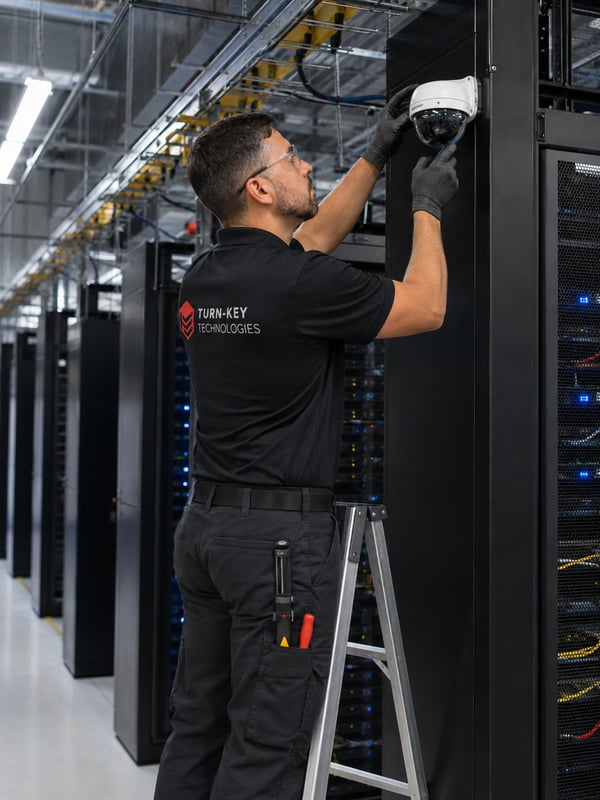
A strong surveillance environment combines camera coverage, recording, analytics, video management, infrastructure, and system support so authorized teams can work from a
more unified view across critical areas.
Deploy cameras around entrances, loading zones, equipment spaces, corridors, parking areas, exterior perimeters, and other priority locations based on operational requirements.
Plan recording infrastructure and storage around camera counts, image quality, retention needs, system architecture, and how footage needs to be accessed.
Bring live and recorded video into a centralized platform that makes cameras easier to monitor, search, organize, and manage.
Use supported analytics to help authorized teams identify relevant events and reduce the amount of video that must be reviewed manually.
Monitor system health and identify issues that may affect cameras, recording, storage, connectivity, or overall system availability.
Coordinate surveillance with switching, bandwidth, fiber and copper cabling, pathways, power requirements, telecommunications spaces, and supporting infrastructure.
The value of data center video surveillance comes from how effectively authorized teams can use the system every day. A well-planned environment can improve visibility, simplify incident review, support more consistent monitoring, and make future expansion easier to manage.
Give authorized teams a more consistent view across entrances, equipment areas, loading zones, perimeter spaces, and other priority locations.
Organized camera naming, video management, and search tools help teams locate relevant footage more efficiently.
Bring cameras from different facility zones or multiple locations into a more consistent video-management environment.
Plan camera coverage, network capacity, storage, licensing, and infrastructure so future device additions can be incorporated more cleanly.
Each phase moves the organization from existing conditions and visibility requirements toward a deployed, configured, tested,
documented, and easier-to-manage surveillance environment.
01
Review existing cameras, recording platforms, coverage gaps, network infrastructure, storage, critical areas, facility layouts, documentation, and current operational challenges.
02
Plan camera locations, fields of view, recording, storage, analytics, video management, network connectivity, access-control coordination, and future expansion.
03
Install cameras and supporting infrastructure, configure recording and management platforms, and validate system connectivity and operation.
04
Provide system documentation, user guidance, training, health-check planning, and ongoing support options where included.
Turn-key Technologies combines physical security expertise with wired and wireless networking and structured cabling capabilities. TTI works with video-security technologies including Avigilon and Pelco, and its source materials describe AI-powered video surveillance, cloud and on-premise video management, scalable access control, and a team of more than 35 highly certified engineers.
Highly certified
engineers*
Support options
available*
Core regional service
area
Best-of-breed
technology approach
“Turn-key Technologies helped us create a much more organized surveillance environment across critical areas of our facility. The system is easier to monitor and review, and we now have a clearer path for future expansion and integration.”
Daniel Foster
Director of Data Center Operations
Turn-key Technologies combines dedicated physical security resources with network-connected video surveillance, Avigilon
technology, structured cabling, fiber infrastructure, networking, and documented project delivery.

Network-connected cameras and video systems depend on structured cabling, fiber, reliable connectivity, coordinated deployment, and documented installation.
Video surveillance deployments are supported by coordinated project management, structured connectivity, fiber and network infrastructure, labeling, testing, and documented project delivery.
Credentials and qualifications that support
safe, reliable, and well-managed project delivery.
Plan camera locations, network connections, pathways, recording infrastructure, security spaces, and future expansion before construction is complete.
Reassess coverage when equipment rooms, loading areas, restricted zones, corridors, or building layouts change.
Evaluate whether existing cameras, recording infrastructure, storage, and video-management platforms still support current operational requirements.
Coordinate surveillance with access-control systems so authorized teams have better context around entrances, restricted spaces, and access events.
A data center video surveillance solution may include IP cameras, recording appliances or servers, storage, video management software, analytics, monitoring tools, network infrastructure, system configuration, documentation, and user training.
Camera placement depends on facility layout and security priorities, but commonly evaluated areas include entrances, corridors, loading areas, equipment spaces, perimeter zones, parking areas, and other locations where improved visibility is needed.
Yes. Depending on the selected platform and network architecture, cameras from multiple data centers can be managed through a centralized video-management environment.
Yes. Depending on the selected platforms, video surveillance and access control can be coordinated so authorized teams have better context around entrances, restricted areas, and access events.
Not necessarily. Existing cameras should be evaluated for image quality, reliability, compatibility, field of view, network requirements, support status, and integration with the proposed video-management environment.
IP surveillance commonly depends on network switching, bandwidth, power, fiber or copper cabling, pathways, telecommunications spaces, recording and storage resources, and adequate network capacity.
Whether you are replacing aging cameras, expanding coverage, centralizing video management, integrating surveillance with access control, or planning a new data center, Turn-key Technologies can help assess your current environment and design a video surveillance solution around the way your facility operates.
.png?width=1920&height=1080&name=TTI%20Web%20background%20(2).png)
Tony Ridzyowski:
Tony Ridzyowski:
Tony Ridzyowski: